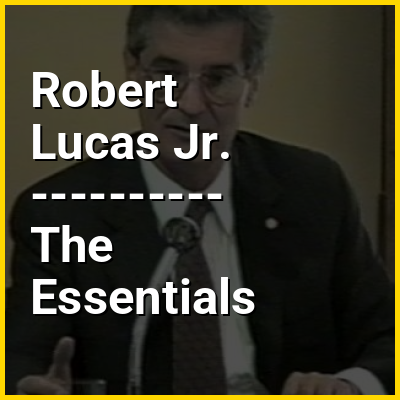
Robert Emerson Lucas Jr. (September 15, 1937 – May 15, 2023) was an American economist at the University of Chicago. Widely regarded as the central figure in the development of the new classical approach to macroeconomics, he received the Nobel Memorial Prize in Economic Sciences in 1995 "for having developed and applied the hypothesis of rational expectations, and thereby having transformed macroeconomic analysis and deepened our understanding of economic policy". N. Gregory Mankiw characterized him as "the most influential macroeconomist of the last quarter of the 20th century". In 2020, he ranked as the 10th most cited economist in the world.
HINT:
In this Dossier
- ⭐ Core Definition: Robert Lucas Jr.
- Robert Lucas Jr. in the context of Milton Friedman
- Robert Lucas Jr. in the context of Lucas critique
Robert Lucas Jr. in the context of Milton Friedman
Milton Friedman (/ˈfriːdmən/ ; July 31, 1912 – November 16, 2006) was an American economist and statistician who received the 1976 Nobel Memorial Prize in Economic Sciences for his research on consumption analysis, monetary history and theory and the complexity of stabilization policy. With George Stigler, Friedman was among the intellectual leaders of the Chicago school of economics, a neoclassical school of economic thought associated with the faculty at the University of Chicago that rejected Keynesianism in favor of monetarism before shifting their focus to new classical macroeconomics in the mid-1970s. Several students, young professors and academics who were recruited or mentored by Friedman at Chicago went on to become leading economists, including Gary Becker (Nobel Prize 1992), Robert Fogel (Nobel Prize 1993), and Robert Lucas Jr. (Nobel Prize 1995).
Friedman's challenges to what he called "naive Keynesian theory" began with his interpretation of consumption, which tracks how consumers spend. He introduced a theory which would later become part of mainstream economics and he was among the first to propagate the theory of consumption smoothing. During the 1960s, he became the main advocate opposing both Marxist and Keynesian government and economic policies, and described his approach (along with mainstream economics) as using "Keynesian language and apparatus" yet rejecting its initial conclusions. He theorized that there existed a natural rate of unemployment and argued that unemployment below this rate would cause inflation to accelerate. He argued that the Phillips curve was in the long run vertical at the "natural rate" and predicted what would come to be known as stagflation. Friedman promoted a macroeconomic viewpoint known as monetarism and argued that a steady, small expansion of the money supply was the preferred policy, as compared to rapid and unexpected changes. His ideas concerning monetary policy, taxation, privatization, and deregulation influenced government policies, especially during the 1980s. His monetary theory influenced the Federal Reserve's monetary policy in response to the 2008 financial crisis.
View the full Wikipedia page for Milton FriedmanRobert Lucas Jr. in the context of Lucas critique
The Lucas critique argues that it is naive to try to predict the effects of a change in economic policy entirely on the basis of relationships observed in historical data, especially highly aggregated historical data. More formally, it states that the decision rules of Keynesian models—such as the consumption function—cannot be considered as structural in the sense of being invariant with respect to changes in government policy variables. It was named after American economist Robert Lucas's work on macroeconomic policymaking.
The Lucas critique is significant in the history of economic thought as a representative of the paradigm shift that occurred in macroeconomic theory in the 1970s towards attempts at establishing micro-foundations.
View the full Wikipedia page for Lucas critique