Robert Keohane in the context of Open Syllabus Project


Robert Keohane in the context of Open Syllabus Project

⭐ Core Definition: Robert Keohane

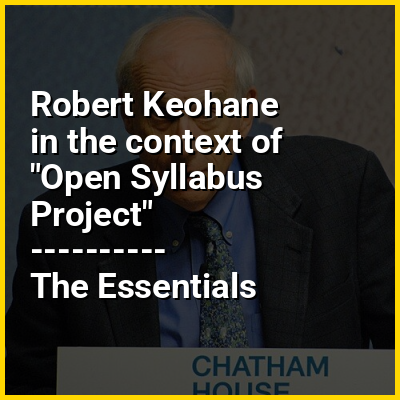
Robert Owen Keohane (born October 3, 1941) is an American political scientist working in the fields of international relations and international political economy. Following the publication of his influential book After Hegemony (1984), he has become widely associated with the theory of neoliberal institutionalism in international relations, as well as transnational relations and world politics in international relations in the 1970s.

He is Professor Emeritus of International Affairs at the Princeton School of Public and International Affairs, and has also taught at Swarthmore College, Duke University, Harvard University and Stanford University. A 2011 survey of International Relations scholars placed Keohane second in terms of influence and quality of scholarship in the last twenty years. According to the Open Syllabus Project, Keohane is the most frequently cited author on college syllabi for political science courses.
↓ Menu
HINT:

In this Dossier

Robert Keohane in the context of Joseph Nye

Joseph Samuel Nye Jr. (January 19, 1937 – May 6, 2025) was an American political scientist. He and Robert Keohane co-founded the international relations theory of neoliberalism, which they developed in their 1977 book Power and Interdependence. Together with Keohane, he developed the concepts of asymmetrical and complex interdependence. They also explored transnational relations and world politics in an edited volume in the 1970s. More recently, he pioneered the theory of soft power. His notion of "smart power" ("the ability to combine hard and soft power into a successful strategy") became popular with the use of this phrase by members of the Clinton Administration and the Obama Administration. These theories from Nye are very commonly seen in courses across the U.S., such as I.B. D.P. Global Politics.

Nye was the Dean of the John F. Kennedy School of Government at Harvard University, where he later held the position of University Distinguished Service Professor, emeritus. In October 2014, US Secretary of State John Kerry appointed Nye to the Foreign Affairs Policy Board. He was also a member of the Defense Policy Board. He was a Harvard faculty member since 1964. He was a fellow of the American Academy of Arts & Sciences, a foreign fellow of the British Academy, and a member of the American Academy of Diplomacy.

View the full Wikipedia page for Joseph Nye
↑ Return to Menu

Robert Keohane in the context of Neoliberalism (international relations)

Liberal institutionalism (or institutional liberalism or neoliberalism) is a theory of international relations that holds that international cooperation between states is feasible and sustainable, and that such cooperation can reduce conflict and competition. Neoliberalism is a revised version of liberalism. Alongside neorealism, liberal institutionalism is one of the two most influential contemporary approaches to international relations.

In contrast to neorealist scholarship (which is skeptical of prospects for sustainable cooperation), liberal institutionalism argues that cooperation is feasible and sustainable. Liberal institutionalists highlight the role of international institutions and regimes in facilitating cooperation between states. Robert Keohane's 1984 book After Hegemony used insights from the new institutional economics to argue that the international system could remain stable in the absence of a hegemon, thus rebutting hegemonic stability theory.

View the full Wikipedia page for Neoliberalism (international relations)
↑ Return to Menu

Robert Keohane in the context of Complex interdependence

Complex interdependence in international relations and international political economy is a concept put forth by Robert Keohane and Joseph Nye in the 1970s to describe the emerging nature of the global political economy. The concept entails that relations between states are becoming increasingly deep and complex. These increasingly complex webs of economic interdependence undermine state power and elevate the influence of transnational non-state actors. These complex relationships can be explored through both the liberal and realism lenses and can later explain the debate of power from complex interdependence.

View the full Wikipedia page for Complex interdependence
↑ Return to Menu

Robert Keohane in the context of Regime theory

Regime theory is a theory within international relations derived from the liberal tradition which argues that international institutions or regimes affect the behavior of states or other international actors. It assumes that cooperation is possible in the anarchic system of states, as regimes are, by definition, instances of international cooperation.

Stephen D. Krasner was a key figure in establishing the theory as a prominent topic of study in IR, in part through the 1983 edited collection International Regimes. Robert Keohane's 1984 book After Hegemony has been described as regime theory's "fullest expression."

View the full Wikipedia page for Regime theory
↑ Return to Menu

Robert Keohane in the context of After Hegemony

After Hegemony (full title: After Hegemony: Cooperation and Discord in the World Political Economy) is a book by Robert Keohane first published in 1984. It is a leading text in the liberal institutionalist international relations scholarship. The book challenges neorealist claims that meaningful international cooperation is not possible, as well as hegemonic stability theory claims that international cooperation is only possible under hegemony. The book applies insights from new institutional economics to international relations. The book shows how realist assumptions about actors and the international system can logically lead to the conclusion that meaningful cooperation is possible.

View the full Wikipedia page for After Hegemony
↑ Return to Menu

Robert Keohane in the context of Peter J. Katzenstein

Peter Joachim Katzenstein FBA (born February 17, 1945) is a German-American political scientist. He is the Walter S. Carpenter, Jr. Professor of International Studies at Cornell University. Katzenstein has made influential contributions to the fields of comparative politics, international relations, and international political economy.

His main concentration lies in the study of culture, religion, identity, and regionalism in the interstate system, for which he is known as a proponent of constructivist thinking. He is often associated with the school of neoliberal institutionalism through his joint projects with Robert Keohane. He is known for his influential research on corporatism.

View the full Wikipedia page for Peter J. Katzenstein
↑ Return to Menu