Reza Qoli Mirza Afshar in the context of "Afsharid Iran"

Play Trivia Questions online!

or

Skip to study material about Reza Qoli Mirza Afshar in the context of "Afsharid Iran"

Ad spacer

⭐ Core Definition: Reza Qoli Mirza Afshar

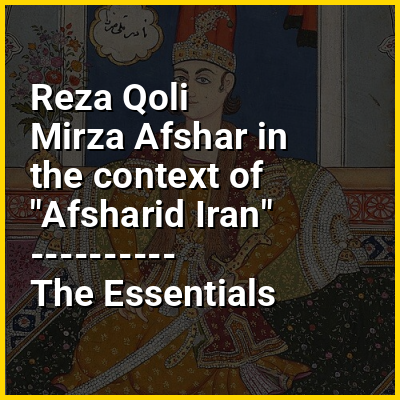
Reza Qoli Mirza Afshar (Persian: رضا قلی میرزا افشار; 1719–1747) was the eldest son of Nader Shah of Afsharid Iran. After his father's coronation in 1736, Reza Qoli, aged 17, became the Governor of the province of Khorasan. During his tenure, he subdued rebellious khans and marched up to Bukhara to put an end to the Khanate of Bukhara, his father's enemies. Before heading off to India, Nader Shah appointed Reza Qoli the regent of Iran. Reza Qoli ensured peace through harsh measures when collecting taxes and executed people for petty crimes. He had Tahmasp II and Abbas III, two pretenders to the throne, killed, which caused an uproar among the people. When Nader Shah returned from India, he dismissed Reza Qoli as regent, snubbing him for his actions during the regency.

Afterwards, Reza Qoli served as a commander in his father's army, but the relationship between the two had turned to bitterness. Reza Qoli, constantly humiliated by Nader, criticised his father, and Nader grew more distrusting of his son. Although he later regretted it, Nader blinded Reza Qoli after suspecting him to be behind an assassination attempt in 1742. Reza Qoli was confided in Kalat fortress until 1747, when he was executed by his cousin and the claimant to the throne, Adel Shah.
↓ Menu

>>>PUT SHARE BUTTONS HERE<<<
In this Dossier

Reza Qoli Mirza Afshar in the context of Shahrokh Shah

Shahrokh Mirza (Persian: شاهرخ‌میرزا‎; 1734–1796), better known by his dynastic title of Shahrokh Shah (شاهرخ‌ شاه‎), was the Afsharid king (shah) of the western part of Khorasan (corresponding to the present-day Khorasan Province) from 1748 to 1796, with a two-month interruption.A grandson of the Iranian conqueror Nader Shah (r. 1736–1747), Shahrokh was the son of Reza Qoli Mirza Afshar and his Safavid wife Fatemeh Soltan Begom, who was the sister of Tahmasp II, the penultimate Safavid shah of Iran. Shahrokh's half-Safavid descent made him stand out amongst his Afsharid relatives and was used to bolster the legitimacy of his grandfather. After the assassination of Nader Shah in 1747, his nephew Ali-qoli Khan (who assumed the regnal name Adel Shah), ascended the throne in Mashhad and had all of Nader Shah's descendants in fortress of Kalat massacred. Shahrokh was spared in case his Safavid lineage would come of use and was instead kept in the fortress as a prisoner. While Adel Shah was battling his rebellious younger brother Ebrahim Mirza, a party of Turkic, Kurdish, and Arab tribal leaders took advantage of his absence and installed Shahrokh on the throne. Both Adel Shah and Ebrahim were eventually defeated and killed, but Shahrokh was not long afterwards overthrown by a party of dissident tribal leaders, who installed the Safavid pretender Mir Sayyed Mohammad (who assumed the regnal name of Suleiman II) on the throne. Shahrokh was soon blinded at the instigation of Mir Alam Khan Khuzayma and other leading nobles, much against Suleiman II's will.

A group of conspirators led by the Turco-Mongol tribal leader Yusuf Ali Khan Jalayir eventually deposed Suleiman II and restored Shahrokh to the throne.

↑ Return to Menu

Reza Qoli Mirza Afshar in the context of Division of the Afsharid Empire

After Nader Shah was assassinated in 1747, his nephew Ali Qoli (who may have been involved in the assassination plot) seized the throne and proclaimed himself Adel Shah (meaning: The Just King). He ordered the execution of all of Nader's sons and grandsons, with the exception of the 13-year-old Shahrokh, the son of Reza Qoli Mirza Afshar.

Meanwhile, Nader's former treasurer, Ahmad Shah Abdali, had declared his independence by founding the Durrani Empire. In the process, the eastern territories were lost and in the following decades became part of Afghanistan, the successor-state to the Durrani Empire. The Ottomans regained lost territories in Eastern Anatolia and Mesopotamia. The northern territories, Iran's most integral regions, had a different fate. Erekle II and Teimuraz II, who, in 1744, had been made the kings of Kakheti and Kartli respectively by Nader himself for their loyal service, capitalised on the eruption of instability, and declared de facto independence. Erekle II assumed control over Kartli after Teimuraz II's death, thus unifying the two as the Kingdom of Kartli-Kakheti, becoming the first Georgian ruler in three centuries to preside over a politically unified eastern Georgia.

↑ Return to Menu