Remembrance Sunday in the context of Two minutes' silence


Remembrance Sunday in the context of Two minutes' silence

⭐ Core Definition: Remembrance Sunday

Remembrance Sunday is held in the United Kingdom as a day to commemorate the contribution of British and Commonwealth military and civilian servicemen and women in the two World Wars and later conflicts. It is held on the second Sunday in November (the Sunday nearest to 11 November, Armistice Day, the anniversary of the end of hostilities in World War I in 1918). Remembrance Sunday, within the Church of England, falls in the liturgical period of Allsaintstide.

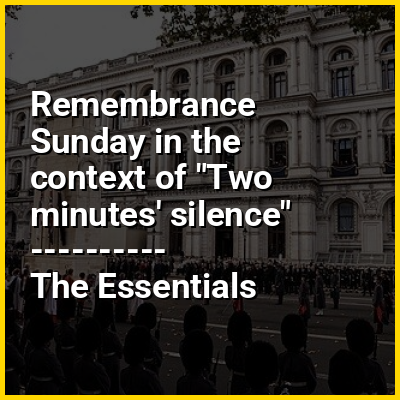
It is marked by ceremonies at local war memorials in most cities, towns and villages, attended by civic dignitaries, ex-servicemen and -women (many are members of the Royal British Legion and other veterans' organisations), members of local armed forces regular and reserve units (Royal Navy and Royal Naval Reserve, Royal Marines and Royal Marines Reserve, Army and Territorial Army, Royal Air Force and Royal Auxiliary Air Force), military cadet forces (Sea Cadet Corps, Army Cadet Force and Air Training Corps as well as the Combined Cadet Force) and youth organisations (e.g. Scouts, Boys' Brigade, Girls' Brigade and Guides). Representatives of the Judiciary also lay wreaths at local war memorials throughout the country. Wreaths of remembrance poppies are laid on the memorials, and two minutes' silence is held at 11 am. Church bells are usually rung half-muffled, creating a sombre effect. The overall ceremony, including parades, service and wreath laying, typically lasts about two hours.
↓ Menu
HINT:

In this Dossier

Remembrance Sunday in the context of Allhallowtide

Allhallowtide, Hallowtide, Allsaintstide, or the Hallowmas season is the Western Christian season encompassing the triduum of All Hallows' Eve (Halloween), All Hallows' Day (All Saints' Day) and All Souls' Day, as well as the International Day of Prayer for the Persecuted Church (observed on the first Sunday of November) and Remembrance Sunday (observed on the second Sunday in November) in some traditions. The period begins on 31 October annually. Allhallowtide is a "time to remember the dead, including martyrs, saints, and all faithful departed Christians." The present date of Hallowmas (All Saints' Day) and thus also of its vigil (Hallowe'en) was established for Rome perhaps by Pope Gregory III (731–741) and was made of obligation throughout the Frankish Empire by Louis the Pious in 835. Elsewhere, other dates were observed even later, with the date in Ireland being 20 April. In the early 11th century, the modern date of All Souls' Day was popularized, after Abbot Odilo established it as a day for the monks of Cluny and associated monasteries to pray for the dead.

View the full Wikipedia page for Allhallowtide
↑ Return to Menu

Remembrance Sunday in the context of Dido's Lament

Dido's Lament ("When I am laid in earth") is the closing aria from the opera Dido and Aeneas by Henry Purcell to a libretto by Nahum Tate.

It is included in many classical music textbooks to illustrate the descending chromatic fourth (passus duriusculus) in the ground bass. The conductor Leopold Stokowski wrote a transcription of the piece for symphony orchestra. This is played annually in London by the massed bands of the Guards Division at the Cenotaph remembrance parade in Whitehall on Remembrance Sunday, the Sunday nearest to 11 November (Armistice Day).

View the full Wikipedia page for Dido's Lament
↑ Return to Menu