Relation (mathematics) in the context of Transitive closure


Relation (mathematics) in the context of Transitive closure

Relation (mathematics) Study page number 1 of 2

Play TriviaQuestions Online!

or

Skip to study material about Relation (mathematics) in the context of "Transitive closure"


⭐ Core Definition: Relation (mathematics)

In mathematics, a relation denotes some kind of relationship between two objects in a set, which may or may not hold. As an example, "is less than" is a relation on the set of natural numbers; it holds, for instance, between the values 1 and 3 (denoted as 1 < 3), and likewise between 3 and 4 (denoted as 3 < 4), but not between the values 3 and 1 nor between 4 and 4, that is, 3 < 1 and 4 < 4 both evaluate to false.As another example, "is sister of" is a relation on the set of all people, it holds e.g. between Marie Curie and Bronisława Dłuska, and likewise vice versa.Set members may not be in relation "to a certain degree" – either they are in relation or they are not.

Formally, a relation R over a set X can be seen as a set of ordered pairs (x,y) of members of X.The relation R holds between x and y if (x,y) is a member of R.For example, the relation "is less than" on the natural numbers is an infinite set Rless of pairs of natural numbers that contains both (1,3) and (3,4), but neither (3,1) nor (4,4).The relation "is a nontrivial divisor of" on the set of one-digit natural numbers is sufficiently small to be shown here:Rdv = { (2,4), (2,6), (2,8), (3,6), (3,9), (4,8) }; for example 2 is a nontrivial divisor of 8, but not vice versa, hence (2,8) ∈ Rdv, but (8,2) ∉ Rdv.

↓ Menu
HINT:

In this Dossier

Relation (mathematics) in the context of Law (mathematics)

In mathematics, a law is a formula that is always true within a given context. Laws describe a relationship, between two or more expressions or terms (which may contain variables), usually using equality or inequality, or between formulas themselves, for instance, in mathematical logic. For example, the formula is true for all real numbers a, and is therefore a law. Laws over an equality are called identities. For example, and are identities. Mathematical laws are distinguished from scientific laws which are based on observations, and try to describe or predict a range of natural phenomena. The more significant laws are often called theorems.

View the full Wikipedia page for Law (mathematics)
↑ Return to Menu

Relation (mathematics) in the context of Representation (mathematics)

In mathematics, a representation is a very general relationship that expresses similarities (or equivalences) between mathematical objects or structures. Roughly speaking, a collection Y of mathematical objects may be said to represent another collection X of objects, provided that the properties and relationships existing among the representing objects yi conform, in some consistent way, to those existing among the corresponding represented objects xi. More specifically, given a set Π of properties and relations, a Π-representation of some structure X is a structure Y that is the image of X under a homomorphism that preserves Π. The label representation is sometimes also applied to the homomorphism itself (such as group homomorphism in group theory).

View the full Wikipedia page for Representation (mathematics)
↑ Return to Menu

Relation (mathematics) in the context of Naive set theory

Naive set theory is any of several theories of sets used in the discussion of the foundations of mathematics.Unlike axiomatic set theories, which are defined using formal logic, naive set theory is defined informally, in natural language. It describes the aspects of mathematical sets familiar in discrete mathematics (for example Venn diagrams and symbolic reasoning about their Boolean algebra), and suffices for the everyday use of set theory concepts in contemporary mathematics.

Sets are of great importance in mathematics; in modern formal treatments, most mathematical objects (numbers, relations, functions, etc.) are defined in terms of sets. Naive set theory suffices for many purposes, while also serving as a stepping stone towards more formal treatments.

View the full Wikipedia page for Naive set theory
↑ Return to Menu

Relation (mathematics) in the context of Mathematical structure

In mathematics, a structure on a set (or on some sets) refers to providing or endowing it (or them) with certain additional features (e.g. an operation, relation, metric, or topology). Τhe additional features are attached or related to the set (or to the sets), so as to provide it (or them) with some additional meaning or significance.

A partial list of possible structures is measures, algebraic structures (groups, fields, etc.), topologies, metric structures (geometries), orders, graphs, events, differential structures, categories, setoids, and equivalence relations.

View the full Wikipedia page for Mathematical structure
↑ Return to Menu

Relation (mathematics) in the context of Adicity

In logic, mathematics, and computer science, arity (/ˈærɪti/ ) is the number of arguments or operands taken by a function, operation or relation. In mathematics, arity may also be called rank, but this word can have many other meanings. In logic and philosophy, arity may also be called adicity and degree. In linguistics, it is usually named valency.

View the full Wikipedia page for Adicity
↑ Return to Menu

Relation (mathematics) in the context of Extension (predicate logic)

The extension of a predicate – a truth-valued function – is the set of tuples of values that, used as arguments, satisfy the predicate. Such a set of tuples is a relation.

View the full Wikipedia page for Extension (predicate logic)
↑ Return to Menu

Relation (mathematics) in the context of Mathematical notation

Mathematical notation consists of using symbols for representing operations, unspecified numbers, relations, and any other mathematical objects and assembling them into expressions and formulas. Mathematical notation is widely used in mathematics, science, and engineering for representing complex concepts and properties in a concise, unambiguous, and accurate way.

For example, the physicist Albert Einstein's formula is the quantitative representation in mathematical notation of mass–energy equivalence.

View the full Wikipedia page for Mathematical notation
↑ Return to Menu

Relation (mathematics) in the context of Definable set

In mathematical logic, a definable set is an n-ary relation on the domain of a structure whose elements satisfy some formula in the first-order language of that structure. A set can be defined with or without parameters, which are elements of the domain that can be referenced in the formula defining the relation.

View the full Wikipedia page for Definable set
↑ Return to Menu

Relation (mathematics) in the context of Incidence (geometry)

In geometry, an incidence relation is a heterogeneous relation that captures the idea being expressed when phrases such as "a point lies on a line" or "a line is contained in a plane" are used. The most basic incidence relation is that between a point, P, and a line, l, sometimes denoted P I l. If P and l are incident, P I l, the pair (P, l) is called a flag.

There are many expressions used in common language to describe incidence (for example, a line passes through a point, a point lies in a plane, etc.) but the term "incidence" is preferred because it does not have the additional connotations that these other terms have, and it can be used in a symmetric manner. Statements such as "line l1 intersects line l2" are also statements about incidence relations, but in this case, it is because this is a shorthand way of saying that "there exists a point P that is incident with both line l1 and line l2". When one type of object can be thought of as a set of the other type of object (viz., a plane is a set of points) then an incidence relation may be viewed as containment.

View the full Wikipedia page for Incidence (geometry)
↑ Return to Menu

Relation (mathematics) in the context of Intrinsic equation

In geometry, an intrinsic equation of a curve is an equation that defines the curve using a relation between the curve's intrinsic properties, that is, properties that do not depend on the location and possibly the orientation of the curve. Therefore an intrinsic equation defines the shape of the curve without specifying its position relative to an arbitrarily defined coordinate system.

The intrinsic quantities used most often are arc length , tangential angle , curvature or radius of curvature, and, for 3-dimensional curves, torsion . Specifically:

View the full Wikipedia page for Intrinsic equation
↑ Return to Menu

Relation (mathematics) in the context of Implicitly defined

In mathematics, an implicit equation is a relation of the form where R is a function of several variables (often a polynomial). For example, the implicit equation of the unit circle is

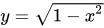
An implicit function is a function that is defined by an implicit equation, that relates one of the variables, considered as the value of the function, with the others considered as the arguments. For example, the equation of the unit circle defines y as an implicit function of x, , assuming −1 ≤ x ≤ 1 and y is restricted to nonnegative values. Some equations do not admit an explicit solution.

View the full Wikipedia page for Implicitly defined
↑ Return to Menu

Relation (mathematics) in the context of Rewriting system

In mathematics, linguistics, computer science, and logic, rewriting covers a wide range of methods of replacing subterms of a formula with other terms. Such methods may be achieved by rewriting systems (also known as rewrite systems, rewrite engines, or reduction systems). In their most basic form, they consist of a set of objects, plus relations on how to transform those objects.

Rewriting can be non-deterministic. One rule to rewrite a term could be applied in many different ways to that term, or more than one rule could be applicable. Rewriting systems then do not provide an algorithm for changing one term to another, but a set of possible rule applications. When combined with an appropriate algorithm, however, rewrite systems can be viewed as computer programs, and several theorem provers and declarative programming languages are based on term rewriting.

View the full Wikipedia page for Rewriting system
↑ Return to Menu