Railgun in the context of Naval Surface Warfare Center Dahlgren Division


Railgun in the context of Naval Surface Warfare Center Dahlgren Division

⭐ Core Definition: Railgun

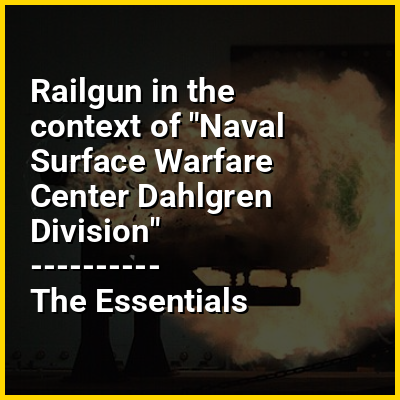
A railgun or rail gun, sometimes referred to as a rail cannon, is a linear motor device, typically designed as a ranged weapon, that uses electromagnetic force to launch high-velocity projectiles. The projectile normally does not contain explosives, instead relying on the projectile's high kinetic energy to inflict damage. The railgun uses a pair of parallel rail-shaped conductors (simply called rails), along which a sliding projectile called an armature is accelerated by the electromagnetic effects of a current that flows down one rail, into the armature and then back along the other rail. It is based on principles similar to those of the homopolar motor.

As of 2020, railguns have been researched as weapons utilizing electromagnetic forces to impart a very high kinetic energy to a projectile (e.g. dart ammunition) rather than using conventional propellants. While explosive-powered military guns cannot readily achieve a muzzle velocity of more than ≈2 km/s (Mach 5.9), railguns can readily exceed 3 km/s (Mach 8.8). For a similar projectile, the range of railguns may exceed that of conventional guns. The destructive force of a projectile depends upon its kinetic energy (proportional to its mass and the square of its velocity) at the point of impact. Because of the potentially higher velocity of a railgun, its force may be much greater than conventionally launched projectiles of the same mass. The absence of explosive propellants or warheads to store and handle, as well as the low cost of projectiles compared to conventional weaponry, are also advantageous.
↓ Menu
HINT:

In this Dossier

Railgun in the context of Guns

A gun is a device that propels a projectile using pressure or explosive force. The projectiles are typically solid, but can also be pressurized liquid (e.g. in water guns or cannons), or gas (e.g. light-gas gun). Solid projectiles may be free-flying (as with bullets and artillery shells) or tethered (as with Tasers, spearguns and harpoon guns). A large-caliber gun is also called a cannon. Guns were designed as weapons for military use, and then found use in hunting. Now, there are guns, e.g., toy guns, water guns, paintball guns, etc., for many purposes.

The means of projectile propulsion vary according to designs, but are traditionally effected pneumatically by a high gas pressure contained within a barrel tube (gun barrel), produced either through the rapid exothermic combustion of propellants (as with firearms), or by mechanical compression (as with air guns). The high-pressure gas is introduced behind the projectile, pushing and accelerating it down the length of the tube, imparting sufficient launch velocity to sustain its further travel towards the target once the propelling gas ceases acting upon it after it exits the muzzle. Alternatively, new-concept linear motor weapons may employ an electromagnetic field to achieve acceleration, in which case the barrel may be substituted by guide rails (as in railguns) or wrapped with magnetic coils (as in coilguns).

View the full Wikipedia page for Guns
↑ Return to Menu

Railgun in the context of Kinetic energy weapon

A kinetic energy weapon (also known as kinetic weapon, kinetic energy warhead, kinetic warhead, kinetic projectile, kinetic kill vehicle) is a projectile weapon based solely on a projectile's kinetic energy to inflict damage to a target, instead of using any explosive, incendiary, chemical or radiological payload. All kinetic weapons work by attaining a high flight speed – generally supersonic or even up to hypervelocity – and collide with their targets, converting their kinetic energy and relative impulse into destructive shock waves, heat and cavitation. In kinetic weapons with unpowered flight, the muzzle velocity or launch velocity often determines the effective range and potential damage of the kinetic projectile.

Kinetic weapons are the oldest and most common ranged weapons used in human history, with the projectiles varying from blunt projectiles such as rocks and round shots, pointed missiles such as arrows, bolts, darts, and javelins, to modern tapered high-velocity impactors such as bullets, flechettes, and penetrators. Typical kinetic weapons accelerate their projectiles mechanically (by muscle power, mechanical advantage devices, elastic energy or pneumatics) or chemically (by propellant combustion, as with firearms), but newer technologies are enabling the development of potential weapons using electromagnetically launched projectiles, such as railguns, coilguns and mass drivers. There are also concept weapons that are accelerated by gravity, as in the case of kinetic bombardment weapons designed for space warfare.

View the full Wikipedia page for Kinetic energy weapon
↑ Return to Menu

Railgun in the context of Sojourn (Overwatch)

Sojourn is the codename of Vivian Chase, a character in the Overwatch media franchise. She first appeared in Overwatch 2, a first-person hero shooter video game developed by Blizzard Entertainment, being added to game's playable character roster upon its early access release in 2022 and was voiced by Cherise Boothe. Initially designed by Arnold Tsang in 2014, Sojourn is a "Damage"-class hero that uses cybernetic enhancements to handle the recoil of her primary weapon; a railgun. In the franchise's lore, she is a Canadian soldier who serves at the rank of captain within the Overwatch team, previously working with Jack Morrison during the Omnic War and commanded agents or provided long-range cover.

Sojourn garnered mixed reception upon her inclusion, with critics praising her cybernetic design and representation of afro-textured hair, whilst others critiquing lack of uniqueness and lore in-game. Particular scrutiny was directed towards Sojourn as a representation of black female in videos, with critics deriding her inclusion as disappointing and bare-minimum; stemming from a long tracked history of criticism directed at Blizzard for the lack of black women representation in the franchise.

View the full Wikipedia page for Sojourn (Overwatch)
↑ Return to Menu