Radicle in the context of "Plumule"

Play Trivia Questions online!

or

Skip to study material about Radicle in the context of "Plumule"

Ad spacer

⭐ Core Definition: Radicle

In botany, the radicle is the first part of a seedling to emerge from the seed, during the process of germination. Germination understood as a biomechanical process describes the radicle with the hypocotyl combined as the embryonic axis in the seed. The radicle emerges from a seed through the micropyle.

The emergence of the radicle is either the end or terminal part (2nd of 2 phases (or) 3rd of 3 phases ) or the 5th of 9 stages of germinating.

↓ Menu

>>>PUT SHARE BUTTONS HERE<<<
In this Dossier

Radicle in the context of Seedling

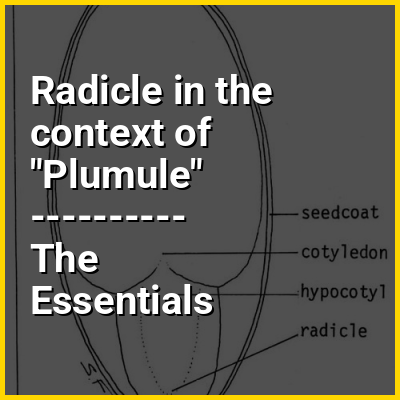
A seedling is a young sporophyte developing out of a plant embryo from a seed. Seedling development starts with germination of the seed. A typical young seedling consists of three main parts: the radicle (embryonic root), the hypocotyl (embryonic shoot), and the cotyledons (seed leaves). The two classes of flowering plants (angiosperms) are distinguished by their numbers of seed leaves: monocotyledons (monocots) have one blade-shaped cotyledon, whereas dicotyledons (dicots) possess two round cotyledons. Gymnosperms are more varied. For example, pine seedlings have up to eight cotyledons. The seedlings of some flowering plants have no cotyledons at all. These are said to be acotyledons.

The plumule is the part of a seed embryo that develops into the shoot bearing the first true leaves of a plant. In most seeds, for example the sunflower, the plumule is a small conical structure without any leaf structure. Growth of the plumule does not occur until the cotyledons have grown above ground. This is epigeal germination. However, in seeds such as the broad bean, a leaf structure is visible on the plumule in the seed. These seeds develop by the plumule growing up through the soil with the cotyledons remaining below the surface. This is known as hypogeal germination.
↑ Return to Menu

Radicle in the context of Acorn

The acorn is the nut of the oaks and their close relatives (genera Quercus, Notholithocarpus and Lithocarpus, in the family Fagaceae). It usually contains a seedling surrounded by two cotyledons (seedling leaves), enclosed in a tough shell known as the pericarp, and borne in a cup-shaped cupule. Acorns are 1–6 cm (122+12 in) long and 0.8–4 cm (381+58 in) on the fat side. Acorns take between 5 and 24 months (depending on the species) to mature; see the list of Quercus species for details of oak classification, in which acorn morphology and phenology are important factors.

↑ Return to Menu

Radicle in the context of Hypocotyl

The hypocotyl (short for "hypocotyledonous stem", meaning "below seed leaf") is the stem of a germinating seedling, found below the cotyledons (seed leaves) and above the radicle (root).

↑ Return to Menu