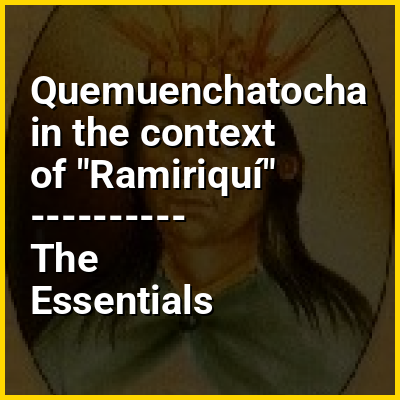
Quemuenchatocha or Quimuinchateca (named in the earliest sources Eucaneme) (Hunza, 1472–Ramiriquí, 1538) was the second-last hoa of Hunza, currently known as Tunja, as of 1490. He was the ruler of the northern Muisca when the Spanish conquistadores arrived in the Muisca highlands. His contemporary enemy psihipquas of the southern Muisca were successively Nemequene and Bogotá.
HINT:
In this Dossier
- ⭐ Core Definition: Quemuenchatocha
- Quemuenchatocha in the context of Spanish conquest of the Muisca
- Quemuenchatocha in the context of Tunja
Quemuenchatocha in the context of Spanish conquest of the Muisca
The Spanish conquest of the Muisca took place from 1537 to 1540. The Muisca were the inhabitants of the central Andean highlands of Colombia before the arrival of the Spanish conquistadors. They were organised in a loose confederation of different rulers; the psihipqua of Muyquytá, with his headquarters in Funza, the hoa of Hunza, the iraca of the sacred City of the Sun Sugamuxi, the Tundama of Tundama, and several other independent caciques. The most important rulers at the time of the conquest were psihipqua Tisquesusa, hoa Eucaneme, iraca Sugamuxi and Tundama in the northernmost portion of their territories. The Muisca were organised in small communities of circular enclosures (ca in their language Muysccubbun; literally "language of the people"), with a central square where the bohío of the cacique was located. They were called "Salt People" because of their extraction of salt in various locations throughout their territories, mainly in Zipaquirá, Nemocón, and Tausa. For the main part self-sufficient in their well-organised economy, the Muisca traded with the European conquistadors valuable products as gold, tumbaga (a copper-silver-gold alloy), and emeralds with their neighbouring indigenous groups. In the Tenza Valley, to the east of the Altiplano Cundiboyacense where the majority of the Muisca lived, they extracted emeralds in Chivor and Somondoco. The economy of the Muisca was rooted in their agriculture with main products maize, yuca, potatoes, and various other cultivations elaborated on elevated fields (in their language called tá). Agriculture had started around 3000 BCE on the Altiplano, following the preceramic Herrera Period and a long epoch of hunter-gatherers since the late Pleistocene. The earliest archaeological evidence of inhabitation in Colombia, and one of the oldest in South America, has been found in El Abra, dating to around 12,500 years BP.
The main part of the Muisca civilisation was concentrated on the Bogotá savanna, a flat high plain in the Eastern Ranges of the Andes, far away from the Caribbean coast. The savanna was an ancient lake, that existed until the latest Pleistocene and formed a highly fertile soil for their agriculture. The Muisca were a deeply religious civilisation with a polytheistic society and an advanced astronomical knowledge, which was represented in their complex lunisolar calendar. Men and women had specific and different tasks in their relatively egalitarian society; while the women took care of the sowing, preparation of food, the extraction of salt, and the elaboration of mantles and pottery, the men were assigned to harvesting, warfare, and hunting. The guecha warriors were tasked with the defence of the Muisca territories, mainly against their western neighbours; the Muzo ("Emerald People") and the bellicose Panche. To impress their enemies, the Muisca warriors wore mummies of important ancestors on their backs, while fighting. In their battles, the men used spears, poisoned arrows, and golden knives.
View the full Wikipedia page for Spanish conquest of the MuiscaQuemuenchatocha in the context of Tunja
Tunja (Spanish pronunciation: [ˈtuŋxa]) is a municipality and city on the Eastern Ranges of the Colombian Andes, in the region known as the Altiplano Cundiboyacense, 130 km northeast of Bogotá. In 2018 the municipality had a population of 172,548. It is the capital of Boyacá department and the Central Boyacá Province. Tunja is an important educational centre of well-known universities. In the time before the Spanish conquest of the Muisca, there was an indigenous settlement, called Hunza, seat of the hoa Eucaneme, conquered by the Spanish conquistadors on August 20, 1537. The Spanish city was founded by captain Gonzalo Suárez Rendón on August 6, 1539, exactly one year after the capital Santafé de Bogotá. The city hosts the most remaining Muisca architecture: Hunzahúa Well, Goranchacha Temple and Cojines del Zaque.
Tunja is a tourist destination, especially for religious colonial architecture, with the Casa Fundador Gonzalo Suárez Rendón recognized as the oldest remnant. In addition to its religious and historical sites it is host to several internationally known festivals and is a jumping-off point for regional tourist destinations such as Villa de Leyva, Paipa, and Sierra Nevada del Cocuy. It is a stop on the Pan American Highway which connects Tunja to Bogotá and Santa Marta and eventually to the northern and southernmost parts of South America.
View the full Wikipedia page for Tunja