Queen's House in the context of "Neo-Palladian"

Play Trivia Questions online!

or

Skip to study material about Queen's House in the context of "Neo-Palladian"

Ad spacer

⭐ Core Definition: Queen's House

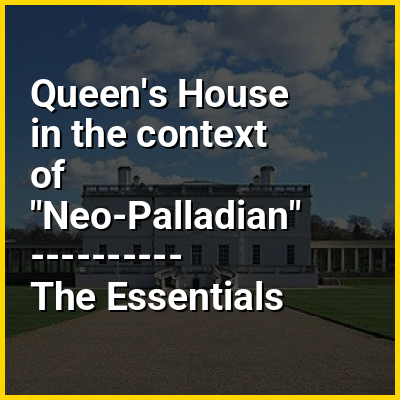
Queen's House is a former royal residence in the London borough of Greenwich, which presently serves as a public art gallery. It was built between 1616 and 1635 on the grounds of the now demolished Greenwich Palace, a few miles downriver from the City of London. In its current setting, it forms a central focus of the Old Royal Naval College with a grand vista leading to the River Thames, a World Heritage Site called, Maritime Greenwich. The Queen's House architect, Inigo Jones, was commissioned by Queen Anne of Denmark and her successor as queen consort, Queen Henrietta Maria. The House was a royal retreat and place to display and enjoy the artworks the queens had commissioned; this included the ceiling in the Great Hall that featured a work by Orazio Gentileschi titled Allegory of Peace and the Arts.

Queen's House is one of the most important buildings in British architectural history, due to it being the first consciously classical building to have been constructed in the country. It was Jones's first major commission after returning from his 1613–1615 grand tour of Roman, Renaissance, and Palladian architecture in Italy. Some earlier English buildings, such as Longleat and Burghley House, had made borrowings from the classical style, but the structure of these buildings was not informed by an understanding of classical precedents. Queen's House would have appeared revolutionary during this period. Although it diverges from the mathematical constraints of Palladio, Jones is often credited with the introduction of Palladianism with the construction of the Queen's House. Jones' unique architecture of the Queen's House also includes features like the Tulip Stairs, an intricate wrought iron staircase that holds itself up, and the Great Hall, a perfect cube.
↓ Menu

>>>PUT SHARE BUTTONS HERE<<<
In this Dossier

Queen's House in the context of Inigo Jones

Inigo Jones (15 July 1573 – 21 June 1652) was an English architect who was the first significant architect in England in the early modern era and the first to employ Vitruvian rules of proportion and symmetry in his buildings.As the most notable architect in England, Jones was the first person to introduce the classical architecture of Rome and the Italian Renaissance to England. He left his mark on London by his design of single buildings, such as the Queen's House which is the first building in England designed in a pure classical style, and the Banqueting House, Whitehall, as well as the layout for Covent Garden square which became a model for future developments in the West End. He made major contributions to stage design by his work as a theatrical designer for several dozen masques, most by royal command and many in collaboration with Ben Jonson.

↑ Return to Menu

Queen's House in the context of Royal Observatory, Greenwich

The Royal Observatory, Greenwich (ROG; known as the Old Royal Observatory from 1957 to 1998, when the working Royal Greenwich Observatory, RGO, temporarily moved south from Greenwich to Herstmonceux) is an observatory situated on a hill in Greenwich Park in south east London, overlooking the River Thames to the north. It played a major role in the history of astronomy and navigation, and because the Prime Meridian passed through it, it gave its name to Greenwich Mean Time, the precursor to today's Coordinated Universal Time (UTC). The ROG has the IAU observatory code of 000, the first in the list. ROG, the National Maritime Museum, the Queen's House and the clipper ship Cutty Sark are collectively designated Royal Museums Greenwich.

The observatory was commissioned in 1675 by King Charles II, with the foundation stone being laid on 10 August. The old hilltop site of Greenwich Castle was chosen by Sir Christopher Wren, a former Savilian Professor of Astronomy; as Greenwich Park was a royal estate, no new land needed to be bought. At that time the King also created the position of Astronomer Royal, to serve as the director of the observatory and to "apply himself with the most exact care and diligence to the rectifying of the tables of the motions of the heavens, and the places of the fixed stars, so as to find out the so much desired longitude of places for the perfecting of the art of navigation." He appointed John Flamsteed as the first Astronomer Royal. The building was completed in the summer of 1676. The building was often called "Flamsteed House", in reference to its first occupant.

↑ Return to Menu

Queen's House in the context of Palace of Placentia

The Palace of Placentia, also known as Greenwich Palace,was an English royal residence that was initially built by Prince Humphrey, Duke of Gloucester, in 1443. Over the centuries it took several different forms, until it was turned into a hospital in the 1690s. The palace was a place designed for pleasure, entertainment and an escape from the city. It was located at Greenwich on the south bank of the River Thames, downstream from London.

On a hill behind his palace, the duke built Duke Humphrey's Tower, later known as Greenwich Castle; the "castle" was subsequently demolished to make way for the Royal Observatory, Greenwich, which survives. The original river-side residence was extensively rebuilt around 1500 by King Henry VII. A detached residence, the Queen's House, was built on the estate in the early 1600s and also survives. In 1660, the old main palace was demolished by Charles II to make way for a proposed new palace, which was only partly constructed in the east wing. Nearly forty years later, at the behest of Queen Mary II, the Greenwich Hospital (now called the Old Royal Naval College) remodelled this wing, expanded, and rebuilt on the site.

↑ Return to Menu

Queen's House in the context of Old Royal Naval College

The Old Royal Naval College are buildings that serve as the architectural centrepiece of Maritime Greenwich, a World Heritage Site in Greenwich, London on the River Thames. Described by the United Nations Educational, Scientific and Cultural Organization (UNESCO) as being of "outstanding universal value" and the site is reckoned to be the "finest and most dramatically sited architectural and landscape ensemble in the British Isles". Formerly the site of a royal palace, the old college was originally constructed to serve as the Royal Navy's Greenwich Hospital, designed by Christopher Wren, and built between 1696 and 1712. The hospital closed in 1869 and so between 1873 and 1998 the buildings were used as a training establishment for the Royal Naval College, Greenwich. Wren incorporated the older Queen's House into the layout design, particularly in maintaining the long axial view for the House to the river. The site is now managed by the Greenwich Foundation for the Old Royal Naval College, established in 1997 to conserve the buildings and grounds and convert them into a cultural destination.

↑ Return to Menu

Queen's House in the context of Palladian architecture

Palladian architecture is a European architectural style derived from the work of the Venetian architect Andrea Palladio (1508–1580). What is today recognised as Palladian architecture evolved from his concepts of symmetry, perspective and the principles of formal classical architecture from ancient Greek and Roman traditions. In the 17th and 18th centuries, Palladio's interpretation of this classical architecture developed into the style known as Palladianism.

Palladianism emerged in England in the early 17th century, led by Inigo Jones, whose Queen's House at Greenwich has been described as the first English Palladian building. Its development faltered at the onset of the English Civil War. After the Stuart Restoration, the architectural landscape was dominated by the more flamboyant English Baroque. Palladianism returned to fashion after a reaction against the Baroque in the early 18th century, fuelled by the publication of a number of architectural books, including Palladio's own I quattro libri dell'architettura (The Four Books of Architecture) and Colen Campbell's Vitruvius Britannicus. Campbell's book included illustrations of Wanstead House, a building he designed on the outskirts of London and one of the largest and most influential of the early neo-Palladian houses. The movement's resurgence was championed by Richard Boyle, 3rd Earl of Burlington, whose buildings for himself, such as Chiswick House and Burlington House, became celebrated. Burlington sponsored the career of the artist, architect and landscaper William Kent, and their joint creation, Holkham Hall in Norfolk, has been described as "the most splendid Palladian house in England". By the middle of the century Palladianism had become almost the national architectural style, epitomised by Kent's Horse Guards at the centre of the nation's capital.

↑ Return to Menu