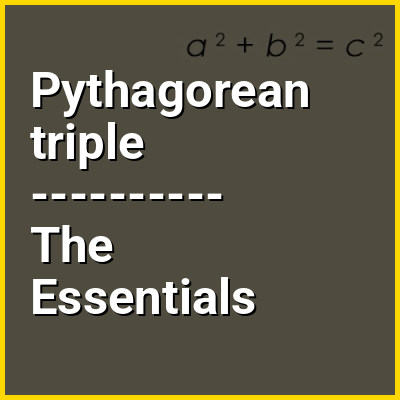
A Pythagorean triple consists of three positive integers a, b, and c, such that a + b = c. Such a triple is commonly written (a, b, c), a well-known example is (3, 4, 5). If (a, b, c) is a Pythagorean triple, then so is (ka, kb, kc) for any positive integer k. A triangle whose side lengths are a Pythagorean triple is a right triangle and called a Pythagorean triangle.
A primitive Pythagorean triple is one in which a, b and c are coprime (that is, they have no common divisor larger than 1). For example, (3, 4, 5) is a primitive Pythagorean triple whereas (6, 8, 10) is not. Every Pythagorean triple can be scaled to a unique primitive Pythagorean triple by dividing (a, b, c) by their greatest common divisor. Conversely, every Pythagorean triple can be obtained by multiplying the elements of a primitive Pythagorean triple by a positive integer (the same for the three elements).