Pumping station in the context of "Pump"

Play Trivia Questions online!

or

Skip to study material about Pumping station in the context of "Pump"

Ad spacer

⭐ Core Definition: Pumping station

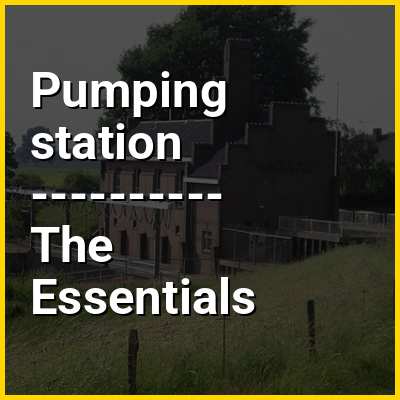
Pumping stations, also called pumphouses, are public utility buildings containing pumps and equipment for pumping fluids from one place to another. They are critical in a variety of infrastructure systems, such as water supply, drainage of low-lying land, canals and removal of sewage to processing sites. A pumping station is an integral part of a pumped-storage hydroelectricity installation.

Pumping stations are designed to move water or sewage from one location to another, overcoming gravitational challenges, and are essential for maintaining navigable canal levels, supplying water, and managing sewage and floodwaters. In canal systems, pumping stations help replenish water lost through lock usage and leakage, ensuring navigability. Similarly, in land drainage, stations pump water to prevent flooding in areas below sea level, a concept pioneered during the Victorian era in places like The Fens in the UK. The introduction of "package pumping stations" has modernized drainage systems, allowing a compact, efficient solution for areas where gravity drainage is impractical.
↓ Menu

>>>PUT SHARE BUTTONS HERE<<<
In this Dossier

Pumping station in the context of Sewerage

Sewerage (or sewage system) is the infrastructure that conveys sewage or surface runoff (stormwater, meltwater, rainwater) using sewers. It encompasses components such as receiving drains, manholes, pumping stations, storm overflows, and screening chambers of the combined sewer or sanitary sewer. Sewerage ends at the entry to a sewage treatment plant or at the point of discharge into the environment. It is the system of pipes, chambers, manholes or inspection chamber, etc. that conveys the sewage or storm water.

In many cities, sewage (municipal wastewater or municipal sewage) is carried together with stormwater, in a combined sewer system, to a sewage treatment plant. In some urban areas, sewage is carried separately in sanitary sewers and runoff from streets is carried in storm drains. Access to these systems, for maintenance purposes, is typically through a manhole. During high precipitation periods a sewer system may experience a combined sewer overflow event or a sanitary sewer overflow event, which forces untreated sewage to flow directly to receiving waters. This can pose a serious threat to public health and the surrounding environment.

↑ Return to Menu

Pumping station in the context of Water supply network

A water supply network or water supply system is a system of engineered hydrologic and hydraulic components that provide water supply. A water supply system typically includes the following:

  1. A drainage basin (see water purification – sources of drinking water)
  2. A raw water collection point (above or below ground) where the water accumulates, such as a lake, a river, or groundwater from an underground aquifer. Raw water may be transferred using uncovered ground-level aqueducts, covered tunnels, or underground pipes to water purification facilities..
  3. Water purification facilities. Treated water is transferred using water pipes (usually underground).
  4. Water storage facilities such as reservoirs, water tanks, or water towers. Smaller water systems may store the water in cisterns or pressure vessels. Tall buildings may also need to store water locally in pressure vessels in order for the water to reach the upper floors.
  5. Additional water pressurizing components such as pumping stations may need to be situated at the outlet of underground or aboveground reservoirs or cisterns (if gravity flow is impractical).
  6. A pipe network for distribution of water to consumers (which may be private houses or industrial, commercial, or institution establishments) and other usage points (such as fire hydrants)
  7. Connections to the sewers (underground pipes, or aboveground ditches in some developing countries) are generally found downstream of the water consumers, but the sewer system is considered to be a separate system, rather than part of the water supply system.

Water supply networks are often run by public utilities of the water industry.

↑ Return to Menu

Pumping station in the context of Sanitary sewer overflow

Sanitary sewer overflow (SSO) is a condition in which untreated sewage is discharged from a sanitary sewer into the environment prior to reaching sewage treatment facilities. When caused by rainfall it is also known as wet weather overflow. Causes of sanitary sewer overflows include: Blockage of sewer lines, infiltration/Inflow of excessive stormwater into sewer lines during heavy rainfall, malfunction of pumping station lifts or electrical power failure, broken sewer lines. Prevention of such overflow events involves regular maintenance and timely upgrades of infrastructure.

SSOs can cause gastrointestinal illnesses (waterborne diseases), beach closures and restrictions on fish and shellfish consumption.

↑ Return to Menu

Pumping station in the context of Great Stink

The Great Stink was an event in Central London during July and August 1858 in which the hot weather exacerbated the smell of untreated human waste and industrial effluent that was present on the banks of the River Thames. The problem had been mounting for some years, with an ageing and inadequate sewer system that emptied directly into the Thames. The miasma from the effluent was thought to transmit contagious diseases, and three outbreaks of cholera before the Great Stink were blamed on the ongoing problems with the river.

The smell, and fears of its possible effects, prompted action by the national and local administrators who had been considering possible solutions to the problem. The authorities accepted a proposal from the civil engineer Joseph Bazalgette to move the effluent eastwards along a series of interconnecting sewers that sloped towards outfalls beyond the metropolitan area. Work on high-, mid- and low-level systems for the new Northern and Southern Outfall Sewers started at the beginning of 1859 and lasted until 1875. To aid the drainage, pumping stations were built to lift the sewage from lower levels into higher pipes. Two of the more ornate stations, Abbey Mills in Stratford and Crossness on the Erith Marshes, with architectural designs by the consultant engineer, Charles Driver, are listed for protection by English Heritage. Bazalgette's plan introduced the three embankments to London in which the sewers ran: the Victoria, Chelsea and Albert Embankments.

↑ Return to Menu

Pumping station in the context of Two-stroke diesel engine

A two-stroke diesel engine is a diesel engine that uses compression ignition in a two-stroke combustion cycle. It was invented by Hugo Güldner in 1899.

In compression ignition, air is first compressed and heated; fuel is then injected into the cylinder, causing it to self-ignite. This delivers a power stroke each time the piston rises and falls, without any need for the additional exhaust and induction strokes of the four-stroke cycle.

↑ Return to Menu

Pumping station in the context of Crofton Pumping Station

Crofton Pumping Station, near the village of Great Bedwyn in Wiltshire, England, supplies the summit pound of the Kennet and Avon Canal with water.

The steam-powered pumping station is preserved and operates on selected weekends. It contains an operational Boulton & Watt steam engine dating from 1812, making it the oldest working beam engine in the world in its original engine house and capable of doing the job for which it was installed.

↑ Return to Menu