Psyche Revived by Cupid's Kiss in the context of Lucius Apuleius


Psyche Revived by Cupid's Kiss in the context of Lucius Apuleius

⭐ Core Definition: Psyche Revived by Cupid's Kiss

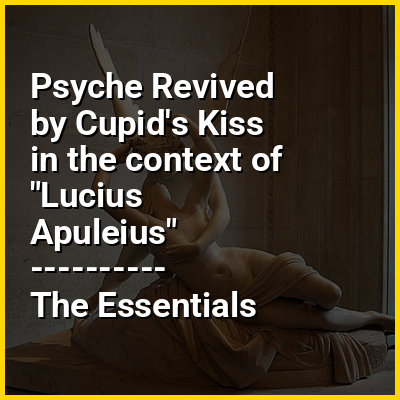
Psyche Revived by Cupid's Kiss (Italian: Amore e Psiche [aˈmoːre e ˈpsiːke]; French: Psyché ranimée par le baiser de l'Amour; Slovene: Amor in Psihe; Russian: Амур и Психея, romanizedAmúr i Psikhéja) is a sculpture by Italian artist Antonio Canova first commissioned in 1787 by Colonel John Campbell. It is regarded as a masterpiece of Neoclassical sculpture, but shows the mythological lovers at a moment of great emotion, characteristic of the emerging movement of Romanticism. It represents the god Cupid in the height of love and tenderness, immediately after awakening the lifeless Psyche with a kiss. The story of Cupid and Psyche is taken from Lucius Apuleius' Latin novel The Golden Ass, and was popular as a theme in art.

Joachim Murat acquired the first or prime version (pictured) in 1800. After his death, the statue entered the Louvre Museum in Paris, France in 1824;Prince Yusupov, a Russian nobleman acquired the second version of the piece from Canova in Rome in 1796, and it later entered the Hermitage Museum in Saint Petersburg. A full-scale model for the second version is in the Metropolitan Museum of Art.
↓ Menu
HINT:

In this Dossier

Psyche Revived by Cupid's Kiss in the context of Prime version

In the art world, if an artwork exists in several versions, the one known or believed to be the earliest is called the prime version. Many artworks produced in media such as painting or carved sculpture which create unique objects are in fact repeated by their artists, often several times. It is regarded as a matter of some importance both by art historians and the art market to establish which version has "priority", that is to say was the original work. The presumption usually is that the prime version is the finest, and perhaps the most carefully done, though some later versions can be argued to improve on the originals.

In many periods the later "repetitions" were often produced by the workshop of the master, with varying degrees of supervision and direct attention from him. This was especially the case with official portraits of monarchs and politicians, which in the Early Modern period were often ordered in large numbers of versions from the court artist as diplomatic gifts. "Prime version" is normally only used when there is another version by the same artist, or his workshop. Other versions by other artists are called copies. Sometimes "reduced versions" that are considerably smaller than the prime one are made. Especially in the case of 19th-century repetitions, the term autograph replica is used of repetitions by the original artist.

View the full Wikipedia page for Prime version
↑ Return to Menu