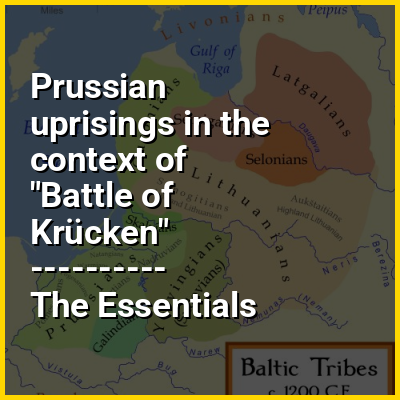
The Prussian uprisings were two major and three smaller uprisings by the Old Prussians, one of the Baltic tribes, against the Teutonic Knights that took place in the 13th century during the Prussian Crusade. The crusading military order, supported by the Popes and Christian Europe, sought to conquer and convert the pagan Prussians. In the first ten years of the crusade, five of the seven major Prussian clans fell under the control of the less numerous Teutonic Knights. However, the Prussians rose against their conquerors on five occasions.
The first uprising was supported by Duke Swietopelk II, Duke of Pomerania. The Prussians were successful at first, reducing the Knights to only five of their strongest castles. The duke then suffered a series of military defeats and was eventually forced to make peace with the Teutonic Knights. With Duke Swietopelk's support for the Prussians broken, a prelate of Pope Innocent IV negotiated a peace treaty between the Prussians and the Knights. This treaty was never honored or enforced, especially after the Prussian victory in the Battle of Krücken at the end of 1249.