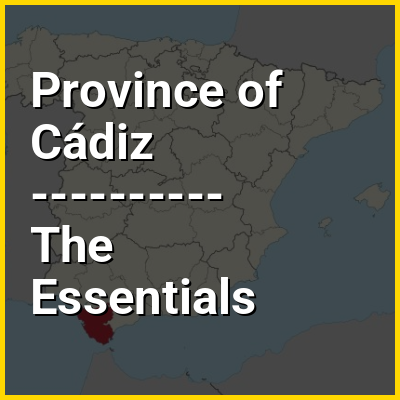
Cádiz is a province of southern Spain, in the southwestern part of the autonomous community of Andalusia. It is the southernmost part of mainland Spain, as well as the southernmost part of continental Europe.
Phoenicians founded a settlement in the peninsula of Almina, which had continuity under Roman and Byzantine rule (Septem Fratres). It was annexed to the early Arab Caliphates upon the Islamic conquest of the Maghreb, only to be destroyed during the Berber Revolt. It was rebuilt in the 9th century by Majkasa Ghomaras, and for much of the middle ages, regional powers north and south of the Strait of Gibraltar vied for control over Ceuta, which was a key contested port in the so-called Battle of the Strait. In 1415, it was annexed to the Kingdom of Portugal, and subsequently, after 1580, to the Hispanic Monarchy, with the city choosing to stay in the latter after 1640. Ceuta was a regular municipality belonging to the Spanish province of Cádiz prior to the passing of its Statute of Autonomy in March 1995, as provided by the Spanish Constitution, henceforth becoming an autonomous city.
Its name comes from the municipal territory of the town of Gibraltar, now a British Overseas Territory. Until 1704, the Campo de Gibraltar was simply the territory for the municipality of Gibraltar, about 500 km (190 sq mi) corresponding approximately to the current municipalities of Algeciras, San Roque, Los Barrios and La Línea de la Concepción. Following the capture of Gibraltar during the War of the Spanish Succession, the former inhabitants settled nearby creating Algeciras, San Roque, and Los Barrios. In 1759, each of them was established as a different municipality.
The area was inhabited in Antiquity, including archaeological strata generally identified with the Roman city of Iulia Traducta. Founded soon after the Islamic conquest of the Iberian Peninsula on the mouth of the Río de la Miel, al-Jazira al-Khadrā [es] became the head of a rump taifa kingdom after Umayyad state collapse in the 11th century. In 1275, the Emirate of Granada ceded the place to the Marinids, who founded the new walled precinct of al-Bunayya after 1282 on the opposite bank of the Río de la Miel. The twin medinas were conquered in 1344 by the Crown of Castile. Medieval urban continuity came to an abrupt end when the town was torn down by the Nasrids circa 1369–1385. The ruins were repopulated and the town eventually refounded upon the arrival of refugees from the 1704 Anglo-Dutch capture of Gibraltar.
Situated on a narrow slice of land surrounded by the sea‚ Cádiz is, in most respects, a typical Andalusian city with well-preserved historical landmarks. The older part of Cádiz, within the remnants of the city walls, is commonly referred to as the Old Town (Spanish: Casco Antiguo), and represents a large area of the total size of the city. It is characterized by the antiquity of its various quarters (barrios), among them El Pópulo, La Viña, and Santa María, which present a marked contrast to the newer areas of town. While the Old City's street plan consists of narrow winding alleys connecting large plazas, newer areas of Cádiz typically have wide avenues and more modern buildings. The city is dotted with parks where exotic plants flourish, including giant trees supposedly brought to the Iberian Peninsula from the New World. This includes the historic Parque Genovés.
The Costa del Sol (Spanish:[ˈkostaðelˈsol]; literally "Coast of the Sun") is a region in the south of Spain in the autonomous community of Andalusia, comprising the coastal towns and communities along the coastline of the Province of Málaga and the eastern part of Campo de Gibraltar in Cádiz. Formerly made up only of a series of small fishing settlements, today the region is a world-renowned tourist destination. The Costa del Sol is situated between two lesser known coastal regions, the Costa de la Luz and the Costa Tropical.
The region has no official limit, but it is generally accepted that the Costa del Sol stretches from the municipality of La Línea de la Concepción in the west to Nerja in the east, spanning around 150 kilometers of coastline. The term Costa del Sol was coined at the beginning of the 20th century by Rodolfo Lussnigg to promote the Almería coastline. Until the late 1960s, it was used in reference to the entire Mediterranean coast of Eastern Andalusia. The name refers to the sunny climate, present in the region most days of the year. The Costa del Sol is one of the most important tourist areas in Spain; around 35% of Andalusia's tourism is concentrated in the region; in 2009 it had 17 million overnight stays.
The foundation of San Roque as a city owes to the creation of a sort of Gibraltar-in-exile by refugees fleeing from the Rock in the wake of its seizure by Anglo-Dutch forces in 1704.
Province of Cádiz in the context of La Línea de la Concepción
La Línea de la Concepción (Spanish pronunciation:[laˈlineaðelakonθeβˈθjon]), often referred to simply as La Línea, is a municipality of Spain belonging to the province of Cádiz, Andalusia.