Provadia in the context of "Cave-church"

Play Trivia Questions online!

or

Skip to study material about Provadia in the context of "Cave-church"

Ad spacer

⭐ Core Definition: Provadia

Provadia (Bulgarian: Провадия [proˈvadijɐ]) is a town in northeastern Bulgaria, part of Varna Province, located in a deep karst gorge (Provadia syncline) along the Provadiya River not far from the Bulgarian Black Sea Coast. It is the administrative centre of Provadia Municipality. As of December 2009, the town had a population of 12,901.

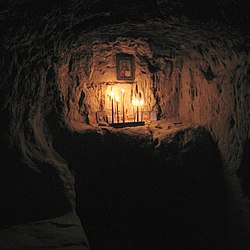
Provadia served as a customs point since ancient times. It is well known for salty mineral waters, its mild climate and a total of 70 km of caves in the surrounding mountain walls. It can be reached by train from Sofia or Varna and there are also hourly buses from and to Varna, and a sophisticated road system.

↓ Menu

>>>PUT SHARE BUTTONS HERE<<<
In this Dossier

Provadia in the context of Provadiya River

The Provadiya or the Provadiyska reka (Bulgarian: Провадийска река) is a 119 km long river in northeastern Bulgaria, named after the town of Provadia.

↑ Return to Menu

Provadia in the context of Varna Necropolis

The Varna Necropolis (Bulgarian: Варненски некропол), or Varna Cemetery, is a burial site in the western industrial zone of Varna (approximately half a kilometre from Lake Varna and 4 km from the city centre), internationally considered one of the key archaeological sites in world prehistory. The oldest gold treasure and jewelry in the world, dating from 4600 BC to 4200 BC, was discovered at the site. Several prehistoric Bulgarian finds are considered no less old – the golden treasures of Hotnitsa, Durankulak, artifacts from the Kurgan settlement of Yunatsite near Pazardzhik, the golden treasure Sakar, as well as beads and gold jewelry found in the Kurgan settlement of ProvadiaSolnitsata (“salt pit”). However, Varna gold is most often called the oldest since this treasure is the largest and most diverse.

↑ Return to Menu

Provadia in the context of Cave monastery

A cave monastery is a monastery built in caves, with possible outside facilities. The 3rd-century monk St. Anthony the Great, known as the founder of Christian monasticism, lived in a cave.

↑ Return to Menu

Provadia in the context of Solnitsata

Solnitsata (Bulgarian: Солницата, "The Saltworks") was a prehistoric town located in present-day Bulgaria, near the modern city of Provadia. It is the oldest salt production center in continental Europe (5500‑4200 BC). It was the first prehistoric urban center in Europe. Solnitsata was a fortified stone settlement - citadelle, inner and outer city with pottery production site and the site of a salt production facility; it flourished c. 4700–4200 BC. The settlement was walled to protect the salt, a crucial commodity in antiquity. Although its population has been estimated at only 350, Vassil Nikolov (bg) argues that it meets established criteria as a prehistoric proto-city.

Salt production drove Solnitsata's economy, and the town is believed to have supplied salt throughout the Balkans. A large collection of gold objects nearby has led archaeologists to consider that this trade resulted in great wealth for the town's residents — Varna Necropolis. Researchers suggest that some of the residential buildings in the settlement were two-story, a fact that indicates relatively advanced architectural planning in a prehistoric context. Nearby is the ancient Anhialos, whose livelihood was the extraction of sea salt. The extraction technology can be seen in the Salt Museum, Pomorie.

↑ Return to Menu