Prince regent in the context of "João VI"

Play Trivia Questions online!

or

Skip to study material about Prince regent in the context of "João VI"


⭐ Core Definition: Prince regent

A prince regent or princess regent is a prince or princess who, due to their position in the line of succession, rules a monarchy as regent in the stead of a monarch, e.g., as a result of the sovereign's incapacity (minority or illness) or absence (e.g., by remoteness, such as exile or long voyage, or the absence of an incumbent).

While the term itself can have the generic meaning and refer to any prince or princess who fills the role of regent, historically it has mainly been used to describe a small number of individual princes and princesses who were regents of non-principalities.

↓ Menu

In this Dossier

Prince regent in the context of Qing dynasty

The Qing dynasty (/ɪŋ/ CHING), officially the Great Qing, was a Manchu-led imperial dynasty of China and an early modern empire in East Asia. The last imperial dynasty in Chinese history, the Qing dynasty was preceded by the Ming dynasty and succeeded by the Republic of China. At its height of power, the empire stretched from the Sea of Japan in the east to the Pamir Mountains in the west, and from the Mongolian Plateau in the north to the South China Sea in the south. Originally emerging from the Later Jin dynasty founded in 1616 and proclaimed in Shenyang in 1636, the dynasty seized control of the Ming capital Beijing and North China in 1644, traditionally considered the start of the dynasty's rule. The dynasty lasted until the Xinhai Revolution of October 1911 led to the abdication of the last emperor in February 1912. The multi-ethnic Qing dynasty assembled the territorial base for modern China. The Qing controlled the most territory of any dynasty in Chinese history, and in 1790 represented the fourth-largest empire in world history to that point. With over 426 million citizens in 1907, it was the most populous country at the time.

Nurhaci, leader of the Jianzhou Jurchens and House of Aisin-Gioro who was also a vassal of the Ming dynasty, unified Jurchen clans (known later as Manchus) and founded the Later Jin dynasty in 1616, renouncing the Ming overlordship. As the founding Khan of the Manchu state he established the Eight Banners military system, and his son Hong Taiji was declared Emperor of the Great Qing in 1636. As Ming control disintegrated, peasant rebels captured Beijing as the short-lived Shun dynasty, but the Ming general Wu Sangui opened the Shanhai Pass to the Qing army, which defeated the rebels, seized the capital, and took over the government in 1644 under the Shunzhi Emperor and his prince regent. While the Qing became a Chinese empire, resistance from Ming rump regimes and the Revolt of the Three Feudatories delayed the complete conquest until 1683, which marked the beginning of the High Qing era. As an emperor of Manchu ethnic origin, the Kangxi Emperor (1661–1722) consolidated control, relished the role of a Confucian ruler, patronised Buddhism, encouraged scholarship, population and economic growth.

↑ Return to Menu

Prince regent in the context of Yugoslavia

Yugoslavia (/ˌjɡˈslɑːviə/; lit.'Land of the South Slavs') was a country in Central Europe and the Balkans that existed from 1918 to 2003. It came into existence following World War I, under the name of the Kingdom of Serbs, Croats and Slovenes, from the merger of the Kingdom of Serbia with the provisional State of Slovenes, Croats and Serbs, and constituted the first union of South Slavic peoples as a sovereign state, following centuries of foreign rule over the region under the Ottoman Empire and the Habsburg monarchy.

Under the rule of the House of Karađorđević, the kingdom gained international recognition on 13 July 1922 at the Conference of Ambassadors in Paris and was renamed the Kingdom of Yugoslavia on 3 October 1929. Peter I was the country's first sovereign. Upon his father's death in 1921, Alexander I went on to rule the country through an extended period of political crisis that culminated in the 6 January Dictatorship and, ultimately, his assassination in 1934. Prince Paul headed the state as a prince regent until Alexander's son Peter II was declared of-age, which happened following the Yugoslav coup d'état in March 1941. Alexander I was the longest reigning of the three Yugoslav monarchs.

↑ Return to Menu

Prince regent in the context of Regent

In a monarchy, a regent (from Latin regens 'ruling, governing') is a person appointed to execute the office of the monarch temporarily. Regencies may arise for a number of reasons, including the monarch being a minor, ill, absent from the country, or otherwise unavailable. A regent may also be appointed in cases where the throne is vacant, or the identity of the legitimate monarch is disputed.

The rule of a regent or regents is called a regency. A regent or regency council may be formed as an ad hoc measure, or there may be a formal and regular appointment process. Regent in some countries has also been used as a formal title granted to a monarch's most trusted advisor or personal assistant. If the regent is holding the position due to their being in the line of succession, the compound term prince regent is often used; if the regent of a minor is their mother, and she is wife or widow of a king, she would be referred to as queen regent.

↑ Return to Menu

Prince regent in the context of Shunzhi Emperor

The Shunzhi Emperor (15 March 1638 – 5 February 1661), also known by his temple name Emperor Shizu of Qing, personal name Fulin, was the second emperor of the Qing dynasty, and the first Qing emperor to rule over China proper. Upon the death of his father Hong Taiji, a committee of Manchu princes chose the 5-year-old Fulin as successor. The princes also appointed two co-regents: Dorgon, the 14th son of Nurhaci, and Jirgalang, one of Nurhaci's nephews, both of whom were members of the Aisin-Gioro clan. In November 1644, the Shunzhi Emperor was enthroned as emperor of China in Beijing.

From 1643 to 1650, political power lay mostly in the hands of the prince regent Dorgon. Under his leadership, the Qing conquered most of the territory of the fallen Ming dynasty, chased Ming loyalist regimes deep into the southwestern provinces, and established the basis of Qing rule over China proper despite highly unpopular policies such as the "hair cutting command" of 1645, which forced all Qing male subjects to shave their forehead and braid their remaining hair into a queue resembling that of the Manchus. After Dorgon's death on the last day of 1650, the young Shunzhi Emperor started to rule personally. He tried, with mixed success, to fight corruption and to reduce the political influence of the Manchu nobility. In the 1650s, he faced a resurgence of Ming loyalist resistance, but by 1661 his armies had defeated the Qing's last enemies, Koxinga and the Prince of Gui, both of whom would succumb the following year.

↑ Return to Menu

Prince regent in the context of George IV

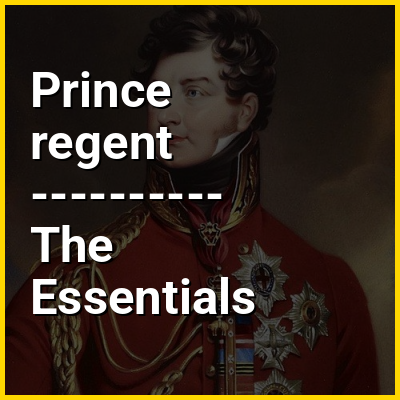
George IV (George Augustus Frederick; 12 August 1762 – 26 June 1830) was King of the United Kingdom of Great Britain and Ireland and King of Hanover from 29 January 1820 until his death in 1830. At the time of his accession to the throne, he was acting as prince regent for his father, King George III, having done so since 5 February 1811 during his father's final mental illness.

George IV was the eldest child of King George III and Queen Charlotte. He led an extravagant lifestyle that contributed to the fashions of the Regency era. He was a patron of new forms of leisure, style and taste. He commissioned John Nash to build the Royal Pavilion in Brighton and remodel Buckingham Palace, and commissioned Jeffry Wyatville to rebuild Windsor Castle. George's charm and culture earned him the title "the first gentleman of England", but his dissolute way of life and poor relationships with his parents and his wife, Caroline of Brunswick, earned him the contempt of the people and dimmed the prestige of the monarchy. He excluded Caroline from his coronation and asked the government to introduce the unpopular Pains and Penalties Bill in an unsuccessful attempt to divorce her.

↑ Return to Menu

Prince regent in the context of Prince Paul of Yugoslavia

Prince Paul of Yugoslavia, also known as Paul Karađorđević (Serbo-Croatian: Павле Карађорђевић, romanizedPavle Karađorđević, English transliteration: Paul Karageorgevich; 27 April 1893 – 14 September 1976), was prince regent of the Kingdom of Yugoslavia during the minority of King Peter II. Paul was a first cousin of Peter's father, Alexander I.

↑ Return to Menu