Presentation miniature in the context of "Putto"

Play Trivia Questions online!

or

Skip to study material about Presentation miniature in the context of "Putto"


⭐ Core Definition: Presentation miniature

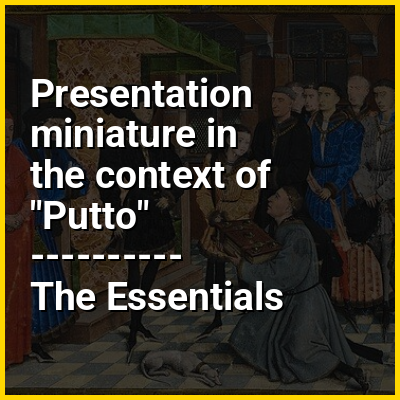
A presentation miniature or dedication miniature is a miniature painting often found in illuminated manuscripts, in which the patron or donor is presented with a book, normally to be interpreted as the book containing the miniature itself. The miniature is thus symbolic, and presumably represents an event in the future. Usually it is found at the start of the volume, as a frontispiece before the main text, but may also be placed at the end, as in the Vivian Bible, or at the start of a particular text in a collection.

In earlier manuscripts the recipient of the book may be a dead saint, the founder of a monastery or monastic order, for example, and the person handing over the book the abbot, or sometimes the scribe of the book. The genre is an extension of other forms of dedication portraits, for example wall-paintings or mosaics in churches showing the person who commissioned the church holding a model of it. Ultimately they stretch back to scenes where classical rulers receive tribute, or those where a procession of Early Christian martyrs carry their crowns to present Christ. The miniatures are often found in luxury books presented to the emperor or another major figure, which usually followed significant donations of land to the monastery concerned.
↓ Menu

In this Dossier

Presentation miniature in the context of Book frontispiece

A frontispiece in books is a decorative or informative illustration facing a book's title page, usually on the left-hand, or verso, page opposite the right-hand, or recto page of a book. In some ancient editions or in modern luxury editions the frontispiece features thematic or allegorical elements, in others is the author's portrait that appears as the frontispiece. In medieval illuminated manuscripts, a presentation miniature showing the book or text being presented (by whom and to whom varies) was often used as a frontispiece.

↑ Return to Menu

Presentation miniature in the context of Jean Wauquelin presenting his 'Chroniques de Hainaut' to Philip the Good

Jean Wauquelin presenting his 'Chroniques de Hainaut' to Philip the Good is a presentation miniature believed to have been painted by the Early Netherlandish artist Rogier van der Weyden (or if not actually from his hand then certainly by his workshop to his designs). It decorates the frontispiece to the Chroniques de Hainaut, MS KBR.9242, Jean Wauquelin's French translation of a three-volume history of the County of Hainaut originally written in Latin by the 14th-century Franciscan historian Jacques de Guyse.

The majority, if not all, of the figures (described in the text as "Chevaliers, conseillers, et chambellans") are portraits of historical figures. The decorative border of the presentation miniature includes the arms of the various territories ruled by Philip, which he had considerably expanded, interspersed with his personal emblem of sparks being struck from a flint.

↑ Return to Menu

Presentation miniature in the context of Grandes Chroniques de France

The Grandes Chroniques de France is a vernacular royal compilation of the history of the Kingdom of France, most manuscripts of which are luxury copies that are heavily illuminated. Copies were produced between the thirteenth and fifteenth centuries, the text being extended at intervals to cover recent events. It was first compiled in the reign of Saint Louis (d. 1270), who wished to preserve the history of the Franks, from the coming of the Trojans to his own time, in an official chronography whose dissemination was tightly controlled. It was continued under his successors until completed in 1461. It covers the Merovingian, Carolingian, and Capetian dynasties of French kings, with illustrations depicting personages and events from virtually all their reigns.

It survives in approximately 130 manuscripts, varying in the richness, number and artistic style of their illuminations, copied and amended for royal and courtly patrons, the central work of vernacular official historiography. Over 75 copies are illustrated, with between one and over 400 scenes shown; analysis of the selections of subjects reveals the changing political preoccupations of the different classes of patrons over time.

↑ Return to Menu

Presentation miniature in the context of Simon Marmion

Simon Marmion (c. 1425 – 24 or 25 December 1489) was a French and Burgundian Early Netherlandish painter of panels and illuminated manuscripts. Marmion lived and worked in what is now France but for most of his lifetime was part of the Duchy of Burgundy in the Southern Netherlands.

↑ Return to Menu

Presentation miniature in the context of Martin le Franc

Martin le Franc (c. 1410 – 1461) was a French poet of the late Middle Ages and early Renaissance.

↑ Return to Menu