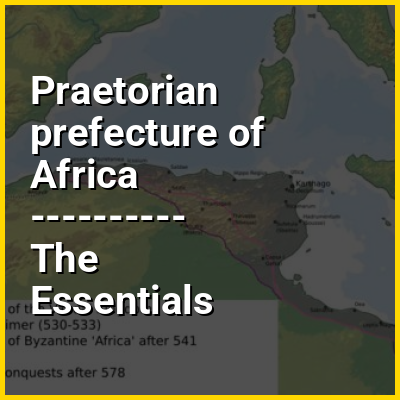
The Praetorian Prefecture of Africa (Latin: praefectura praetorio Africae) was an administrative division of the Byzantine Empire in the Maghreb. With its seat at Carthage, it was established after the reconquest of northwestern Africa from the Vandals in 533–534 by the Byzantine Emperor Justinian I. It continued to exist until 591, when it was replaced by the Exarchate of Africa.
>>>PUT SHARE BUTTONS HERE<<<
In this Dossier
- ⭐ Core Definition: Praetorian prefecture of Africa
- Praetorian prefecture of Africa in the context of Roman Carthage
- Praetorian prefecture of Africa in the context of Mauretania Caesariensis
- Praetorian prefecture of Africa in the context of Constans
- Praetorian prefecture of Africa in the context of Antalas
Praetorian prefecture of Africa in the context of Roman Carthage
Roman Carthage was an important city in ancient Rome, located in modern-day Tunisia. Approximately 100 years after the destruction of Punic Carthage in 146 BC, a new city of the same name (Latin Carthāgō) was built on the same land by the Romans in the period from 49 to 44 BC. By the 3rd century, Carthage had developed into one of the largest cities of the Roman Empire, with a population of several hundred thousand. It was the center of the Roman province of Africa, which was a major breadbasket of the empire. Carthage briefly became the capital of a usurper, Domitius Alexander, in 308–311. Conquered by the Vandals in 439, Carthage served as the capital of the Vandal Kingdom for a century. Re-conquered by the Eastern Roman Empire in 533–534, it continued to serve as a Roman regional center, as the seat of the praetorian prefecture of Africa (after 590 the Exarchate of Africa).
The city was sacked and destroyed by Umayyad Arab forces after the Battle of Carthage in 698 to prevent it from being reconquered by the Byzantine Empire. A fortress on the site was garrisoned by Muslim forces until the Hafsid period, when it was captured by Crusaders during the Eighth Crusade. After the withdrawal of the Crusaders, the Hafsids decided to destroy the fortress to prevent any future use by a hostile power. Roman Carthage was used as a source of building materials for Kairouan and Tunis in the 8th century.
Praetorian prefecture of Africa in the context of Mauretania Caesariensis
Mauretania Caesariensis (Latin for "Caesarean Mauretania") was a Roman province located in present-day Algeria. The full name refers to its capital Caesarea Mauretaniae (modern Cherchell).
The province had been part of the Kingdom of Mauretania and named for the Mauri people who lived there. Formerly an independent kingdom, and later a client state of Rome, it was annexed into the Empire formally during the reign of Claudius and divided into two provinces about 42 AD. A third province, named Mauretania Sitifensis, was later split off from the eastern portion during the reign of Diocletian in 293 AD. During and after the fall of the Western Roman Empire in the 5th century, most of the hinterland area was lost, first to the Vandal Kingdom and later to the Mauro-Roman Kingdom, with Roman administration limited to the capital of Caesarea. The land was reconquered by Rome during the reign of Justinian. This province was a part of Praetorian prefecture of Africa, later Exarchate of Africa. The Muslim conquest of the Maghreb brought an end to Roman rule in Mauretania, permanently this time, which became ruled by the Umayyad Caliphate as part of Medieval Muslim Algeria.
Praetorian prefecture of Africa in the context of Constans
Flavius Julius Constans (c. 323 – 350), also called Constans I, was Roman emperor from 337 to 350. He held the imperial rank of caesar from 333, and was the youngest son of Constantine the Great.
After his father's death, he was made augustus alongside his brothers in September 337. Constans was given the administration of the praetorian prefectures of Italy, Illyricum, and Africa. He defeated the Sarmatians in a campaign shortly afterwards. Quarrels over the sharing of power led to a civil war with his eldest brother and co-emperor Constantine II, who invaded Italy in 340 and was killed in battle by Constans's forces near Aquileia. Constans gained from him the praetorian prefecture of Gaul. Thereafter there were tensions with his remaining brother and co-augustus Constantius II (r. 337–361), including over the exiled bishop Athanasius of Alexandria, who in turn eulogized Constans as "the most pious Augustus... of blessed and everlasting memory." In the following years he campaigned against the Franks, and in 343 he visited Roman Britain, the last legitimate emperor to do so until Manuel II in 1400, more than a thousand years later.
Praetorian prefecture of Africa in the context of Antalas
Antalas (Greek: Ἀντάλας; c. 500 – after 548) was a Berber tribal leader who played a major role in the wars of the Byzantine Empire against the Berber tribes in Africa. Antalas and his tribe, the Frexes initially served the Byzantines as allies, but after 544 switched sides. With the final Byzantine victory in his and his tribe once again became Byzantine subjects. The main sources on his life are the epic poem Iohannis of Flavius Cresconius Corippus and the Histories of the Wars of Procopius of Caesarea.