Pound sign in the context of "Bank of England"

Play Trivia Questions online!

or

Skip to study material about Pound sign in the context of "Bank of England"

Ad spacer

⭐ Core Definition: Pound sign

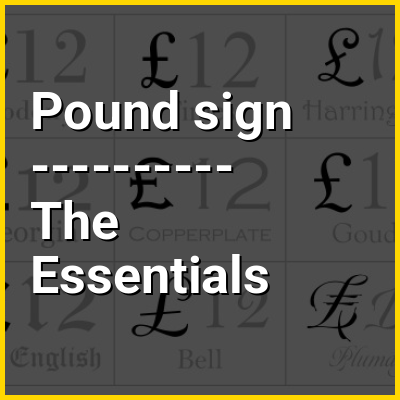
The pound sign (£) is the symbol for the pound unit of sterling – the currency of the United Kingdom and its associated Crown Dependencies and British Overseas Territories and previously of Great Britain and of the Kingdom of England. The same symbol is used for other currencies called pound, such as the Egyptian and Syrian pounds. The sign may be drawn with one or two bars depending on personal preference, but the Bank of England has used the one-bar style exclusively on banknotes since 1975.

In the United States, "pound sign" refers to the symbol # (number sign). In Canada, "pound sign" can mean £ or #.
↓ Menu

>>>PUT SHARE BUTTONS HERE<<<
In this Dossier

Pound sign in the context of Pound sterling

Sterling (symbol: £; currency code: GBP) is the currency of the United Kingdom and nine of its associated territories. The pound is the main unit of sterling, and the word pound is also used to refer to the British currency generally, often qualified in international contexts as the British pound or the pound sterling.

Sterling is the world's oldest currency in continuous use since its inception. In 2022, it was the fourth-most-traded currency in the foreign exchange market, after the United States dollar, the euro, and the Japanese yen. Together with those three currencies and the renminbi, it forms the basket of currencies that calculate the value of IMF special drawing rights. As of late 2022, sterling is also the fourth most-held reserve currency in global reserves.

↑ Return to Menu

Pound sign in the context of Pound (currency)

Pound is a name of various units of currency. It is used in some countries today and previously was used in many others. The English word "pound" derives from the Latin expression lībra pondō, "a pound by weight", in which lībra means 'scale' or 'balance' and pondō means 'pound' or 'weight'. The currency's symbol is '£', a stylised form of the blackletter 'L' () (from libra), crossed to indicate abbreviation.

The term was adopted in England from the weight of silver used to make 240 pennies, and eventually spread to British colonies all over the world. Although silver penny mintage began seven centuries earlier, the first pound coin was minted under Henry VII in 1489.

↑ Return to Menu

Pound sign in the context of Coins of the pound sterling

The standard circulating coinage of the United Kingdom, British Crown Dependencies and British Overseas Territories is denominated in pennies and pounds sterling (symbol "£", commercial GBP), and ranges in value from one penny sterling to two pounds. Since decimalisation, on 15 February 1971, the pound has been divided into 100 pence (shown on coins as "new pence" until 1981). Before decimalisation, twelve pence made a shilling, and twenty shillings made a pound.

British coins are minted by the Royal Mint in Llantrisant, Wales. The Royal Mint also commissions the coins' designs; however they also have to be accepted by the reigning monarch.

↑ Return to Menu

Pound sign in the context of French livre

The livre (abbreviation: £ or ₶., French for libra (pound)) was the currency of Kingdom of France and its predecessor states of Francia and West Francia from 781 to 1794. Several different livres existed, some concurrently. The livre was the name of coins and of units of account.

↑ Return to Menu

Pound sign in the context of Syrian pound

The Syrian pound, known locally as the Syrian lira, (Arabic: الليرة السورية, romanizedal-Līra as-Sūriyya; abbreviation: LS or SP in Latin, ل.س in Arabic, historically also £S, and £Syr; ISO code: SYP) is the currency of Syria. It is issued by the Central Bank of Syria. The pound is nominally divided into 100 piastres (قرش qirsh, plural قروش qurūsh in Arabic, abbreviated to p.), although piastre coins are no longer issued.

Before 1947, the Arabic inscription of the word "qirsh" was spelled with the initial Arabic letter غ, after which the word began with ق. Until 1958, banknotes were issued with Arabic on the obverse and French on the reverse. Since 1958, English has been used on the reverses, hence the three different names for this currency. Coins used both Arabic and French until independence, then only Arabic.

↑ Return to Menu