Potsdam Conference in the context of "Potsdam"

Play Trivia Questions online!

or

Skip to study material about Potsdam Conference in the context of "Potsdam"

Ad spacer

⭐ Core Definition: Potsdam Conference

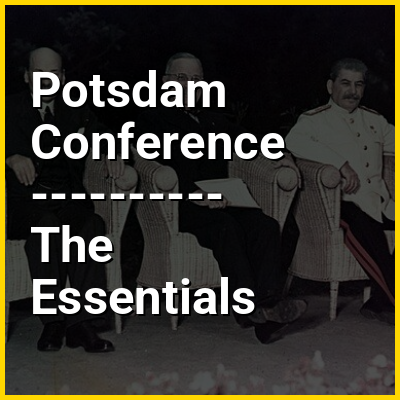
The Potsdam Conference (German: Potsdamer Konferenz) was held at Potsdam in the Soviet occupation zone from 17 July to 2 August 1945, to allow the three leading Allies to plan the postwar peace, while avoiding the mistakes of the Paris Peace Conference of 1919. The participants were the Soviet Union, the United Kingdom, and the United States. They were represented respectively by General Secretary Joseph Stalin, prime ministers Winston Churchill and Clement Attlee, and President Harry S. Truman. They gathered to decide how to administer Germany, which had agreed to an unconditional surrender nine weeks earlier. The goals of the conference also included establishing the postwar order, solving issues on the peace treaty, and countering the effects of the war.

The foreign ministers and aides played key roles: Vyacheslav Molotov, Anthony Eden and Ernest Bevin, and James F. Byrnes. From 17 July to 25 July, nine meetings were held, when the Conference was interrupted for two days, as the results of the British general election were announced. By 28 July, Attlee had defeated Churchill and replaced him as Britain's representative, with Britain's new Secretary of State for Foreign Affairs, Ernest Bevin, replacing Anthony Eden. Four days of further discussion followed. During the conference, there were meetings of the three heads of government with their foreign secretaries, as well as meetings of only the foreign secretaries. Committees that were appointed by the latter for precursory consideration of questions before the conference also met daily. During the Conference, Truman was secretly informed that the Trinity test of the first atomic bomb on 16 July had been successful. He hinted to Stalin that the U.S. was about to use a new kind of weapon against the Japanese. Though this was the first time the Soviets had been officially given information about the atomic bomb, Stalin was already aware of the bomb project, having learned about it through espionage long before.
↓ Menu

>>>PUT SHARE BUTTONS HERE<<<
In this Dossier

Potsdam Conference in the context of Fall of communism in Poland

The history of Poland from 1945 to 1989 spans the period of Marxist–Leninist regime in Poland after the end of World War II. These years, while featuring general industrialization, urbanization and many improvements in the standard of living, were marred by early Stalinist repressions, social unrest, political strife and severe economic difficulties.Near the end of World War II, the advancing Soviet Red Army, along with the Polish Armed Forces in the East, pushed out the Nazi German forces from occupied Poland. In February 1945, the Yalta Conference sanctioned the formation of a provisional government of Poland from a compromise coalition, until postwar elections. Joseph Stalin, the leader of the Soviet Union, manipulated the implementation of that ruling. A practically communist-controlled Provisional Government of National Unity was formed in Warsaw by ignoring the Polish government-in-exile based in London since 1940.

During the subsequent Potsdam Conference in July–August 1945, the three major Allies ratified a massive westerly shift of Poland's borders and approved its new territory between the Oder–Neisse line and the Curzon Line. The area of Poland was reduced in comparison to its pre-World War II extent and geographically resembled that of the medieval early Piast dynasty era. Following the destruction of the Polish-Jewish population in the Holocaust, the flight and expulsion of Germans in the west, resettlement of Ukrainians in the east, and the expulsion and resettlement of Poles from the Eastern Borderlands (Kresy), Poland became for the first time in its history an ethnically homogeneous nation-state without prominent minorities. The new government solidified its political power, while the Polish United Workers' Party (PZPR) under Bolesław Bierut gained firm control over the country, which would remain an independent state within the Soviet sphere of influence. The July Constitution was promulgated on 22 July 1952 and the country officially became the Polish People's Republic (PRL).

↑ Return to Menu

Potsdam Conference in the context of Berlin Declaration (1945)

The Berlin Declaration (German: Berliner Erklärung/Deklaration) of 5 June 1945, or the Declaration regarding the defeat of Germany, had the governments of the United States, the Soviet Union, the United Kingdom, and France, acting on behalf of the Allies of World War II, jointly assume de jure "supreme authority" over Germany after its military defeat and asserted the legitimacy of their joint determination of issues regarding its administration and boundaries prior to the forthcoming Potsdam Conference.
Cite error: There are <ref group=n> tags on this page, but the references will not show without a {{reflist|group=n}} template (see the help page).

↑ Return to Menu

Potsdam Conference in the context of Potsdam Agreement

The Potsdam Agreement (German: Potsdamer Abkommen) was the agreement among three of the Allies of World War II: the United Kingdom, the United States, and the Soviet Union after the war ended in Europe that was signed on 1 August 1945 and published the following day. A product of the Potsdam Conference, it concerned the military occupation and reconstruction of Germany, its border, and the entire European Theatre of War territory. It also addressed Germany's demilitarisation, reparations, the prosecution of war criminals and the mass expulsion of ethnic Germans from various parts of Europe. France was not invited to the conference but formally remained one of the powers occupying Germany.

Executed as a communiqué, the agreement was not a peace treaty according to international law, although it created accomplished facts. It was superseded by the Treaty on the Final Settlement with Respect to Germany signed on 12 September 1990.

↑ Return to Menu

Potsdam Conference in the context of Western betrayal

Western betrayal is the view that the United Kingdom, France and the United States failed to meet their legal, diplomatic, military and moral obligations to the Czechoslovaks and Poles before, during and after World War II. It also sometimes refers to the treatment of other Central and Eastern European states by those three nations.

The concept primarily derives from several events, including British and French appeasement towards Nazi Germany during its 1938 occupation of Czechoslovakia and the perceived failure of Britain and France to adequately assist the Poles during the German invasion of Poland in 1939. It also derives from concessions made by American and British political leaders to the Soviet Union during the Tehran, Yalta, and Potsdam conferences and their limited response during the 1944 Warsaw Uprising along with post-war events, which allocated Poland to the Soviet sphere of influence as part of the Eastern Bloc.

↑ Return to Menu

Potsdam Conference in the context of Potsdam Declaration

The Potsdam Declaration, or the Proclamation Defining Terms for Japanese Surrender, was a statement that called for the surrender of all Japanese armed forces during World War II. On July 26, 1945, United States President Harry S. Truman, United Kingdom Prime Minister Winston Churchill, and President of China Chiang Kai-shek issued the document, which outlined the terms of surrender for the Empire of Japan, as agreed upon at the Potsdam Conference. The ultimatum stated that, if Japan did not surrender, it would face "prompt and utter destruction."

↑ Return to Menu

Potsdam Conference in the context of First Indochina War

The First Indochina War (generally known as the Indochina War in France, and as the Anti-French Resistance War in Vietnam, and alternatively internationally as the French Indochina War) was fought in Indochina between France and the Việt Minh, and their respective allies, from 19 December 1946 until 1 August 1954. The Việt Minh was led by Võ Nguyên Giáp and Hồ Chí Minh. The conflict mainly happened in Vietnam.

At the Potsdam Conference in July 1945, the Allied Combined Chiefs of Staff decided that Indochina south of latitude 16° north was to be included in the Southeast Asia Command under British Admiral Mountbatten. The French return to southern Indochina was also supported by the Allies. On V-J Day, September 2, Hồ Chí Minh proclaimed in Hanoi the establishment of the Democratic Republic of Vietnam (DRV). Also in September 1945, Chinese forces entered Hanoi, and Japanese forces to the north of that line surrendered to Generalissimo Chiang Kai-shek. At the same time, British forces landed in Saigon, and Japanese forces in the south surrendered to the British. The Chinese acknowledged the DRV and the communist-led Việt Minh, then in power in Hanoi, even though they also supported pro-Chinese nationalist factions. The British refused to do that in Saigon, and deferred to the French. The DRV ruled as the only civil government in all of Vietnam for a period of about 20 days, after the abdication of Emperor Bảo Đại, who had governed Vietnam since 1926.

↑ Return to Menu

Potsdam Conference in the context of Tehran Conference

The Tehran Conference (codenamed Eureka) was a strategy meeting of the Allies of World War II, held between Joseph Stalin, Franklin D. Roosevelt, and Winston Churchill from 28 November to 1 December 1943. It was the first of the Allied World War II conferences involving the "Big Three" (the Soviet Union, the United States, and the United Kingdom) and took place at the Soviet embassy in Tehran just over a year after the Anglo-Soviet invasion of Iran. The meeting occurred shortly after the Cairo Conference was held in Egypt for a discussion between the United States, the United Kingdom, and China from 22 to 26 November 1943. The Big Three would not meet again until 1945, when the Yalta Conference was held in Crimea from 4 to 11 February and the Potsdam Conference was held in Allied-occupied Germany from 17 July to August 2. Notably, President Franklin D. Roosevelt arrived on the USS Iowa.

Although the three leaders arrived in Tehran with differing objectives, the main outcome of the meeting was a British and American commitment to opening a second front against Nazi Germany, thereby forcing it to pull military assets away from the Eastern Front with the Soviets. In addition to this decision, the Tehran Conference also addressed: the Big Three's relations with Turkey and Iran, as the former was being pressed to enter the conflict and the latter was under Allied occupation; operations in Yugoslavia and against Japan; and the envisaged settlement following the expected defeat of the Axis powers. A separate contract also saw the Big Three pledge to recognize Iranian independence.

↑ Return to Menu