Point reflection in the context of "P-symmetry"

Play Trivia Questions online!

or

Skip to study material about Point reflection in the context of "P-symmetry"

Ad spacer

⭐ Core Definition: Point reflection

In geometry, a point reflection (also called a point inversion or central inversion) is a geometric transformation of affine space in which every point is reflected across a designated inversion center, which remains fixed. In Euclidean or pseudo-Euclidean spaces, a point reflection is an isometry (preserves distance). In the Euclidean plane, a point reflection is the same as a half-turn rotation (180° or π radians), while in three-dimensional Euclidean space a point reflection is an improper rotation which preserves distances but reverses orientation. A point reflection is an involution: applying it twice is the identity transformation.

An object that is invariant under a point reflection is said to possess point symmetry (also called inversion symmetry or central symmetry). A point group including a point reflection among its symmetries is called centrosymmetric. Inversion symmetry is found in many crystal structures and molecules, and has a major effect upon their physical properties.

↓ Menu

>>>PUT SHARE BUTTONS HERE<<<
In this Dossier

Point reflection in the context of Reflection (mathematics)

In mathematics, a reflection (also spelled reflexion) is a mapping from a Euclidean space to itself that is an isometry with a hyperplane as the set of fixed points; this set is called the axis (in dimension 2) or plane (in dimension 3) of reflection. The image of a figure by a reflection is its mirror image in the axis or plane of reflection. For example the mirror image of the small Latin letter p for a reflection with respect to a vertical axis (a vertical reflection) would look like q. Its image by reflection in a horizontal axis (a horizontal reflection) would look like b. A reflection is an involution: when applied twice in succession, every point returns to its original location, and every geometrical object is restored to its original state.

The term reflection is sometimes used for a larger class of mappings from a Euclidean space to itself, namely the non-identity isometries that are involutions. The set of fixed points (the "mirror") of such an isometry is an affine subspace, but is possibly smaller than a hyperplane. For instance a reflection through a point is an involutive isometry with just one fixed point; the image of the letter p under itwould look like a d. This operation is also known as a central inversion (Coxeter 1969, §7.2), and exhibits Euclidean space as a symmetric space. In a Euclidean vector space, the reflection in the point situated at the origin is the same as vector negation. Other examples include reflections in a line in three-dimensional space. Typically, however, unqualified use of the term "reflection" means reflection in a hyperplane.

↑ Return to Menu

Point reflection in the context of Parity (physics)

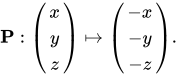
In physics, a parity transformation (also called parity inversion) is the flip in the sign of one spatial coordinate. In three dimensions, it can also refer to the simultaneous flip in the sign of all three spatial coordinates (a point reflection or point inversion):

↑ Return to Menu

Point reflection in the context of Centrosymmetry

In crystallography, a centrosymmetric point group contains an inversion center as one of its symmetry elements. In such a point group, for every point (x, y, z) in the unit cell there is an indistinguishable point (-x, -y, -z). Such point groups are also said to have inversion symmetry. Point reflection is a similar term used in geometry.Crystals with an inversion center cannot display certain properties, such as the piezoelectric effect and the frequency doubling effect (second-harmonic generation). In addition, in such crystals, one-photon absorption (OPA) and two-photon absorption (TPA) processes are mutually exclusive, i.e., they do not occur simultaneously, and provide complementary information.

The following space groups have inversion symmetry: the triclinic space group 2, the monoclinic 10-15, the orthorhombic 47-74, the tetragonal 83-88 and 123-142, the trigonal 147, 148 and 162-167, the hexagonal 175, 176 and 191-194, the cubic 200-206 and 221-230.

↑ Return to Menu

Point reflection in the context of Improper rotation

In geometry, an improper rotation (also called rotation-reflection, rotoreflection, rotary reflection, or rotoinversion) is an isometry in Euclidean space that is a combination of a rotation about an axis and a reflection in a plane perpendicular to that axis. Reflection and inversion are each a special case of improper rotation. Any improper rotation is an affine transformation and, in cases that keep the coordinate origin fixed, a linear transformation.It is used as a symmetry operation in the context of geometric symmetry, molecular symmetry and crystallography, where an object that is unchanged by a combination of rotation and reflection is said to have improper rotation symmetry.

It is important to note the distinction between rotary reflection and rotary inversion symmetry operations and their associated symmetry elements. Rotary reflections are generally used to describe the symmetry of individual molecules and are defined as a 360°/n rotation about an n-fold rotation axis followed by a reflection over a mirror plane perpendicular to the n-fold rotation axis. Rotoinversions are generally used to describe the symmetry of crystals and are defined as a 360°/n rotation about an n-fold rotation axis followed by an inversion through the origin. Although rotary reflection operations have a rotoinversion analogue and vice versa, rotoreflections and rotoinversions of the same order need not be identical. For example, a 6-fold rotoinversion axis and its associated with symmetry operations are distinct from those resulting from a 6-fold reflection axis.

↑ Return to Menu