The Point Park Civic Center was a proposed civic center for downtown Pittsburgh, Pennsylvania, United States, where the confluence of the Allegheny and Monongahela Rivers forms the Ohio River. Frank Lloyd Wright designed the structure on a commission from Edgar J. Kaufmann in the late 1940s. Wright initially envisioned a circular building more than 1,000 feet (300 m) in diameter and 175 feet (53 m) tall. The structure, containing an opera house, sports arena, three movie theaters, and a convention hall, was wrapped by a spiraling strip of road. The plan expressed Wright's insistence on bringing the automobile into the social setting. It did not find favor with Pittsburgh authorities.
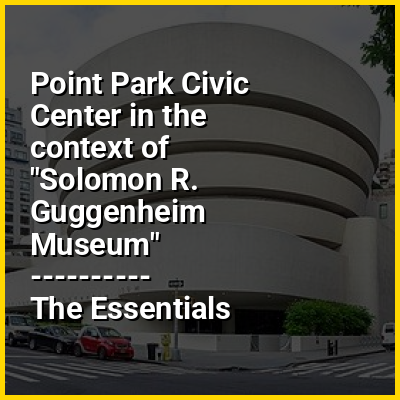
To make the design more palatable to its audience, Wright developed a radically different proposal for a monolithic tower supporting bridges across the Allegheny and Monongahela. This too was unsuccessful, and none of Wright's work for the site was ever built. The site is now occupied by Point State Park. Elements of Wright's plan contain similarities to other Wright designs, including the Solomon R. Guggenheim Museum and his unrealized plans for Monona Terrace.