Plesiosaur in the context of "Mesozoic Era"

Play Trivia Questions online!

or

Skip to study material about Plesiosaur in the context of "Mesozoic Era"

Ad spacer

⭐ Core Definition: Plesiosaur

The Plesiosauria or plesiosaurs are an order or clade of extinct Mesozoic marine reptiles, belonging to the Sauropterygia.

Plesiosaurs first appeared in the latest Triassic Period, possibly in the Rhaetian stage, about 203 million years ago. They became especially common during the Jurassic Period, thriving until their disappearance due to the Cretaceous–Paleogene extinction event at the end of the Cretaceous Period, about 66 million years ago. They had a worldwide oceanic distribution, and some species at least partly inhabited freshwater environments.

↓ Menu

>>>PUT SHARE BUTTONS HERE<<<
In this Dossier

Plesiosaur in the context of Marine reptile

Marine reptiles are reptiles which have become secondarily adapted for an aquatic or semiaquatic life in a marine environment. Only about 100 of the 12,000 extant reptile species and subspecies are classed as marine reptiles, including marine iguanas, sea snakes, sea turtles and saltwater crocodiles.

The earliest marine reptile was Mesosaurus (not to be confused with Mosasaurus), which arose in the Permian period of the Paleozoic era. During the Mesozoic era, many groups of reptiles became adapted to life in the seas, including such familiar clades as the ichthyosaurs, plesiosaurs (these two orders were once thought united in the group "Enaliosauria", a classification now cladistically obsolete), mosasaurs, nothosaurs, placodonts, sea turtles, thalattosaurs and thalattosuchians. Most marine reptile groups became extinct at the end of the Cretaceous period, but some still existed during the Cenozoic, most importantly the sea turtles. Other Cenozoic marine reptiles included the bothremydids, palaeophiid snakes, a few choristoderes such as Simoedosaurus and dyrosaurid crocodylomorphs. Various types of marine gavialid crocodilians remained widespread as recently as the Late Miocene.

↑ Return to Menu

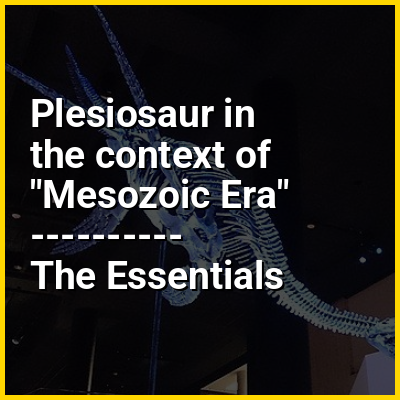
Plesiosaur in the context of Mesozoic era

The Mesozoic Era is the era of Earth's geological history, lasting from about 252 to 66 million years ago, comprising the Triassic, Jurassic and Cretaceous Periods. It is characterized by the dominance of archosaurian reptiles such as the dinosaurs, and of gymnosperms such as cycads, ginkgoaceae and araucarian conifers; a hot greenhouse climate; and the tectonic break-up of Pangaea. The Mesozoic is the middle of the three eras since complex life evolved: the Paleozoic, the Mesozoic, and the Cenozoic.

The Mesozoic is commonly known as the Age of the Dinosaurs because the terrestrial animals that dominated both hemispheres for the majority of it were Dinosaurs. This era began in the wake of the Permian–Triassic extinction event, the largest mass extinction in Earth's history, and ended with the Cretaceous–Paleogene extinction event, another mass extinction whose victims included the non-avian dinosaurs, pterosaurs, mosasaurs, and plesiosaurs. The Mesozoic was a time of significant tectonic, climatic, and evolutionary activity. The supercontinent Pangaea began to break apart into separate landmasses. The climate of the Mesozoic was varied, alternating between warming and cooling periods. Overall, however, the Earth was hotter than it is today.
↑ Return to Menu

Plesiosaur in the context of Blubber

Blubber is a thick layer of vascularized adipose tissue under the skin of all cetaceans, pinnipeds, penguins, sirenians, and polar bears. It was present in many marine reptiles, such as ichthyosaurs and plesiosaurs.

↑ Return to Menu

Plesiosaur in the context of Maastrichtian

The Maastrichtian ( /mɑːˈstrɪktiən/ mahss-TRIK-tee-ən) is, in the International Commission on Stratigraphy (ICS) geologic timescale, the latest age (uppermost stage) of the Late Cretaceous Epoch or Upper Cretaceous Series, the Cretaceous Period or System, and of the Mesozoic Era or Erathem. It spanned the interval from 72.2 to 66 million years ago. The Maastrichtian was preceded by the Campanian and succeeded by the Danian (part of the Paleogene and Paleocene). It is named after the city of Maastricht, the capital and largest city of the Limburg province in the Netherlands.

The Cretaceous–Paleogene extinction event (formerly known as the Cretaceous–Tertiary extinction event) occurred at the end of this age. In this mass extinction, many commonly recognized groups such as non-avian dinosaurs, pterosaurs, plesiosaurs and mosasaurs, as well as many other lesser-known groups, died out. The cause of the extinction is most commonly linked to an asteroid about 10 to 15 kilometres (6.2 to 9.3 mi) wide colliding with Earth, ending the Cretaceous.

↑ Return to Menu

Plesiosaur in the context of Niobrara Formation

The Niobrara Formation /ˌn.əˈbrærə/, also called the Niobrara Chalk, is a geologic formation in North America that was deposited between 87 and 82 million years ago during the Coniacian, Santonian, and Campanian stages of the Late Cretaceous. It is composed of two structural units, the Smoky Hill Chalk Member overlying the Fort Hays Limestone Member. The chalk formed from the accumulation of coccoliths from microorganisms living in what was once the Western Interior Seaway, an inland sea that divided the continent of North America during much of the Cretaceous. It underlies much of the Great Plains of the US and Canada. Evidence of vertebrate life is common throughout the formation and includes specimens of plesiosaurs, mosasaurs, pterosaurs, and several primitive aquatic birds. The type locality for the Niobrara Chalk is the Niobrara River in Knox County in northeastern Nebraska. The formation gives its name to the Niobrara cycle of the Western Interior Seaway.

↑ Return to Menu

Plesiosaur in the context of William Conybeare (geologist)

William Daniel Conybeare FRS (7 June 1787 – 12 August 1857), dean of Llandaff, was an English geologist, palaeontologist and clergyman. He is probably best known for his ground-breaking work on fossils and excavation in the 1820s, including important papers for the Geological Society of London on ichthyosaur anatomy and the first published scientific description of a plesiosaur.

↑ Return to Menu

Plesiosaur in the context of List of largest fish

Fish vary greatly in size. The extant whale shark and basking shark exceed all other fish by a considerable margin in weight and length. The extinct Otodus megalodon exceeds all other fish, extant and extinct (excluding tetrapods), in size. Fish in the common usage are a paraphyletic group that describes aquatic vertebrates while excluding the tetrapods, four limbed vertebrates nested within the lobe-finned fish, which include all land vertebrates and their nearest extinct relatives.

This list therefore excludes the various marine reptiles and mammals, such as the extinct ichthyosaur, plesiosaur and mosasaur reptiles (none of which are dinosaurs) and the extant sirenia and cetacea mammals (such as the marine tetrapod blue whale, generally considered to be the largest animal known to have ever lived).

↑ Return to Menu

Plesiosaur in the context of Gastrolith

A gastrolith, also called a stomach stone or gizzard stone, is a rock held inside a gastrointestinal tract. Gastroliths in some species are retained in the muscular gizzard and used to grind food in animals lacking suitable grinding teeth. In other species the rocks are ingested and pass through the digestive system and are frequently replaced. The grain size depends upon the size of the animal and the gastrolith's role in digestion. Other species use gastroliths as ballast. Particles ranging in size from sand to cobble have been documented.

↑ Return to Menu