Pika in the context of "Rodents"

Play Trivia Questions online!

or

Skip to study material about Pika in the context of "Rodents"

Ad spacer

⭐ Core Definition: Pika

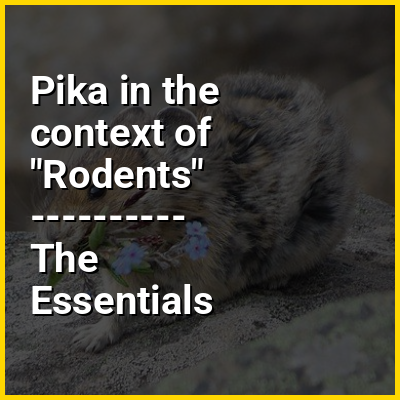
A pika (/ˈpkə/ PEE-kə, US also /ˈpkə/ PY-kə) is a small, mountain-dwelling mammal native to Asia and North America. With short limbs, a very round body, an even coat of fur, and no external tail, they resemble their close relative the rabbit, but with short, rounded ears. The large-eared pika of the Himalayas and nearby mountains lives at elevations of more than 6,000 m (20,000 ft).

The name pika appears to be derived from the Tungusic piika, and the scientific name Ochotona is derived from the Mongolian word ogotno (оготно), which means 'pika'. It is used for any member of the Ochotonidae (/ˌɒkəˈtnɪd/), a family within the order of lagomorphs, the order which also includes the Leporidae (rabbits and hares). They are the smallest animal in the lagomorph group. Only one genus, Ochotona (/ˌɒkəˈtnə/ OK-ə-TOHN), is extant within the family, covering 37 species, though many fossil genera are known. Another species, the Sardinian pika, belonging to the separate genus Prolagus, has become extinct within the last 2,000 years owing to human activity.
↓ Menu

>>>PUT SHARE BUTTONS HERE<<<
In this Dossier

Pika in the context of Rodent

Rodents (from Latin rodere, 'to gnaw') are mammals of the order Rodentia (/rˈdɛnʃə/ roh-DEN-shə), which are characterized by a single pair of continuously growing incisors in each of the upper and lower jaws. About 40% of all mammal species are rodents. They are native to all major land masses except for Antarctica, and several oceanic islands, though they have subsequently been introduced to most of these land masses by human activity.

Rodents are extremely diverse in their ecology and lifestyles and can be found in almost every terrestrial habitat, including human-made environments. Species can be arboreal, fossorial (burrowing), saltatorial/ricochetal (leaping on their hind legs), or semiaquatic. However, all rodents share several morphological features, including having only a single upper and lower pair of ever-growing incisors. Well-known rodents include mice, rats, squirrels, prairie dogs, porcupines, beavers, guinea pigs, and hamsters. Once included with rodents, rabbits, hares, and pikas, which also have incisors that grow continuously, are now considered to be in a separate order, the Lagomorpha, distinguished by an extra pair of incisors. Both Rodentia and Lagomorpha are sister groups, sharing a single common ancestor and forming the clade of Glires.

↑ Return to Menu

Pika in the context of Rabbit

Rabbits or bunnies are small mammals in the family Leporidae (which also includes the hares), which is in the order Lagomorpha (which also includes pikas). They are familiar throughout the world as a small herbivore, a prey animal, a domesticated form of livestock, and a pet, having a widespread effect on ecologies and cultures. The most widespread rabbit genera are Oryctolagus and Sylvilagus. The former, Oryctolagus, includes the European rabbit, Oryctolagus cuniculus, which is the ancestor of the hundreds of breeds of domestic rabbit and has been introduced on every continent except Antarctica. The latter, Sylvilagus, includes over 13 wild rabbit species, among them the cottontails and tapetis. Wild rabbits not included in Oryctolagus and Sylvilagus include several species of limited distribution, including the pygmy rabbit, volcano rabbit, and Sumatran striped rabbit.

Rabbits are a paraphyletic grouping, and do not constitute a clade, as hares (belonging to the genus Lepus) are nested within the Leporidae clade and are not described as rabbits. Although once considered rodents, lagomorphs diverged earlier and have a number of traits rodents lack, including two extra incisors. Similarities between rabbits and rodents were once attributed to convergent evolution, but studies in molecular biology have found a common ancestor between lagomorphs and rodents and place them in the clade Glires.

↑ Return to Menu

Pika in the context of Cecotrope

Cecotropes (also caecotropes, cecotrophs, caecotrophs, cecal pellets, soft feces, or night feces) are a nutrient-filled package created in the gastrointestinal (GI) tract that is expelled and eaten by many animals (such as rabbits, guinea pigs, mice, hamsters, and chinchillas) to obtain more nutrients out of their food. When food passes through the GI tract the first time, the stomach and the small intestine digest the food material, which then moves into the colon, where the food particles are sorted by size. The smaller particles of fiber are moved into the cecum where they are fermented by microbes. This creates useable nutrients which are stored and expelled in cecotropes. The nutrients from the cecotropes are absorbed in the small intestine. The nutrients gained from cecotrophy include short-chain fatty acids, vitamin B, sodium, potassium, amino acids, and protein.

Lagomorphs (a grouping including rabbits, hares, and pikas) are perhaps the most well-known for producing and eating cecotropes, but other monogastric fermenters, such as rodents, also produce cecotropes. Rodents including beavers, guinea pigs, mice, hamsters, and chinchillas are known cecotrophs. Other animals also eat cecotropes, such as the common ringtail possum and the coppery ringtail possum.

↑ Return to Menu

Pika in the context of Lagomorpha

The lagomorphs (from Ancient Greek λαγώς lagós 'hare' and μορφή morphḗ 'form') are the members of the taxonomic order Lagomorpha, of which there are two living families: the Leporidae (rabbits and hares) and the Ochotonidae (pikas). There are 110 recent species of lagomorph, of which 109 species in twelve genera are extant, including ten genera of rabbits (42 species), one genus of hare (33 species), and one genus of pika (34 species); and in which one monospecific genus is recently extinct, that of the Sardinian pika.

↑ Return to Menu

Pika in the context of Glires

Glires (/ˈɡlaɪərz, -aɪərz/; from Latin glīrēs 'dormice') is a clade (sometimes ranked as a grandorder) consisting of rodents and lagomorphs (rabbits, hares, and pikas). The hypothesis that these form a monophyletic group has been long debated based on morphological evidence. Two morphological studies, published in 2001 and 2003, strongly support the monophyly of Glires. In particular, the 2003 study reported the discovery of fossil material of basal members of Glires, particularly the genera Mimotona, Gomphos, Heomys, Matutinia, Rhombomylus, and Sinomylus. Their description, in 2005, helped to bridge the gap between more typical rodents and lagomorphs. Data published in 2001, based on nuclear DNA, supported Glires as a sister of Euarchonta to form Euarchontoglires, but some genetic data from both nuclear and mitochondrial DNA have been less supportive. A study, published in 2007, investigating retrotransposon presence/absence data unambiguously supports the Glires hypothesis. Studies published in 2011 and 2015 place Scandentia as a sister clade of the Glires, invalidating Euarchonta as a clade.

↑ Return to Menu

Pika in the context of Leporidae

Leporidae (/ləˈpɔːrɪd, -d/) is the family of rabbits and hares (Lepus), containing over 70 species of extant mammals in all. Together with the pikas, the Leporidae constitute the mammalian order Lagomorpha. Leporidae differ from pikas in that they have short, furry tails and elongated ears and hind legs.

The common name rabbit usually applies to all genera in the family except Lepus, while members of the genus Lepus (comprising nearly half the species) are usually called hares. Like most common names, however, the distinction does not match current taxonomy completely; jackrabbits are members of Lepus, and members of the genera Pronolagus and Caprolagus are called red rock hares and hispid hares respectively.

↑ Return to Menu

Pika in the context of Volcano rabbit

The volcano rabbit (Romerolagus diazi) (Spanish: conejo de los volcanes), also known as the teporingo or zacatuche, is a species of small rabbit that lives in pine and alder forests on volcanic slopes in Mexico. It is the only species in the genus Romerolagus, and is considered to be the most primitive species among the rabbits and hares. It has small rounded ears, short legs, a large forehead, and short, thick fur. It is one of the world's smallest rabbits, lives in groups that consist of between two and five members, and makes burrows (underground nests) and runways (worn-down, frequently traveled surface paths) among bunchgrasses. Up to 3 young are produced per litter, born in nests formed from shallow depressions in the ground lined with fur and plant matter.

Uniquely among the rabbits, the volcano rabbit emits high-pitched sounds to warn other rabbits of danger, a habit common in the related pikas. It is awake and most active in the evening and early morning. Populations have been estimated as approximately 7,000 adult individuals over their entire range. Human developments surrounding the volcano rabbit's habitat—including overgrazing, hunting, and burning of the species' preferred scrublands—have caused significant declines in population, even in protected parks. Both the IUCN and the Mexican government consider the volcano rabbit an endangered species, and it is listed on Appendix I of the CITES treaty, which is intended to restrict trade of the animal.

↑ Return to Menu