Pietro da Cortona in the context of "Cortona"

Play Trivia Questions online!

or

Skip to study material about Pietro da Cortona in the context of "Cortona"

Ad spacer

⭐ Core Definition: Pietro da Cortona

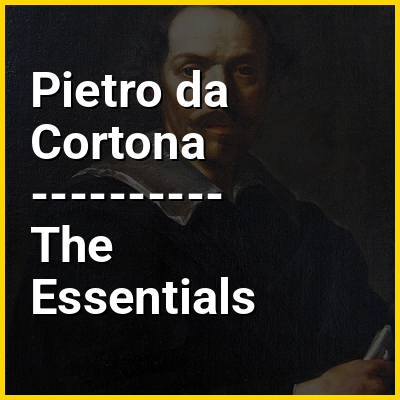
Pietro da Cortona (Italian: [ˈpjɛːtro da (k)korˈtoːna]; 1 November 1596 or 1597 – 16 May 1669) was an Italian Baroque painter and architect. Along with his contemporaries and rivals Gian Lorenzo Bernini and Francesco Borromini, he was one of the key figures in the emergence of Roman Baroque architecture. He was also an important designer of interior decorations.

He was born Pietro Berrettini, but is primarily known by the name of his native town of Cortona in Tuscany. He worked mainly in Rome and Florence. He is best known for his frescoed ceilings, such as the vault of the salone or main salon of the Palazzo Barberini in Rome and carried out extensive painting and decorative schemes for the Medici family in Florence and for the Oratorian fathers at the church of Santa Maria in Vallicella in Rome. He also painted numerous canvases. Only a limited number of his architectural projects were built, but nonetheless they are as distinctive and as inventive as those of his rivals.
↓ Menu

>>>PUT SHARE BUTTONS HERE<<<
In this Dossier

Pietro da Cortona in the context of Luca Giordano

Luca Giordano (18 October 1634 – 3 January 1705) was an Italian late-Baroque painter and printmaker in etching. Giordano was one of the most celebrated artists of the Neapolitan Baroque, whose vast output included altarpieces, mythological paintings and many decorative fresco cycles in both palaces and churches. He moved away from the dark manner of early 17th-century Neapolitan art as practised by Caravaggio and his followers and Jusepe de Ribera, and, drawing on the ideas of many other artists, above all the 16th-century Venetians and Pietro da Cortona, he introduced a new sense of light and glowing colour, of movement and dramatic action. He was internationally successful and travelled widely, working in Naples, Rome, Florence, and Venice, before spending a decade in Spain.

↑ Return to Menu

Pietro da Cortona in the context of Guardian angel

A guardian angel is a type of angel that is assigned to protect and guide a particular person, group or nation. Belief in tutelary beings can be traced throughout all antiquity. The idea of angels that guard over people played a major role in Ancient Judaism. In Christianity, the hierarchy of angels was extensively developed in the 5th century by Pseudo-Dionysius the Areopagite. The theology of angels and tutelary spirits has undergone many changes since the 5th century. The belief is that guardian angels serve to protect whichever person God assigns them to. The Memorial of the Holy Guardian Angels is celebrated on 2 October.

The idea of a guardian angel is central to the 15th-century book The Book of the Sacred Magic of Abramelin the Mage by Abraham of Worms, a German Cabalist. In 1897, this book was translated into English by Samuel Liddell MacGregor Mathers (1854–1918), a co-founder of the Hermetic Order of the Golden Dawn, who styled the guardian angel as the Holy Guardian Angel.

↑ Return to Menu

Pietro da Cortona in the context of Golden age

The term Golden Age comes from Greek mythology, particularly the Works and Days of Hesiod, and is part of the description of temporal decline of the state of peoples through five Ages, Gold being the first and the one during which the Golden Race of humanity (Greek: χρύσεον γένος chrýseon génos) lived. After the end of the first age was the Silver, then the Bronze, after this the Heroic age, with the fifth and current age being Iron.

By extension, "Golden Age" denotes a period of primordial peace, harmony, stability, and prosperity. During this age, peace and harmony prevailed in that people did not have to work to feed themselves for the earth provided food in abundance. They lived to a very old age with a youthful appearance, eventually dying peacefully, with spirits living on as "guardians". Plato in Cratylus (397 e) recounts the golden race of humans who came first. He clarifies that Hesiod did not mean literally made of gold, but good and noble.

↑ Return to Menu

Pietro da Cortona in the context of Sebastiano Ricci

Sebastiano Ricci (1 August 1659 – 15 May 1734) was an Italian Baroque painter of the late Baroque period in Venetian painting. About the same age as Piazzetta, and an elder contemporary of Tiepolo, he represents a late version of the vigorous and luminous Cortonesque style of grand manner fresco painting.

He was the uncle of Marco Ricci (1676 – 1730), who trained with him, and became an innovator in landscape painting.

↑ Return to Menu

Pietro da Cortona in the context of Borromini

Francesco Borromini (/ˌbɒrəˈmni/, Italian: [franˈtʃesko borroˈmiːni]), byname of Francesco Castelli (Italian: [kaˈstɛlli]; 25 September 1599 – 2 August 1667), was an Italian architect born in the modern Swiss canton of Ticino who, with his contemporaries Gian Lorenzo Bernini and Pietro da Cortona, was a leading figure in the emergence of Roman Baroque architecture.

A keen student of the architecture of Michelangelo and the ruins of Antiquity, Borromini developed an inventive and distinctive, if somewhat idiosyncratic, architecture employing manipulations of Classical architectural forms, geometrical rationales in his plans, and symbolic meanings in his buildings. His soft lead drawings are particularly distinctive. He seems to have had a sound understanding of structures that perhaps Bernini and Cortona lacked, as they were principally trained in other areas of the visual arts. He appears to have been a self-taught scholar, amassing a large library by the end of his life.

↑ Return to Menu

Pietro da Cortona in the context of Alessandro Algardi

Alessandro Algardi (July 31, 1598 – June 10, 1654) was an Italian high-Baroque sculptor active almost exclusively in Rome. In the latter decades of his life, he was, along with Francesco Borromini and Pietro da Cortona, one of the major rivals of Gian Lorenzo Bernini, in Rome. He is now most admired for his portrait busts that have great vivacity and dignity.

↑ Return to Menu

Pietro da Cortona in the context of Accademia di San Luca

The Accademia di San Luca (English: Academy of Saint Luke) is an Italian academy of artists in Rome. The establishment of the Accademia de i Pittori e Scultori di Roma was approved by papal brief in 1577, and in 1593 Federico Zuccari became its first principe or director; the statutes were ratified in 1607. Other founders included Girolamo Muziano and Pietro Olivieri. The Academy was named for Luke the Evangelist, the patron saint of painters.

From the late sixteenth century until it moved to its present location at the Palazzo Carpegna, it was based in an urban block by the Roman Forum and although these buildings no longer survive, the Academy church of Santi Luca e Martina, does. Designed by the Baroque architect, Pietro da Cortona, its main façade overlooks the Forum.

↑ Return to Menu