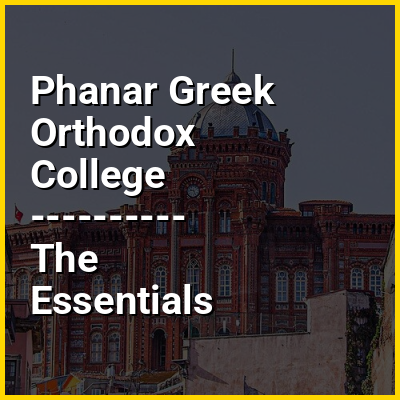
Phanar Greek Orthodox College or Phanar Roman Orthodox Lyceum (Turkish: Özel Fener Rum Lisesi), known in Greek as the Great School of the Nation and Patriarchal Academy of Constantinople (Greek: Μεγάλη του Γένους Σχολή, Megáli toú Genous Scholí), is the oldest surviving and most prestigious Greek Orthodox school in Istanbul, Turkey.
HINT:
In this Dossier
- ⭐ Core Definition: Phanar Greek Orthodox College
- Phanar Greek Orthodox College in the context of Greeks in Turkey
- Phanar Greek Orthodox College in the context of Demetrius Nicolaides
- Phanar Greek Orthodox College in the context of Phanariot Greeks
- Phanar Greek Orthodox College in the context of Phanariotes
- Phanar Greek Orthodox College in the context of Phanariots
Phanar Greek Orthodox College in the context of Greeks in Turkey
The Greeks in Turkey constitute a small population of Greek and Greek-speaking Eastern Orthodox Christians who mostly live in Istanbul, as well as on the two islands of the western entrance to the Dardanelles: Imbros and Tenedos (Turkish: Gökçeada and Bozcaada). Greeks are one of the four ethnic minorities officially recognized in Turkey by the 1923 Treaty of Lausanne, together with Jews, Armenians, and Bulgarians.
They are the remnants of the estimated 200,000 Greeks who were permitted under the provisions of the Convention Concerning the Exchange of Greek and Turkish Populations to remain in Turkey following the 1923 population exchange, which involved the forcible resettlement of approximately 1.2 million Greeks from Anatolia and East Thrace and of half a million Turks from all of Greece except for Western Thrace. After years of persecution (e.g. the Varlık Vergisi, the Istanbul Pogrom and the 1964 expulsion of Istanbul Greeks), emigration of ethnic Greeks from the Istanbul region greatly accelerated, reducing the Greek minority population from 119,822 before the 1955 pogrom to about 7,000 by 1978. The 2008 figures released by the Turkish Foreign Ministry places the current number of Turkish citizens of Greek descent at the 3,000–4,000 mark.However, according to the Human Rights Watch the Greek population in Turkey is estimated at 2,500 in 2006. The Greek population in Turkey is collapsing as the community is now far too small to sustain itself demographically, due to emigration, much higher death rates than birth rates and continuing discrimination.
View the full Wikipedia page for Greeks in TurkeyPhanar Greek Orthodox College in the context of Demetrius Nicolaides
Demetrius Nicolaides (Greek: Δημήτριος Νικολαΐδης Dimitrios Nikolaidis; French: Démétrius Nicolaïdes; c. 1843 – 3 July 1915), also known as Nikolaidis Efendi, was an Ottoman Greek journalist and compiler of legislation. Johann Strauss, author of A Constitution for a Multilingual Empire: Translations of the Kanun-ı Esasi and Other Official Texts into Minority Languages, wrote that Nicolaides was "an extremely active but somewhat enigmatic figure in the press life of 19th century Istanbul".
Nicolaides was born and raised in Ottoman Constantinople (now Istanbul) and attended the Great School of the Nation (Megalē tou Genous scholē), from which he graduated in 1861. His family was the Ieromnimon.
View the full Wikipedia page for Demetrius NicolaidesPhanar Greek Orthodox College in the context of Phanariot Greeks
Phanariots, Phanariotes, or Fanariots (Greek: Φαναριώτες, Romanian: Fanarioți, Turkish: Fenerliler) were members of prominent Greek families in Phanar (Φανάρι, modern Fener), the chief Greek quarter of Constantinople where the Ecumenical Patriarchate is located, who traditionally occupied four important positions in the Ottoman Empire: Hospodar of Moldavia, Hospodar of Wallachia, Grand Dragoman of the Porte and Grand Dragoman of the Fleet. Despite their cosmopolitanism and often-Western education, the Phanariots were aware of their Greek ancestry and culture; according to Nicholas Mavrocordatos' Philotheou Parerga, "We are a race completely Hellenic".
They emerged as a class of wealthy Greek merchants (of mostly noble Byzantine descent) during the second half of the 16th century, and were influential in the administration of the Ottoman Empire's Balkan domains in the 18th century. The Phanariots usually built their houses in the Phanar quarter to be near the court of the Patriarch, who (under the Ottoman millet system) was recognized as the spiritual and secular head (millet-bashi) of the Orthodox subjects—the Rum Millet, or "Roman nation" of the empire, except those under the spiritual care of the Patriarchs of Antioch, Jerusalem, Alexandria, Ohrid and Peć—often acting as archontes of the Ecumenical See. They dominated the administration of the patriarchate, often intervening in the selection of hierarchs (including the Ecumenical Patriarch of Constantinople).
View the full Wikipedia page for Phanariot GreeksPhanar Greek Orthodox College in the context of Phanariotes
Phanariots, Phanariotes, or Fanariots (Greek: Φαναριώτες, Romanian: Fanarioți, Turkish: Fenerliler) were members of prominent Greek families in Phanar (Φανάρι, modern Fener), the chief Greek quarter of Constantinople where the Ecumenical Patriarchate is located, who traditionally occupied four important positions in the Ottoman Empire: Hospodar of Moldavia, Hospodar of Wallachia, Grand Dragoman of the Porte and Grand Dragoman of the Fleet. Despite their cosmopolitanism and often-Western education, the Phanariots were aware of their Greek ancestry and culture; according to Nicholas Mavrocordatos’s Philotheou Parerga, "We are a race completely Hellenic".
They emerged as a class of wealthy Greek merchants (of mostly noble Byzantine descent) during the second half of the 16th century, and were influential in the administration of the Ottoman Empire's Balkan domains in the 18th century. The Phanariots usually built their houses in the Phanar quarter to be near the court of the Patriarch, who (under the Ottoman millet system) was recognized as the spiritual and secular head (millet-bashi) of the Orthodox subjects—the Rum Millet, or "Roman nation" of the empire, except those under the spiritual care of the Patriarchs of Antioch, Jerusalem, Alexandria, Ohrid and Peć—often acting as archontes of the Ecumenical See. They dominated the administration of the patriarchate, often intervening in the selection of hierarchs (including the Ecumenical Patriarch of Constantinople).
View the full Wikipedia page for PhanariotesPhanar Greek Orthodox College in the context of Phanariots
Phanariots, Phanariotes, or Fanariots (Greek: Φαναριώτες, Romanian: Fanarioți, Turkish: Fenerliler) were members of prominent Greek families in Phanar (Φανάρι, modern Fener), the chief Greek quarter of Constantinople where the Ecumenical Patriarchate is located, who traditionally occupied four important positions in the Ottoman Empire: Hospodar of Moldavia, Hospodar of Wallachia, Grand Dragoman of the Porte and Grand Dragoman of the Fleet. Despite their cosmopolitanism and often-Western education, the Phanariots were aware of their Greek ancestry and culture; according to Nicholas Mavrocordatos's Philotheou Parerga, "We are a race completely Hellenic".
They emerged as a class of wealthy Greek merchants (of mostly noble Byzantine descent) during the second half of the 16th century, and were influential in the administration of the Ottoman Empire's Balkan domains in the 18th century. The Phanariots usually built their houses in the Phanar quarter to be near the court of the Patriarch, who (under the Ottoman millet system) was recognized as the spiritual and secular head (millet-bashi) of the Orthodox subjects—the Rum Millet, or "Roman nation" of the empire, except those under the spiritual care of the Patriarchs of Antioch, Jerusalem, Alexandria, Ohrid and Peć—often acting as archontes of the Ecumenical See. They dominated the administration of the patriarchate, often intervening in the selection of hierarchs (including the Ecumenical Patriarch of Constantinople).
View the full Wikipedia page for Phanariots