Peter Stuyvesant in the context of "Religious pluralism"

Play Trivia Questions online!

or

Skip to study material about Peter Stuyvesant in the context of "Religious pluralism"

Ad spacer

⭐ Core Definition: Peter Stuyvesant

Peter Stuyvesant (c. 1610 – August 1672) was a Dutch colonial administrator who served as the director-general of New Netherland from 1647 to 1664, when the colony was provisionally ceded to the Kingdom of England. He was a major figure in the history of New York City and his name has been given to various landmarks and points of interest throughout the city (e.g. Stuyvesant High School, Stuyvesant Town, Bedford–Stuyvesant neighborhood, etc.).

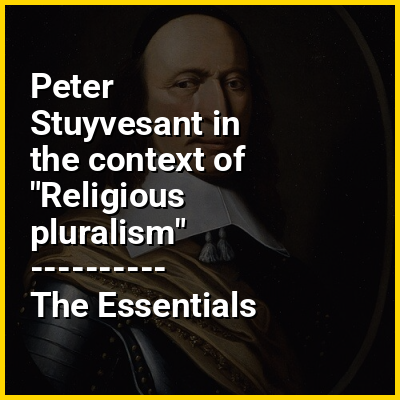
Stuyvesant's accomplishments as director-general of New Netherland included a great expansion for the settlement of New Amsterdam beyond the southern tip of Manhattan. Among the projects built by Stuyvesant's administration were the protective wall on Wall Street, the canal that became Broad Street, and Broadway. Stuyvesant, himself a member of the Dutch Reformed Church, opposed religious pluralism and came into conflict with Lutherans, Jews, Roman Catholics, and Quakers as they attempted to build places of worship in the city and practice their faiths.
↓ Menu

>>>PUT SHARE BUTTONS HERE<<<
In this Dossier

Peter Stuyvesant in the context of Province of New York

The Province of New York was a British proprietary colony and later a royal colony on the northeast coast of North America from 1664 to 1783. It extended from Long Island on the Atlantic, up the Hudson River and Mohawk River valleys to the Great Lakes and North to the colonies of New France and claimed lands further west.

In 1664, Charles II of England and his brother James, Duke of York raised a fleet to take the Dutch colony of New Netherland, then under the Directorship of Peter Stuyvesant. Stuyvesant surrendered to the English fleet without recognition from the Dutch West India Company. The province was renamed for the Duke of York, as its proprietor. England's rule was established de facto following military control in 1664, and became established de jure as sovereign rule in 1667 in the Treaty of Breda and the Treaty of Westminster (1674). It was not until 1674 that English common law was applied in the colony.

↑ Return to Menu

Peter Stuyvesant in the context of Fort Amsterdam

Fort Amsterdam (later Fort George, among other names) was a fortification on the southern tip of Manhattan Island at the confluence of the Hudson and East rivers in what is now New York City. The fort and the island were the center of trade and the administrative headquarters for the Dutch rule of the colony of New Netherland and thereafter British rule of the Province of New York. The fort was the nucleus of the settlement on the island which was at first named New Amsterdam and is central to New York's early history.

Before the fort was constructed, it was the scene where the purchase of Manhattan Island occurred. In its subsequent history, the fort was known under various names such as Fort James, Fort Willem Hendrick and its anglicized Fort William Henry, Fort Anne, and Fort George. The fort changed hands eight times in various battles, the first episode involving Dutch Governor Peter Stuyvesant, who surrendered the fort to Richard Nicolls of England in 1664. In the 18th century, the fort was at the center of the Stamp Act riots in New York when it was used to store shipments of stamped paper brought over from England, while serving as a safe haven for a number of stamp tax collectors. During the American Revolution, it was involved in the Battle of Brooklyn, when volleys were exchanged between the fort and British emplacements on Governor's Island. After 165 years of service, involving a number of conflicts, the fort was finally torn down in 1790 after the American Revolution. After the fort's demolition, the Government House was constructed on the site as a possible house for the United States President. The site is now occupied by the Alexander Hamilton U.S. Custom House, which houses a branch of the National Museum of the American Indian; Bowling Green is nearby.

↑ Return to Menu

Peter Stuyvesant in the context of Capitulation (surrender)

Capitulation (Latin: capitulum, a little head or division; capitulare, to treat upon terms) is an agreement in time of war for the surrender to a hostile armed force of a particular body of troops, a town or a territory.

It is an ordinary incident of war, and therefore no previous instructions from the captors' government are required before finally settling the conditions of capitulation. The most usual of such conditions are freedom of religion and security of private property on one hand, and a promise not to bear arms within a certain period on the other.

↑ Return to Menu

Peter Stuyvesant in the context of Bowery

The Bowery (/ˈbaʊəri/) is a street and neighborhood in Lower Manhattan in New York City, New York. The street runs from Chatham Square at Park Row, Worth Street, and Mott Street in the south to Cooper Square at 4th Street in the north. The eponymous neighborhood runs roughly from the Bowery east to Allen Street and First Avenue, and from Canal Street north to Cooper Square/East Fourth Street. The neighborhood roughly overlaps with Little Australia. To the south is Chinatown, to the east are the Lower East Side and the East Village, and to the west are Little Italy and NoHo. It has historically been considered a part of the Lower East Side of Manhattan.

In the 17th century, the road branched off Broadway north of Fort Amsterdam at the tip of Manhattan to the homestead of Peter Stuyvesant, director-general of New Netherland. The street was known as Bowery Lane prior to 1807. "Bowery" is an anglicization of the Dutch bouwerie, derived from an antiquated Dutch word for "farm": In the 17th century the area contained many large farms.

↑ Return to Menu