Petar II Petrović-Njegoš in the context of "Turks in the Balkans"

Play Trivia Questions online!

or

Skip to study material about Petar II Petrović-Njegoš in the context of "Turks in the Balkans"

Ad spacer

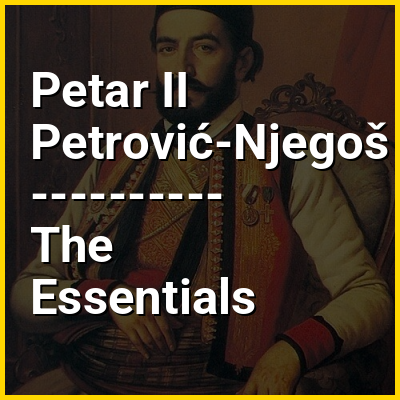
⭐ Core Definition: Petar II Petrović-Njegoš

Petar II Petrović-Njegoš (Serbian Cyrillic: Петар II Петровић-Његош, pronounced [pětar drûɡi pětroʋitɕ ɲêɡoʃ]; 13 November [O.S. 1 November] 1813 – 31 October [O.S. 19 October] 1851), commonly referred to simply as Njegoš (Његош), was a Prince-Bishop (vladika) of Montenegro, poet and philosopher whose works are widely considered some of the most important in Montenegrin and Serbian literature.

Njegoš was born in the village of Njeguši, near Montenegro's then-capital Cetinje. He was educated at several Serbian monasteries and became the country's spiritual and political leader following the death of his uncle Petar I. After eliminating all initial domestic opposition to his rule, he concentrated on uniting Montenegro's tribes and establishing a centralized state. He introduced regular taxation, formed a personal guard and implemented a series of new laws to replace those composed by his predecessor many years earlier. His taxation policies proved extremely unpopular with the tribes of Montenegro and were the cause of several revolts during his lifetime. Njegoš's reign was also defined by the constant political and military struggle with the Ottoman Empire, and by his attempts to expand Montenegro's territory while gaining unconditional recognition from the Sublime Porte. He was a proponent of uniting and liberating the Serb people, willing to concede his princely rights in exchange for a union with Serbia and his recognition as the religious leader of all Serbs (akin to a modern-day Patriarch of the Serbian Orthodox Church). Although unification between the two states did not occur during his lifetime, Njegoš laid some of the foundations of Yugoslavism and introduced modern political concepts to Montenegro. Venerated as a poet and philosopher, Njegoš is well known for his epic poem Gorski vijenac (The Mountain Wreath), which is considered a masterpiece of Serbian and other South Slavic literature, and the national epic of Serbia, Montenegro, and Yugoslavia. Njegoš has remained influential in Serbia and Montenegro, as well in neighboring countries.
↓ Menu

>>>PUT SHARE BUTTONS HERE<<<
In this Dossier

Petar II Petrović-Njegoš in the context of Balkan Turks

The Balkan Turks or Rumelian Turks (Turkish: Balkan Türkleri) are the Turkish people who have been living in the Balkans since Ottoman rule, as well as their descendants who still live in the region today. The Turks are officially recognized as a minority in Bosnia and Herzegovina, Bulgaria, Croatia, Kosovo, North Macedonia, and Romania; in Greece the Turkish minority is recognized as "Greek Muslims". Furthermore, the Turkish language has minority language status in Bosnia and Herzegovina, North Macedonia and Romania. The Ottoman Empire conquered parts of the Balkans between the 14th and the 16th centuries.

Historically, from the Ottoman conquest until the 19th century, ethnically non-Turkish, especially South Slavic Muslims of the Balkans were referred to in the local languages as Turks (term for Muslims). This usage is common in literature, such as in the works of Ivan Mažuranić and Petar II Petrović-Njegoš. Today, the largest mainly Muslim Slavic ethnic group is known as the Bosniaks followed by Pomaks.

↑ Return to Menu

Petar II Petrović-Njegoš in the context of Njegoš's Testament Church

The Njegoš's Testament Church (Serbian: Његошева завјетна црква, Njegoševa zavjetna crkva) was a Serbian Orthodox church at the site of modern-day Mausoleum of Njegoš located on the top of Lovćen, mountain and national park in southwestern Montenegro. It was a chapel dedicated to Saint Peter of Cetinje, built in 1845 according to the wishes of Petar II Petrović-Njegoš, with the desire to be buried there. Njegoš died on October 31, 1851, but was initially buried in the Cetinje Monastery out of fear that the Ottoman forces might desecrate his grave. His remains were later transferred to Lovćen on August 27, 1855. The Russian ethnographer Pavel Rovinsky attended a memorial service for Njegoš. The chapel was finally demolished in 1972 to make way for the construction of the Njegoš Mausoleum, completed in 1974.

↑ Return to Menu

Petar II Petrović-Njegoš in the context of Cetinje Monastery

The Cetinje Monastery (Serbian: Цетињски манастир, romanizedCetinjski manastir) is a monastery of the Serbian Orthodox Church in Montenegro. It is located in Cetinje and is the seat of the Metropolitanate of Montenegro. A center of historical and cultural importance, it was founded c. 1484 by Prince Ivan Crnojević of Zeta, and designated as the cathedral monastery of the Eparchy of Zeta. It was devastated in 1692, during the Morean War, and rebuilt between 1701 and 1704 by Metropolitan Danilo Petrović-Njegoš on the site of the former court of Ivan Crnojević.

There are several relics in the monastery: remains of St. Peter of Cetinje, right hand of John the Baptist, particles of the True Cross, icon of the Philermos Mother of God, remains of Petar II Petrović-Njegoš (relocated), bishop's crown of St. Peter of Cetinje, among others.

↑ Return to Menu

Petar II Petrović-Njegoš in the context of The Mountain Wreath

The Mountain Wreath (Serbian: Горски вијенац / Gorski vijenac) is a poem and a play written by Prince-Bishop and poet Petar II Petrović-Njegoš.

Njegoš wrote The Mountain Wreath during 1846 in Cetinje and published it the following year after the printing in an Armenian monastery in Vienna. It is a modern epic written in verse as a play, thus combining three of the major modes of literary expression. It is considered a masterpiece of Serbian and Montenegrin literature.

↑ Return to Menu