Permittivity in the context of "Permeability (electromagnetism)"

Play Trivia Questions online!

or

Skip to study material about Permittivity in the context of "Permeability (electromagnetism)"

Ad spacer

⭐ Core Definition: Permittivity

In electromagnetism, the absolute permittivity, often simply called permittivity and denoted by the Greek letter ε (epsilon), is a measure of the electric polarizability of a dielectric material. A material with high permittivity polarizes more in response to an applied electric field than a material with low permittivity, thereby storing more energy in the material. In electrostatics, the permittivity plays an important role in determining the capacitance of a capacitor.

In the simplest case, the electric displacement field D resulting from an applied electric field E is

↓ Menu

>>>PUT SHARE BUTTONS HERE<<<
In this Dossier

Permittivity in the context of Electric constant

Vacuum permittivity, commonly denoted ε0 (pronounced "epsilon nought" or "epsilon zero"), is the value of the absolute dielectric permittivity of classical vacuum. It may also be referred to as the permittivity of free space, the electric constant, or the distributed capacitance of the vacuum. It is an ideal (baseline) physical constant. Its CODATA value is:

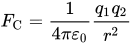
It is a measure of how dense of an electric field is "permitted" to form in response to electric charges and relates the units for electric charge to mechanical quantities such as length and force. For example, the force between two separated electric charges with spherical symmetry (in the vacuum of classical electromagnetism) is given by Coulomb's law:Here, q1 and q2 are the charges, r is the distance between their centres, and the value of the constant fraction 1/(4πε0) is approximately 9×10 N⋅m⋅C. Likewise, ε0 appears in Maxwell's equations, which describe the properties of electric and magnetic fields and electromagnetic radiation, and relate them to their sources. In electrical engineering, ε0 itself is used as a unit to quantify the permittivity of various dielectric materials.

↑ Return to Menu

Permittivity in the context of Medium (optics)

In optics, an optical medium is material through which light and other electromagnetic waves propagate. It is a form of transmission medium. The permittivity and permeability of the medium define how electromagnetic waves propagate in it.

↑ Return to Menu

Permittivity in the context of Capacitance

Capacitance is the ability of an object to store electric charge. It is measured by the change in charge in response to a difference in electric potential, expressed as the ratio of those quantities. Commonly recognized are two closely related notions of capacitance: self capacitance and mutual capacitance. An object that can be electrically charged exhibits self capacitance, for which the electric potential is measured between the object and ground. Mutual capacitance is measured between two components, and is particularly important in the operation of the capacitor, an elementary linear electronic component designed to add capacitance to an electric circuit.

The capacitance between two conductors depends only on the geometry; the opposing surface area of the conductors and the distance between them; and the permittivity of any dielectric material between them. For many dielectric materials, the permittivity, and thus the capacitance, is independent of the potential difference between the conductors and the total charge on them.

↑ Return to Menu

Permittivity in the context of Capacitance probe

Capacitance sensors (or Dielectric sensors) use capacitance to measure the dielectric permittivity of a surrounding medium. The configuration is like the neutron probe where an access tube made of PVC is installed in the soil; probes can also be modular (comb-like) and connected to a logger. The sensing head consists of an oscillator circuit, the frequency is determined by an annular electrode, fringe-effect capacitor, and the dielectric constant of the soil. Each capacitor sensor consists of two metal rings mounted on the circuit board at some distance from the top of the access tube. These rings are a pair of electrodes, which form the plates of the capacitor with the soil acting as the dielectric in between. The plates are connected to an oscillator, consisting of an inductor and a capacitor. The oscillating electrical field is generated between the two rings and extends into the soil medium through the wall of the access tube. The capacitor and the oscillator form a circuit, and changes in dielectric constant of surrounding media are detected by changes in the operating frequency. The capacitance sensors are designed to oscillate in excess of 100 MHz inside the access tube in free air. The output of the sensor is the frequency response of the soil’s capacitance due to its soil moisture level.

↑ Return to Menu

Permittivity in the context of Magnetic permeability

In electromagnetism, permeability is the measure of magnetization produced in a material in response to an applied magnetic field. Permeability is typically represented by the (italicized) Greek letter μ. It is the ratio of the magnetic induction to the magnetizing field in a material. The term was coined by William Thomson, 1st Baron Kelvin in 1872, and used alongside permittivity by Oliver Heaviside in 1885. The reciprocal of permeability is magnetic reluctivity.

In SI units, permeability is measured in henries per meter (H/m), or equivalently in newtons per ampere squared (N/A). The permeability constant μ0, also known as the magnetic constant or the permeability of free space, is the proportionality between magnetic induction and magnetizing force when forming a magnetic field in a classical vacuum.

↑ Return to Menu

Permittivity in the context of Tensor

In mathematics, a tensor is an algebraic object that describes a multilinear relationship between sets of algebraic objects associated with a vector space. Tensors may map between different objects such as vectors, scalars, and even other tensors. There are many types of tensors, including scalars and vectors (which are the simplest tensors), dual vectors, multilinear maps between vector spaces, and even some operations such as the dot product. Tensors are defined independent of any basis, although they are often referred to by their components in a basis related to a particular coordinate system; those components form an array, which can be thought of as a high-dimensional matrix.

Tensors have become important in physics, because they provide a concise mathematical framework for formulating and solving physics problems in areas such as mechanics (stress, elasticity, quantum mechanics, fluid mechanics, moment of inertia, etc.), electrodynamics (electromagnetic tensor, Maxwell tensor, permittivity, magnetic susceptibility, etc.), and general relativity (stress–energy tensor, curvature tensor, etc.). In applications, it is common to study situations in which a different tensor can occur at each point of an object. For example, the stress within an object may vary from one location to another. A family of tensors, that vary across space in this way, is a tensor field. In some areas, tensor fields are so ubiquitous that they are often simply called "tensors".

↑ Return to Menu