Pentacle in the context of "Talisman"

Play Trivia Questions online!

or

Skip to study material about Pentacle in the context of "Talisman"


⭐ Core Definition: Pentacle

A pentacle (also spelled and pronounced as pantacle in Thelema, following Aleister Crowley, though that spelling ultimately derived from Éliphas Lévi) is a talisman that is used in magical evocation, and is usually made of parchment, paper, cloth, or metal (although it can be of other materials), upon which a magical design is drawn. Symbols may also be included (sometimes on the reverse), a common one being the six-point form of the Seal of Solomon.

Pentacles may be sewn to the chest of one's garment, or may be flat objects that hang from one's neck or are placed flat upon the ground or altar. Pentacles are almost always shaped as disks or flat circles. In the Hermetic Order of the Golden Dawn, though, a pentacle is placed within the triangle of evocation.
↓ Menu

In this Dossier

Pentacle in the context of Wicca

Wicca (English: /ˈwɪkə/), is a modern pagan, syncretic, Earth-centred religion. Considered a new religious movement by scholars of religion, the path evolved from Western esotericism, developed in England during the first half of the 20th century, and was introduced to the public in 1954 by Gerald Gardner, a retired British civil servant. Wicca draws upon ancient pagan and 20th-century Hermetic motifs for theological and ritual purposes. Doreen Valiente joined Gardner in the 1950s, further building Wicca's liturgical tradition of beliefs, principles, and practices, disseminated through published books as well as secret written and oral teachings passed along to initiates.

Many variations of the religion have grown and evolved over time, associated with a number of diverse lineages, sects, and denominations, referred to as traditions, each with its own organisational structure and level of centralisation. Given its broadly decentralised nature, disagreements arise over the boundaries that define Wicca. Some traditions, collectively referred to as British Traditional Wicca (BTW), strictly follow the initiatory lineage of Gardner and consider Wicca specific to similar traditions, excluding newer, eclectic traditions. Other traditions, as well as scholars of religion, apply Wicca as a broad term for a religion with denominations that differ on some key points but share core beliefs and practices.

↑ Return to Menu

Pentacle in the context of Pentagram

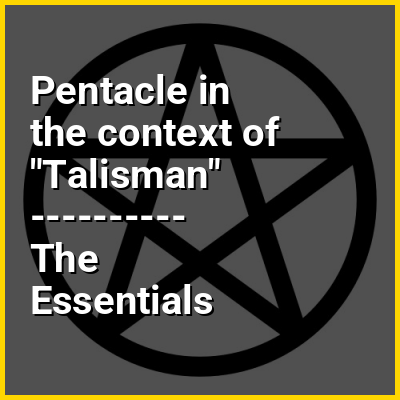
A pentagram (sometimes known as a pentalpha, pentangle, or star pentagon) is a regular five-pointed star polygon, formed from the diagonal line segments of a convex (or simple, or non-self-intersecting) regular pentagon. Drawing a circle around the five points creates a similar symbol referred to as the pentacle, which is used widely by Wiccans and in paganism, or as a sign of life and connections.

The word pentagram comes from the Greek word πεντάγραμμον (pentagrammon), from πέντε (pente), "five" + γραμμή (grammē), "line".The word pentagram refers to just the star and the word pentacle refers to the star within a circle, although there is some overlap in usage. The word pentalpha is a 17th-century revival of a post-classical Greek name of the shape.

↑ Return to Menu