Penal labour in the context of "Forced labor"

Play Trivia Questions online!

or

Skip to study material about Penal labour in the context of "Forced labor"

Ad spacer

⭐ Core Definition: Penal labour

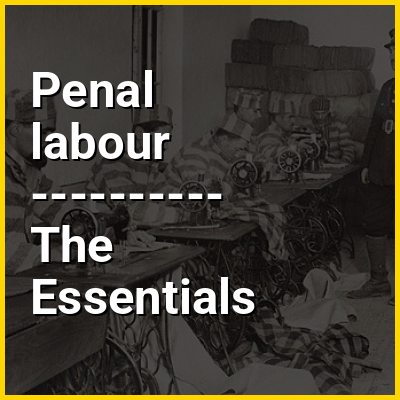
Penal labour or prison labour is a term for various kinds of forced labour that prisoners are required to perform, typically manual labour. The work may be light or hard, depending on the context. Forms of sentence involving penal labour have included involuntary servitude, penal servitude, and imprisonment with hard labour. The term may refer to several related scenarios: labour as a form of punishment, the prison system used as a means to secure labour, and labour as providing occupation for convicts. These scenarios are sometimes applied to those imprisoned for political, religious, war, or other reasons as well as to criminal convicts.

Large-scale implementations of penal labour include labour camps, prison farms, penal colonies, penal military units, penal transportation, or aboard prison ships.

↓ Menu

>>>PUT SHARE BUTTONS HERE<<<
In this Dossier

Penal labour in the context of Penal colony

A penal colony or exile colony is a settlement used to exile prisoners and separate them from the general population by placing them in a remote location, often an island or distant colonial territory. Although the term can be used to refer to a correctional facility located in a remote location, it is more commonly used to refer to communities of prisoners overseen by wardens or governors having absolute authority.

Historically, penal colonies have often been used for penal labour in an economically underdeveloped part of a state's (usually colonial) territories, and on a far larger scale than a prison farm.

↑ Return to Menu

Penal labour in the context of Unfree labour

Forced labour, or unfree labour, is any work relation, especially in modern or early modern history, in which people are employed against their will with the threat of destitution, detention, or violence, including death or other forms of extreme hardship to either themselves or members of their families.

Unfree labour includes all forms of slavery, penal labour, and the corresponding institutions, such as debt slavery, serfdom, corvée and labour camps.

↑ Return to Menu

Penal labour in the context of Hammersmith Ghost murder case

The Hammersmith Ghost murder case of 1804 set a legal precedent in the UK regarding self-defence: that someone could be held liable for their actions even if they were the consequence of a mistaken belief.

Near the end of 1803, many people claimed to have seen or even been attacked by a ghost in the Hammersmith area of London, a ghost believed by locals to be the spirit of a suicide victim. On January 3, 1804, a 29-year-old excise officer named Francis Smith, a member of one of the armed patrols set up in the wake of the reports, shot and killed a bricklayer, Thomas Millwood, mistaking the white clothes of Millwood's trade for the shroud of a ghostly apparition. Smith was found guilty of murder and sentenced to death, later commuted to one year's hard labour.

↑ Return to Menu

Penal labour in the context of Penal military unit

A penal military unit, also known as a penal formation, disciplinary unit, or just penal unit (usually named for their formation and size, such as penal battalion for battalions, penal regiment for regiments, penal company for companies, etc.), is a military formation consisting of convicts mobilized for military service. Such formations may consist of military prisoners convicted under military law, civilian prisoners convicted in civilian courts, prisoners of war who have chosen to side with their captors, or a combination of these groups.

Service in penal military units is generally considered a form of punishment, discipline, or penal labour, used in lieu of, or offered as an alternative to, imprisonment or capital punishment. Penal units have historically been used as disposable cannon fodder, treated poorly or with little regard and used in compromising or dangerous situations (commonly suicide missions such as demining or forlorn hope advance parties), as march battalions that maintain replacement personnel as reserves, or kept in the rear for military operations other than war or menial labour relating to the war effort, guarded and overseen by regular military units, military police, or barrier troops to ensure they do not attempt to escape, retreat, or mutiny. However, this is not always the case: some penal units are treated the same as regular units and, depending on military organization, a dedicated penal unit may not exist at all, with convicts instead being placed in a regular unit. Rewards and incentives for convicts to serve in a penal unit vary—often expungement, commutation, stay of execution, or a pardon—though penal units used as punishment typically lack those by nature.
↑ Return to Menu

Penal labour in the context of Festungshaft

Festungshaft (English: fortress confinement; Latin: custodia honesta, lit.'honorary custody') was a privileged custodial sentence in Germany from the 16th century until 1970. It also existed in some neighbouring territories and states.

Fortress confinement was a sentence which was generally seen as not conferring dishonour; it granted the sentenced person wide-ranging liberties, and carried no obligation to penal labour.

↑ Return to Menu