Partition of a set in the context of Equivalence classes


Partition of a set in the context of Equivalence classes

Partition of a set Study page number 1 of 2

Play TriviaQuestions Online!

or

Skip to study material about Partition of a set in the context of "Equivalence classes"


⭐ Core Definition: Partition of a set

In mathematics, a partition of a set is a grouping of its elements into non-empty subsets, in such a way that every element is included in exactly one subset.

Every equivalence relation on a set defines a partition of this set, and every partition defines an equivalence relation. A set equipped with an equivalence relation or a partition is sometimes called a setoid, typically in type theory and proof theory.

↓ Menu
HINT:

πŸ‘‰ Partition of a set in the context of Equivalence classes

In mathematics, when the elements of some set have a notion of equivalence (formalized as an equivalence relation), then one may naturally split the set into equivalence classes. These equivalence classes are constructed so that elements and belong to the same equivalence class if, and only if, they are equivalent.

↓ Explore More Topics
In this Dossier

Partition of a set in the context of Axiom of choice

In mathematics, the axiom of choice, abbreviated AC or AoC, is an axiom of set theory. Informally put, the axiom of choice says that given any collection of non-empty sets, it is possible to construct a new set by choosing one element from each set, even if the collection is infinite. Formally, it states that for every indexed family of nonempty sets, there exists an indexed set such that for every . The axiom of choice was formulated in 1904 by Ernst Zermelo in order to formalize his proof of the well-ordering theorem.The axiom of choice is equivalent to the statement that every partition has a transversal.

In many cases, a set created by choosing elements can be made without invoking the axiom of choice, particularly if the number of sets from which to choose the elements is finite, or if a canonical rule on how to choose the elements is available β€” some distinguishing property that happens to hold for exactly one element in each set. An illustrative example is sets picked from the natural numbers. From such sets, one may always select the smallest number, e.g. given the sets {{4, 5, 6}, {10, 12}, {1, 400, 617, 8000}}, the set containing each smallest element is {4, 10, 1}. In this case, "select the smallest number" is a choice function. Even if infinitely many sets are collected from the natural numbers, it will always be possible to choose the smallest element from each set to produce a set. That is, the choice function provides the set of chosen elements. But no definite choice function is known for the collection of all non-empty subsets of the real numbers. In that case, the axiom of choice must be invoked.

View the full Wikipedia page for Axiom of choice
↑ Return to Menu

Partition of a set in the context of Dichotomy

A dichotomy (/daΙͺˈkΙ’tΙ™mi/) is a partition of a whole (or a set) into two parts (subsets). In other words, this couple of parts must be

If there is a concept A, and it is split into parts B and not-B, then the parts form a dichotomy: they are mutually exclusive, since no part of B is contained in not-B and vice versa, and they are jointly exhaustive, since they cover all of A, and together again give A.

View the full Wikipedia page for Dichotomy
↑ Return to Menu

Partition of a set in the context of Quantile

In statistics and probability, quantiles are cut points dividing the range of a probability distribution into continuous intervals with equal probabilities or dividing the observations in a sample in the same way. There is one fewer quantile than the number of groups created. Common quantiles have special names, such as quartiles (four groups), deciles (ten groups), and percentiles (100 groups). The groups created are termed halves, thirds, quarters, etc., though sometimes the terms for the quantile are used for the groups created, rather than for the cut points.

q-quantiles are values that partition a finite set of values into q subsets of (nearly) equal sizes. There are q βˆ’ 1 partitions of the q-quantiles, one for each integer k satisfying 0 < k < q. In some cases the value of a quantile may not be uniquely determined, as can be the case for the median (2-quantile) of a uniform probability distribution on a set of even size. Quantiles can also be applied to continuous distributions, providing a way to generalize rank statistics to continuous variables (see percentile rank). When the cumulative distribution function of a random variable is known, the q-quantiles are the application of the quantile function (the inverse function of the cumulative distribution function) to the values {1/q, 2/q, …, (q βˆ’ 1)/q}.

View the full Wikipedia page for Quantile
↑ Return to Menu

Partition of a set in the context of Up to

Two mathematical objects a and b are called "equal up to an equivalence relation R"

  • if a and b are related by R, that is,
  • if aRb holds, that is,
  • if the equivalence classes of a and b with respect to R are equal.

This figure of speech is mostly used in connection with expressions derived from equality, such as uniqueness or count.For example, "x is unique up to R" means that all objects x under consideration are in the same equivalence class with respect to the relation R.

View the full Wikipedia page for Up to
↑ Return to Menu

Partition of a set in the context of Stratified sampling

In statistics, stratified sampling is a method of sampling from a population which can be partitioned into subpopulations.

In statistical surveys, when subpopulations within an overall population vary, it could be advantageous to sample each subpopulation (stratum) independently.

View the full Wikipedia page for Stratified sampling
↑ Return to Menu

Partition of a set in the context of Interior (topology)

In mathematics, specifically in topology,the interior of a subset S of a topological space X is the union of all subsets of S that are open in X.A point that is in the interior of S is an interior point of S.The interior of S is the complement of the closure of the complement of S.In this sense interior and closure are dual notions.

The exterior of a set S is the complement of the closure of S; it consists of the points that are in neither the set nor its boundary.The interior, boundary, and exterior of a subset together partition the whole space into three blocks (or fewer when one or more of these is empty).

View the full Wikipedia page for Interior (topology)
↑ Return to Menu

Partition of a set in the context of Dedekind cut

In mathematics, Dedekind cuts, named after German mathematician Richard Dedekind (but previously considered by Joseph Bertrand), are Π° method of constructing the real numbers from the rational numbers. A Dedekind cut is a partition of the rational numbers into two sets A and B, such that each element of A is less than every element of B, and A contains no greatest element. The set B may or may not have a smallest element among the rationals. If B has a smallest element among the rationals, the cut corresponds to that rational. Otherwise, that cut defines a unique irrational number which, loosely speaking, fills the "gap" between A andΒ B. In other words, A contains every rational number less than the cut, and B contains every rational number greater than or equal to the cut. An irrational cut is equated to an irrational number which is in neither set. Every real number, rational or not, is equated to one and only one cut of rationals.

Dedekind cuts can be generalized from the rational numbers to any totally ordered set by defining a Dedekind cut as a partition of a totally ordered set into two non-empty parts A and B, such that A is closed downwards (meaning that for all a in A, x ≀ a implies that x is in A as well) and B is closed upwards, and A contains no greatest element. See also completeness (order theory).

View the full Wikipedia page for Dedekind cut
↑ Return to Menu

Partition of a set in the context of Equivalence relation

In mathematics, an equivalence relation is a binary relation that is reflexive, symmetric, and transitive. The equipollence relation between line segments in geometry is a common example of an equivalence relation. A simpler example is numerical equality. Any number is equal to itself (reflexive). If , then (symmetric). If and , then (transitive).

Each equivalence relation provides a partition of the underlying set into disjoint equivalence classes. Two elements of the given set are equivalent to each other if and only if they belong to the same equivalence class.

View the full Wikipedia page for Equivalence relation
↑ Return to Menu

Partition of a set in the context of Terminal and nonterminal symbols

In formal languages, terminal and nonterminal symbols are parts of the vocabulary under a formal grammar. Vocabulary is a finite, nonempty set of symbols. Terminal symbols are symbols that cannot be replaced by other symbols of the vocabulary. Nonterminal symbols are symbols that can be replaced by other symbols of the vocabulary by the production rules under the same formal grammar.

A formal grammar defines a formal language over the vocabulary of the grammar.

View the full Wikipedia page for Terminal and nonterminal symbols
↑ Return to Menu

Partition of a set in the context of Piecewise

In mathematics, a piecewise function (also called a piecewise-defined function, a hybrid function, or a function defined by cases) is a function whose domain is partitioned into several intervals ("subdomains") on which the function may be defined differently. Piecewise definition is actually a way of specifying the function, rather than a characteristic of the resulting function itself, as every function whose domain contains at least two points can be rewritten as a piecewise function. The first three paragraphs of this article only deal with this first meaning of "piecewise".

Terms like piecewise linear, piecewise smooth, piecewise continuous, and others are also very common. The meaning of a function being piecewise , for a property , is roughly that the domain of the function can be partitioned into pieces on which the property holds, but this term is used slightly differently by different authors. Unlike the first meaning, this is a property of the function itself and not only a way to specify it. Sometimes the term is used in a more global sense involving triangulations; see Piecewise linear manifold.

View the full Wikipedia page for Piecewise
↑ Return to Menu

Partition of a set in the context of Bell number

In combinatorial mathematics, the Bell numbers count the possible partitions of a set. These numbers have been studied by mathematicians since the 19th century, and their roots go back to medieval Japan. In an example of Stigler's law of eponymy, they are named after Eric Temple Bell, who wrote about them in the 1930s.

The Bell numbers are denoted , where is an integer greater than or equal to zero. Starting with , the first few Bell numbers are

View the full Wikipedia page for Bell number
↑ Return to Menu

Partition of a set in the context of Enumerative combinatorics

Enumerative combinatorics is an area of combinatorics that deals with the number of ways that certain patterns can be formed. Two examples of this type of problem are counting combinations and counting permutations. More generally, given an infinite collection of finite sets Si indexed by the natural numbers, enumerative combinatorics seeks to describe a counting function which counts the number of objects in Sn for each n. Although counting the number of elements in a set is a rather broad mathematical problem, many of the problems that arise in applications have a relatively simple combinatorial description. The twelvefold way provides a unified framework for counting permutations, combinations and partitions.

The simplest such functions are closed formulas, which can be expressed as a composition of elementary functions such as factorials, powers, and so on. For instance, as shown below, the number of different possible orderings of a deck of n cards is f(n) = n!. The problem of finding a closed formula is known as algebraic enumeration, and frequently involves deriving a recurrence relation or generating function and using this to arrive at the desired closed form.

View the full Wikipedia page for Enumerative combinatorics
↑ Return to Menu

Partition of a set in the context of Voronoi cell

In mathematics, a Voronoi diagram is a partition of a plane into regions close to each of a given set of objects. It can be classified also as a tessellation. In the simplest case, these objects are just finitely many points in the plane (called seeds, sites, or generators). For each seed there is a corresponding region, called a Voronoi cell, consisting of all points of the plane closer to that seed than to any other. The Voronoi diagram of a set of points is dual to that set's Delaunay triangulation.

The Voronoi diagram is named after mathematician Georgy Voronoy, and is also called a Voronoi tessellation, a Voronoi decomposition, a Voronoi partition, or a Dirichlet tessellation (after Peter Gustav Lejeune Dirichlet). Voronoi cells are also known as Thiessen polygons, after Alfred H. Thiessen. Voronoi diagrams have practical and theoretical applications in many fields, mainly in science and technology, but also in visual art.

View the full Wikipedia page for Voronoi cell
↑ Return to Menu

Partition of a set in the context of Discrete global grid

A discrete global grid (DGG) is a mosaic that covers the entire Earth's surface.Mathematically it is a space partitioning: it consists of a set of non-empty regions that form a partition of the Earth's surface. In a usual grid-modeling strategy, to simplify position calculations, each region is represented by a point, abstracting the grid as a set of region-points. Each region or region-point in the grid is called a cell.

When each cell of a grid is subject to a recursive partition, resulting in a "series of discrete global grids with progressively finer resolution", forming a hierarchical grid, it is called a hierarchical DGG (sometimes "global hierarchical tessellation"or "DGG system").

View the full Wikipedia page for Discrete global grid
↑ Return to Menu

Partition of a set in the context of Conditional expectation

In probability theory, the conditional expectation, conditional expected value, or conditional mean of a random variable is its expected value evaluated with respect to the conditional probability distribution. If the random variable can take on only a finite number of values, the "conditions" are that the variable can only take on a subset of those values. More formally, in the case when the random variable is defined over a discrete probability space, the "conditions" are a partition of this probability space.

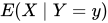
Depending on the context, the conditional expectation can be either a random variable or a function. The random variable is denoted analogously to conditional probability. The function form is either denoted or a separate function symbol such as is introduced with the meaning .

View the full Wikipedia page for Conditional expectation
↑ Return to Menu

Partition of a set in the context of Strict weak ordering

In mathematics, especially order theory, a weak ordering is a mathematical formalization of the intuitive notion of a ranking of a set, some of whose members may be tied with each other. Weak orders are a generalization of totally ordered sets (rankings without ties) and are in turn generalized by (strictly) partially ordered sets and preorders.

There are several common ways of formalizing weak orderings, that are different from each other but cryptomorphic (interconvertable with no loss of information): they may be axiomatized as strict weak orderings (strictly partially ordered sets in which incomparability is a transitive relation), as total preorders (transitive binary relations in which at least one of the two possible relations exists between every pair of elements), or as ordered partitions (partitions of the elements into disjoint subsets, together with a total order on the subsets). In many cases another representation called a preferential arrangement based on a utility function is also possible.

View the full Wikipedia page for Strict weak ordering
↑ Return to Menu