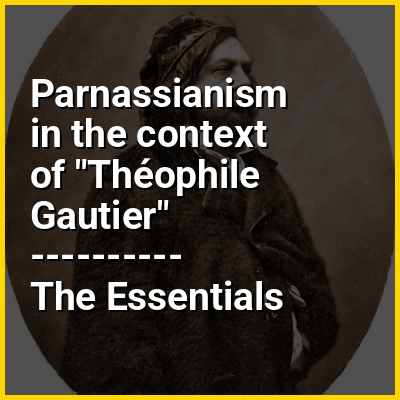
Parnassianism (or Parnassism) was a group of French poets that began during the positivist period of the 19th century (1860s–1890s), occurring after romanticism and prior to symbolism. The style was influenced by the author Théophile Gautier as well as by the philosophical ideas of Arthur Schopenhauer.
HINT:
In this Dossier
- ⭐ Core Definition: Parnassianism
- Parnassianism in the context of Paul Verlaine
- Parnassianism in the context of Brazilian National Anthem
- Parnassianism in the context of Modernismo
Parnassianism in the context of Paul Verlaine
Paul-Marie Verlaine (/vɛərˈlɛn/ vair-LEN; French: [pɔl maʁi vɛʁlɛn]; 30 March 1844 – 8 January 1896) was a French poet, writer and critic associated with the Symbolist, Parnassianist, and Decadent movements. He is considered one of the paramount exponents of the fin de siècle in French and international poetry.
Born in Metz to a petit-bourgeois family, Verlaine bore a lifelong interest in the arts, whether literary, musical or visual. His début collection, Poèmes saturniens (1866), were released at the age of twenty-two; they were published by Alphonse Lemerre. Verlaine's tempestuous sexual relationship with young poet Arthur Rimbaud (ten years his junior and under eighteen years, and while he himself had a wife and infant son), a member of the Zutistes, aroused great controversy; the couple peregrinated throughout England and Belgium until their split in 1873, which was caused by him wounding Rimbaud with a revolver. Following trial, Verlaine was sentenced to two years in prison for battery and sodomy. During his sentence, Verlaine reverted to practising Catholicism and composed Sagesse (published 1880), Jadis et naguère (published 1884) and Parallèlement (published 1889). As his reputation grew, he became increasingly haunted by guilt and paranoia, lapsing into depression, alcohol and chemical abuse and disease, culminating in his death in Paris from acute pneumonia.
View the full Wikipedia page for Paul VerlaineParnassianism in the context of Brazilian National Anthem
The "Brazilian National Anthem" (Hino Nacional Brasileiro), also known as the National anthem of Brazil, was composed by Francisco Manuel da Silva in 1831 and had been given at least two sets of unofficial lyrics before a 1922 decree by president Epitácio Pessoa gave the anthem its definitive, official lyrics, by Joaquim Osório Duque-Estrada, after several changes were made to his proposal, written in 1909.
The lyrics have been described as Parnassian in style and Romantic in content.
View the full Wikipedia page for Brazilian National AnthemParnassianism in the context of Modernismo
Modernismo is a literary movement that took place primarily during the end of the nineteenth and early 20th century in the Spanish-speaking world, best exemplified by Rubén Darío, who is known as the father of modernismo. The term modernismo specifically refers to the literary movement that took place primarily in poetry. This literary movement began in 1888 after the publication of Rubén Darío's Azul.... It gave modernismo a new meaning. The movement died out around 1920, four years after the death of Rubén Darío. In Aspects of Spanish-American Literature, Arturo Torres-Ríoseco writes (1963),
Other notable exponents are Leopoldo Lugones, Manuel Gutiérrez Nájera, José Asunción Silva, Julio Herrera y Reissig, Julián del Casal, Manuel González Prada, Aurora Cáceres, Delmira Agustini, Manuel Díaz Rodríguez and José Martí. It is a recapitulation and blending of three European currents: Romanticism, Symbolism and especially Parnassianism. Inner passions, visions, harmonies and rhythms are expressed in a rich, highly stylized verbal music. This movement was of great influence in the whole Hispanic world (including the Philippines), finding a temporary vogue also among the Generation of '98 in Spain, which posited various reactions to its perceived aestheticism.
View the full Wikipedia page for Modernismo