Paris Observatory in the context of "French Academy of Sciences"

Play Trivia Questions online!

or

Skip to study material about Paris Observatory in the context of "French Academy of Sciences"


⭐ Core Definition: Paris Observatory

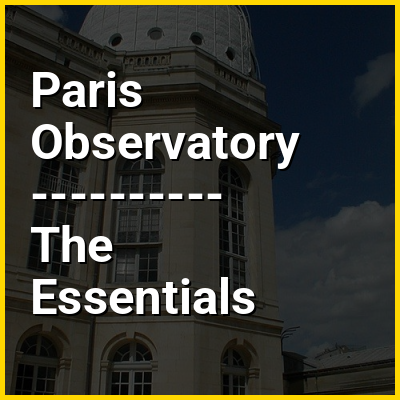
The Paris Observatory (French: Observatoire de Paris, pronounced [ɔbsɛʁvatwaʁ d(ə) paʁi]), a research institution of the Paris Sciences et Lettres University, is the foremost astronomical observatory of France, and one of the largest astronomical centres in the world. Its historic building is on the Left Bank of the Seine in central Paris, but most of the staff work on a satellite campus in Meudon, a suburb southwest of Paris.

The Paris Observatory was founded in 1667 as the first public observatory. Construction was completed by the early 1670s and coincided with a major push for increased science, and the founding of the Royal Academy of Sciences. King Louis XIV's minister of finance organized a "scientific powerhouse" to increase understanding of astronomy, maritime navigation, and science in general.
↓ Menu

👉 Paris Observatory in the context of French Academy of Sciences

The French Academy of Sciences (French: Académie des sciences, [akademi de sjɑ̃s]) is a learned society, founded in 1666 by Louis XIV at the suggestion of Jean-Baptiste Colbert, to encourage and protect the spirit of French scientific research. It was at the forefront of scientific developments in Europe in the 17th and 18th centuries, and is one of the earliest Academies of Sciences.

Currently headed by Patrick Flandrin (President of the academy), it is one of the five Academies of the Institut de France.

↓ Explore More Topics
In this Dossier

Paris Observatory in the context of Jean Baptiste Joseph Delambre

Jean Baptiste Joseph, chevalier Delambre (19 September 1749 – 19 August 1822) was a French mathematician, astronomer, historian of astronomy, and geodesist. He was also director of the Paris Observatory, and author of well-known books on the history of astronomy from ancient times to the 18th century.

↑ Return to Menu

Paris Observatory in the context of Georges Rayet

Georges-Antoine-Pons Rayet (12 December 1839 – 14 June 1906) was a French astronomer.

He was born in Bordeaux, France. He began working at the Paris Observatory in 1863. He worked on meteorology in addition to astronomy. He specialized in what was then the new field of spectroscopy.

↑ Return to Menu

Paris Observatory in the context of Paris meridian

The Paris meridian is a meridian line running through the Paris Observatory in Paris, France – now longitude 2°20′14.02500″ East. It was a long-standing rival to the Greenwich meridian as the prime meridian of the world. The "Paris meridian arc" or "French meridian arc" (French: la Méridienne de France) is the name of the meridian arc measured along the Paris meridian.

The French meridian arc was important for French cartography, since the triangulations of France began with the measurement of the French meridian arc. Moreover, the French meridian arc was important for geodesy as it was one of the meridian arcs which were measured to determine the figure of the Earth via the arc measurement method. The determination of the figure of the Earth was a problem of the highest importance in astronomy, as the diameter of the Earth was the unit to which all celestial distances had to be referred.

↑ Return to Menu

Paris Observatory in the context of Claude Perrault

Claude Perrault (French pronunciation: [klod pɛʁo]; 25 September 1613 – 9 October 1688) was a French physician and amateur architect, best known for his participation in the design of the east façade of the Louvre in Paris. He also designed the Paris Observatory and was an anatomist and author who wrote treatises on architecture, physics, and natural history.

His brother, Charles Perrault, is remembered as the classic reteller of the old story of Cinderella among other fables.

↑ Return to Menu

Paris Observatory in the context of 14th arrondissement of Paris

The 14th arrondissement of Paris (French: XIV arrondissement [katɔʁzjɛm aʁɔ̃dismɑ̃]), officially named arrondissement de l'Observatoire (IPA: [aʁɔ̃dismɑ̃ lɔpsɛʁvatwaʁ]; meaning "arrondissement of the Observatory"; named after the Paris Observatory), is one of the 20 arrondissements of Paris, the capital city of France.

It is situated on the left bank of the River Seine, containing most of the Montparnasse district. Although today Montparnasse is best known for its skyscraper, Tour Montparnasse, as well as its major railway terminus, Gare Montparnasse, both are only partially located in the neighbouring 15th arrondissement. The district has traditionally been home to many artists as well as a significant Breton community, which arrived at the beginning of the 20th century upon the creation of the Montparnasse railway terminus.

↑ Return to Menu

Paris Observatory in the context of Alexandre de Cassini

Viscount Alexandre Henri Gabriel (vicomte) de Cassini (9 May 1781 – 23 April 1832) was a French botanist and naturalist, who specialised in the sunflower family (Asteraceae) (then known as family Compositae).

He was the youngest of five children of Jean-Dominique, Comte de Cassini (Cassini IV), famous for completing the map of France, who had succeeded his father as the director of the Paris Observatory. He was also the great-great-grandson of famous Italian-French astronomer, Giovanni Domenico Cassini, discoverer of Jupiter's Great Red Spot and the Cassini division in Saturn's rings.

↑ Return to Menu