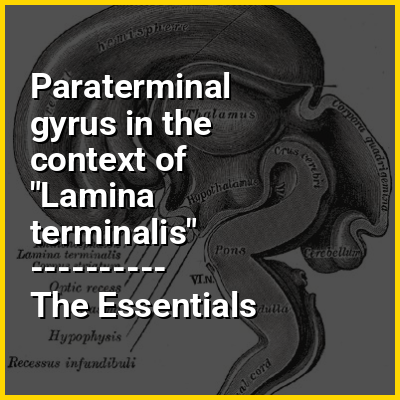
The subcallosal gyrus (paraterminal gyrus, peduncle of the corpus callosum) is a narrow lamina on the medial surface of the hemisphere in front of the lamina terminalis, behind the parolfactory area, and below the rostrum of the corpus callosum. It is continuous around the genu of the corpus callosum with the indusium griseum. It is also considered a part of limbic system of the brain.
HINT:
In this Dossier
Paraterminal gyrus in the context of Limbic lobe
The limbic lobe is an arc-shaped cortical region of the limbic system, on the medial surface of each cerebral hemisphere of the mammalian brain, consisting of parts of the frontal, parietal and temporal lobes. The term is ambiguous, with some authors including the paraterminal gyrus, the subcallosal area, the cingulate gyrus, the parahippocampal gyrus, the dentate gyrus, the hippocampus and the subiculum;
View the full Wikipedia page for Limbic lobe