Pappus of Alexandria in the context of "Greek mathematicians"

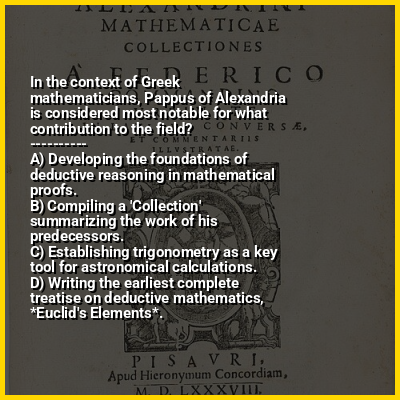
⭐ In the context of Greek mathematicians, Pappus of Alexandria is considered most notable for what contribution to the field?

Ad spacer

⭐ Core Definition: Pappus of Alexandria

Pappus of Alexandria (/ˈpæpəs/ ; Ancient Greek: Πάππος ὁ Ἀλεξανδρεύς; c. 290 – c.  350 AD) was a Greek mathematician of late antiquity known for his Synagoge (Συναγωγή) or Collection (c. 340), and for Pappus's hexagon theorem in projective geometry. Almost nothing is known about his life except for what can be found in his own writings, many of which are lost. Pappus apparently lived in Alexandria, where he worked as a mathematics teacher to higher level students, one of whom was named Hermodorus.

The Collection, his best-known work, is a compendium of mathematics in eight volumes, the bulk of which survives. It covers a wide range of topics that were part of the ancient mathematics curriculum, including geometry, astronomy, and mechanics.

↓ Menu

>>>PUT SHARE BUTTONS HERE<<<
In this Dossier

Pappus of Alexandria in the context of Greek mathematics

Ancient Greek mathematics refers to the history of mathematical ideas and texts in Ancient Greece during classical and late antiquity, mostly from the 5th century BC to the 6th century AD. Greek mathematicians lived in cities spread around the shores of the ancient Mediterranean, from Anatolia to Italy and North Africa, but were united by Greek culture and the Greek language. The development of mathematics as a theoretical discipline and the use of deductive reasoning in proofs is an important difference between Greek mathematics and those of preceding civilizations.

The early history of Greek mathematics is obscure, and traditional narratives of mathematical theorems found before the fifth century BC are regarded as later inventions. It is now generally accepted that treatises of deductive mathematics written in Greek began circulating around the mid-fifth century BC, but the earliest complete work on the subject is Euclid's Elements, written during the Hellenistic period. The works of renown mathematicians Archimedes and Apollonius, as well as of the astronomer Hipparchus, also belong to this period. In the Imperial Roman era, Ptolemy used trigonometry to determine the positions of stars in the sky, while Nicomachus and other ancient philosophers revived ancient number theory and harmonics. During late antiquity, Pappus of Alexandria wrote his Collection, summarizing the work of his predecessors, while Diophantus' Arithmetica dealt with the solution of arithmetic problems by way of pre-modern algebra. Later authors such as Theon of Alexandria, his daughter Hypatia, and Eutocius of Ascalon wrote commentaries on the authors making up the ancient Greek mathematical corpus.
↑ Return to Menu

Pappus of Alexandria in the context of Euclid

Euclid (/ˈjklɪd/; Ancient Greek: Εὐκλείδης; fl. 300 BC) was an ancient Greek mathematician active as a geometer and logician. Considered the "father of geometry", he is chiefly known for the Elements treatise, which established the foundations of geometry that largely dominated the field until the early 19th century. His system, now referred to as Euclidean geometry, involved innovations in combination with a synthesis of theories from earlier Greek mathematicians, including Eudoxus of Cnidus, Hippocrates of Chios, Thales and Theaetetus. With Archimedes and Apollonius of Perga, Euclid is generally considered among the greatest mathematicians of antiquity, and one of the most influential in the history of mathematics.

Very little is known of Euclid's life, and most information comes from the scholars Proclus and Pappus of Alexandria many centuries later. Medieval Islamic mathematicians invented a fanciful biography, and medieval Byzantine and early Renaissance scholars mistook him for the earlier philosopher Euclid of Megara. It is now generally accepted that he spent his career in Alexandria and lived around 300 BC, after Plato's students and before Archimedes. There is some speculation that Euclid studied at the Platonic Academy and later taught at the Musaeum; he is regarded as bridging the earlier Platonic tradition in Athens with the later tradition of Alexandria.

↑ Return to Menu

Pappus of Alexandria in the context of Apollonius of Perga

Apollonius of Perga (Ancient Greek: Ἀπολλώνιος ὁ Περγαῖος Apollṓnios ho Pergaîos; c. 240 BC – c. 190 BC) was an ancient Greek geometer and astronomer known for his work on conic sections. Beginning from the earlier contributions of Euclid and Archimedes on the topic, he brought them to the state prior to the invention of analytic geometry. His definitions of the terms ellipse, parabola, and hyperbola are the ones in use today. With his predecessors Euclid and Archimedes, Apollonius is generally considered among the greatest mathematicians of antiquity.

Aside from geometry, Apollonius worked on numerous other topics, including astronomy. Most of this work has not survived, where exceptions are typically fragments referenced by other authors like Pappus of Alexandria. His hypothesis of eccentric orbits to explain the apparently aberrant motion of the planets, commonly believed until the Middle Ages, was superseded during the Renaissance. The Apollonius crater on the Moon is named in his honor.

↑ Return to Menu

Pappus of Alexandria in the context of Pappus's hexagon theorem

In mathematics, Pappus's hexagon theorem (attributed to Pappus of Alexandria) states that

  • given one set of collinear points and another set of collinear points then the intersection points of line pairs and and and are collinear, lying on the Pappus line. These three points are the points of intersection of the "opposite" sides of the hexagon .

It holds in a projective plane over any field, but fails for projective planes over any noncommutative division ring. Projective planes in which the "theorem" is valid are called pappian planes.

↑ Return to Menu

Pappus of Alexandria in the context of Pandrosion

Pandrosion of Alexandria (Ancient Greek: Πανδροσίων) was a mathematician in fourth-century-AD Alexandria, discussed in the Mathematical Collection of Pappus of Alexandria and known for having possibly developed an approximate method for doubling the cube. She is likely the earliest known female mathematician.

↑ Return to Menu

Pappus of Alexandria in the context of Pappus's centroid theorem

In mathematics, Pappus's centroid theorem (also known as the Guldinus theorem, Pappus–Guldinus theorem or Pappus's theorem) is either of two related theorems dealing with the surface areas and volumes of surfaces and solids of revolution.

The theorems are attributed to Pappus of Alexandria and Paul Guldin. Pappus's statement of this theorem appears in print for the first time in 1659, but it was known before, by Kepler in 1615 and by Guldin in 1640.

↑ Return to Menu