Teodoro Cano Garcia (born 1932) is an artist from Papantla, Veracruz, Mexico who is best known for his mural work depicting the Totonac culture of his native region in northern Veracruz. Cano was discovered by Diego Rivera, who helped Cano as a youth enter the prestigious San Carlos Academy and then employed him as an assistant with the mural work being done at the Ciudad Universitaria in Mexico City. Cano painted his first solo mural in 1953, and since then has produced paintings, murals, sculptures, photography, book illustrations and more, including creating a high relief technique with a cement base. However, Cano is best known for his mural work which depicts and promotes the Totonac culture, and much of his work can be seen in his hometown, including a monumental sculpture of a Volador dancer overlooking the city. Cano also worked as an academic for over 36 years, recently retiring, but he continues to work as an artist based in Xalapa.
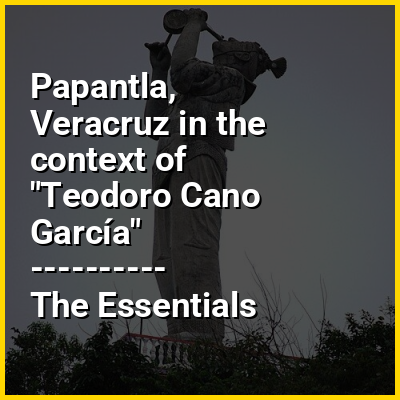
- 👉 Papantla, Veracruz in the context of Teodoro Cano García
- Papantla, Veracruz in the context of Totonacapan
Papantla, Veracruz in the context of Totonacapan
Totonacapan refers to the historical extension where the Totonac people of Mexico dominated, as well as to a region in the modern states of Veracruz and Puebla. The historical territory was much larger than the currently named region, extending from the Cazones River in the north to the Papaloapan River in the south and then west from the Gulf of Mexico into what is now the Sierra Norte de Puebla region and into parts of Hidalgo. When the Spanish arrived, the Totonac ethnicity dominated this large region, although they themselves were dominated by the Aztec Empire. For this reason, they allied with Hernán Cortés against Tenochtitlán. However, over the colonial period, the Totonac population and territory shrank, especially after 1750 when mestizos began infiltrating Totonacapan, taking political and economic power. This continued into the 19th and 20th centuries, prompting the division of most of historical Totonacpan between the states of Puebla and Veracruz. Today, the term refers only to a region in the north of Veracruz where Totonac culture is still important. This region is home to the El Tajín and Cempoala archeological sites as well as Papantla, which is noted for its performance of the Danza de los Voladores.
View the full Wikipedia page for Totonacapan