Pak Hon-yong in the context of Kim Kyu-sik


Pak Hon-yong in the context of Kim Kyu-sik

⭐ Core Definition: Pak Hon-yong

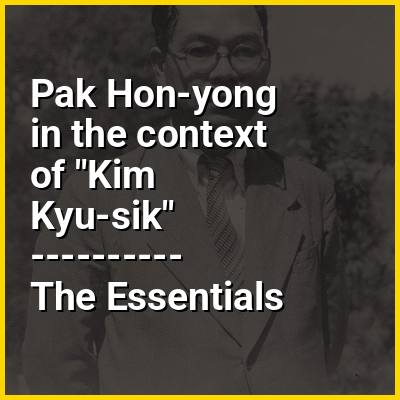
Pak Hon-yong (Korean박헌영; Hanja朴憲永; 28 May 1900 – 18 December 1955), courtesy name Togyong (덕영), was a Korean independence activist, politician, philosopher, communist activist and one of the main leaders of the Korean communist movement during Japan's colonial rule (1910–1945).

During the Japanese occupation of Korea, he tried to organize the Korean Communist Party. When the Japanese authorities cracked down on the party, he went into hiding. After Korea's liberation, August 1945, he set up the Communist Party of Korea in the South, but under pressure from American authorities he moved to North Korea (then People's Committee of North Korea) in April 1948. He attended a meeting with Kim Ku and Kim Kyu-sik on the subject of Korean reunification.

↓ Menu
HINT:

In this Dossier

Pak Hon-yong in the context of General Secretary of the Workers' Party of Korea

The general secretary of the Workers' Party of Korea (Korean조선로동당 총비서) is the leader of the Workers' Party of Korea (WPK), the ruling party in North Korea, and the country's supreme leader. Party rules stipulate that the party congress elects the general secretary. The party conference and the Central Committee are empowered to remove and elect the party leader. The general secretary is ex officio chairman of the WPK Central Military Commission and leads the work of the secretariat. Additionally, the general secretary is by right of office a member of the WPK Presidium, the WPK Politburo and the WPK Secretariat.

The office traces its lineage back to the reestablishment of the Communist Party of Korea (CPK) on 14 September 1945 when Pak Hon-yong was elected Chairman of the CPK Central Committee. Later on 13 October 1945 the CPK established an internal North Korean Branch Bureau (NKBB) and nominated Hyon Chun-hyok as branch secretary. Hyon Chun-hyok was assassinated on 3 September 1945 and Kim Yong-bom was elected as branch secretary in his place. On 10 April 1946 the NKBB became independent of the CPK and changed its name to Communist Party of North Korea (CPNK). Later that year, on 30 August, the CPNK merged with the New People's Party of Korea to establish the Workers' Party of North Korea (WPNK). Kim Tu-bong was elected WPNK Chairman by the 1st WPNK Central Committee. In the meantime the Workers' Party of South Korea (WPSK) was established through the merger of the Communist Party of South Korea (led by Pak Hon-yong), New People's Party of Korea and a faction of the People's Party of Korea on 24 November 1946. The WPSK Central Committee elected Ho Hon as its party chairman. On the merger of the WPNK and the WPSK on 24 June 1949, the 2nd Central Committee elected Kim Il Sung as Chairman of the WPK Central Committee.

View the full Wikipedia page for General Secretary of the Workers' Party of Korea
↑ Return to Menu

Pak Hon-yong in the context of Communist Party of Korea

The Communist Party of Korea (Korean조선공산당; Hanja朝鮮共產黨; MRChosŏn Kongsandang) was a communist party in Korea founded during a secret meeting in Seoul in 1925. The Governor-General of Korea had banned communist and socialist parties under the Peace Preservation Law so the party had to operate in a clandestine manner. The leaders of the party were Kim Yong-bom and Pak Hon-yong.

Kim Il Sung led the foundation of the Workers' Party of North Korea while Pak Hon-yong led the foundation of the Workers' Party of South Korea.

View the full Wikipedia page for Communist Party of Korea
↑ Return to Menu

Pak Hon-yong in the context of 2nd Central Committee of the Workers' Party of Korea

The 2nd Central Committee (2nd CC) of the Workers' Party of Korea (WPK) was elected at the 2nd Congress on 30 March 1948, and remained in session until the election of the 3rd Central Committee on 29 April 1956. In between party congresses and specially convened conferences the Central Committee is the highest decision-making institution in the WPK and North Korea. The 2nd Central Committee was not a permanent institution and delegated day-to-day work to elected bodies, such as the Political Committee, the Standing Committee, the Organisation Committee and the Inspection Committee in this case. It convened meetings, known as "Plenary Session of the [term] Central Committee", to discuss major policies. Only full members had the right to vote, but if a full member could not attend a plenary session, the person's spot was taken over by an alternate. Plenary session could also be attended by non-members, such meetings are known as "Enlarged Plenary Session", to participate in the committee's discussions. During its tenure it held five plenary sessions, one enlarged session, seven joint plenary sessions and four stand-alone plenums.

A feature of North Korean politics was its factionalism. Four loosely defined factions were struggling for dominance; Kim Il Sung's partisans, domestic communists, the Yanan group and the Soviet Koreans. The 2nd CC, which consisted of 67 members and 20 alternate members, was divided along factional lines. Of the 67 members, 30 had served in the 1st Central Committee. Among those not reelected were Chon Song-hwa and Chong Tal-hyon from the domestic faction. The position of the partisan faction was strengthened, with Kang Kon, Kim Kwang-hyop, Kim Kyong-sok and Pak Kum-chol being elected to the 2nd Central Committee. Despite this, the domestic faction had the most representation on the 2nd CC. Further the 2nd CC reelected Yanan communist Kim Tu-bong as Chairman of the Central Committee while partisan Kim Il Sung and Chu Yong-ha from the domestic group were elected to the office of Vice Chairman. All the members of the 1st Political Committee were re-elected, while two new were added; Kim Chaek and Pak Il-u. Upon the merger of the Workers' Party of North Korea and the Workers' Party of South Korea (WPSK) on 24 June 1949, the 2nd Central Committee merged with the 1st WPSK Central Committee and gained 31 new members. The newly expanded 2nd CC elected Kim Il Sung as chairman and domestic communist Pak Hon-yong and Soviet Korean Ho Ka-i as vice chairmen. Also, Ho Ka-i with domestic communists (and former WPSK members) Yi Sung-yop and Kim Sam-yong were elected First, Second and Third Secretary respectively in charge of administrative affairs. Thirty-six individuals were re-elected to the 3rd Central Committee, of these 29 were original members of the WPNK's 2nd CC.

View the full Wikipedia page for 2nd Central Committee of the Workers' Party of Korea
↑ Return to Menu