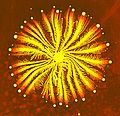
Paenibacillus is a genus of facultative anaerobic or aerobic, endospore-forming bacteria, originally included within the genus Bacillus, and then reclassified as a separate genus in 1993. Bacteria belonging to this genus have been detected in a variety of environments, such as soil, water, rhizosphere, vegetable matter, forage, and insect larvae, as well as clinical samples. The name reflects: Latin paene means almost, so the paenibacilli are literally "almost bacilli". The genus includes P. larvae, which causes American foulbrood in honeybees, P. polymyxa, which is capable of fixing nitrogen, so is used in agriculture and horticulture, the Paenibacillus sp. JDR-2 which is a rich source of chemical agents for biotechnology applications, and pattern-forming strains such as P. vortex and P. dendritiformis discovered in the early '90s, which develop complex colonies with intricate architectures as shown in the pictures:
-
 A colony generated by the chiral morphotype bacteria of P. dendritiformis: The colony diameter is 5 cm and the colors indicate the bacterial density (bright yellow for high density). The branches are curly with well-defined handedness.
 -
 A colony generated by P. vortex sp. bacteria: The colony diameter is 5 cm and the colors indicate the bacterial density (bright yellow for high density). The bright dots are the vortices described in the text.
 -
 A colony generated by the branching (tip splitting) morphotype bacteria of P. dendritiformis: The colony diameter is 6 cm and the colors indicate the bacterial density (darker shade for higher density).


