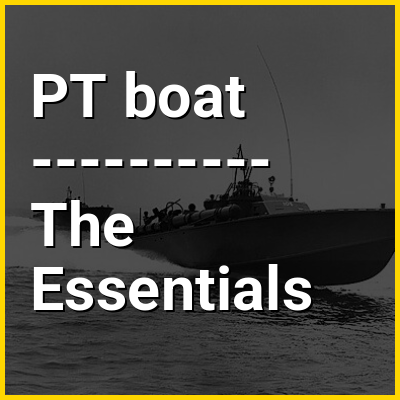
A PT boat (short for patrol torpedo boat) is a motor torpedo boat used by the United States Navy in World War II. These vessels were small, fast, and inexpensive to build, and were valued for their maneuverability and speed. However, PT boats were hampered at the beginning of the war by ineffective torpedoes, limited armament, and comparatively fragile construction that limited some of the variants to coastal waters. In the US Navy they were organized in Motor Torpedo Boat Squadrons (MTBRONs).
PT boats were very different from the first generation of torpedo boats, which had been developed at the end of the 19th century and featured a displacement hull form. These first generation torpedo boats rode low in the water, displaced up to 300 tons, and had a top speed of 25 to 27 kn (46 to 50 km/h). During World War I Italy, the US, and UK developed the first high-performance, gasoline-powered motor torpedo boats (often with top speeds over 40 kn (74 km/h)) and corresponding torpedo tactics, but these projects were all quickly disbanded after the Armistice. Design of World War II PT boats continued to exploit some of the advances in planing hull design borrowed from offshore powerboat racing and used multiple lightweight but more powerful marinized aircraft-derived V-12 engines, and thus were able to advance in both size and speed.