Overline in the context of Endpoint (geometry)


Overline in the context of Endpoint (geometry)

Overline Study page number 1 of 1

Play TriviaQuestions Online!

or

Skip to study material about Overline in the context of "Endpoint (geometry)"


⭐ Core Definition: Overline

An overline, overscore, or overbar, is a typographical feature of a horizontal line drawn immediately above the text. In old mathematical notation, an overline was called a vinculum, a notation for grouping symbols which is expressed in modern notation by parentheses, though it persists for symbols under a radical sign. The original use in Ancient Greek was to indicate compositions of Greek letters as Greek numerals. In Latin, it indicates Roman numerals multiplied by a thousand and it forms medieval abbreviations (sigla). Marking one or more words with a continuous line above the characters is sometimes called overstriking, though overstriking generally refers to printing one character on top of an already-printed character.

An overline, that is, a single line above a chunk of text, should not be confused with the macron, a diacritical mark placed above (or sometimes below) individual letters. The macron is narrower than the character box.

↓ Menu
HINT:

In this Dossier

Overline in the context of Line segment

In geometry, a line segment is a part of a straight line that is bounded by two distinct endpoints (its extreme points), and contains every point on the line that is between its endpoints. It is a special case of an arc, with zero curvature. The length of a line segment is given by the Euclidean distance between its endpoints. A closed line segment includes both endpoints, while an open line segment excludes both endpoints; a half-open line segment includes exactly one of the endpoints. In geometry, a line segment is often denoted using an overline (vinculum) above the symbols for the two endpoints, such as in AB.

Examples of line segments include the sides of a triangle or square. More generally, when both of the segment's end points are vertices of a polygon or polyhedron, the line segment is either an edge (of that polygon or polyhedron) if they are adjacent vertices, or a diagonal. When the end points both lie on a curve (such as a circle), a line segment is called a chord (of that curve).

View the full Wikipedia page for Line segment
↑ Return to Menu

Overline in the context of Degree of polymerization

The degree of polymerization, or DP, is the number of monomeric units in a macromolecule or polymer or oligomer molecule.

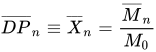
For a homopolymer, there is only one type of monomeric unit and the number-average degree of polymerization is given by ,where is the number-average molecular weight and is the molecular weight of the monomer unit. The overlines indicate arithmetic mean values. For most industrial purposes, degrees of polymerization in the thousands or tens of thousands are desired. This number does not reflect the variation in molecule size of the polymer that typically occurs, it only represents the mean number of monomeric units.

View the full Wikipedia page for Degree of polymerization
↑ Return to Menu

Overline in the context of Vinculum (symbol)

A vinculum (from Latin vinculum 'fetter, chain, tie') is a horizontal line used in mathematical notation for various purposes. It may be placed as an overline or underline above or below a mathematical expression to group the expression's elements. Historically, vincula were extensively used to group items together, especially in written mathematics, but in modern mathematics its use for this purpose has almost entirely been replaced by the use of parentheses. It was also used to mark Roman numerals whose values are multiplied by 1,000. Today, however, the common usage of a vinculum to indicate the repetend of a repeating decimal is a significant exception and reflects the original usage.

View the full Wikipedia page for Vinculum (symbol)
↑ Return to Menu

Overline in the context of Nomina sacra

In Christian scribal practice, nomina sacra (singular: nomen sacrum, Latin for 'sacred name') is the abbreviation of several frequently occurring divine names or titles, especially in Greek manuscripts of the Bible. A nomen sacrum consists of two or more letters from the original word spanned by an overline.

Biblical scholar and textual critic Bruce M. Metzger lists 15 such words treated as nomina sacra from Greek papyri: the Greek counterparts of God, Lord, Jesus, Christ, Son, Spirit, David, Cross, Mother, Father, Israel, Savior, Man, Jerusalem, and Heaven. These nomina sacra are all found in Greek manuscripts of the 3rd century and earlier, except Mother, which appears in the 4th. All 15 occur in Greek manuscripts later than the 4th century.

View the full Wikipedia page for Nomina sacra
↑ Return to Menu