Ottoman Dynasty in the context of "First Constitutional Era"

Play Trivia Questions online!

or

Skip to study material about Ottoman Dynasty in the context of "First Constitutional Era"

Ad spacer

⭐ Core Definition: Ottoman Dynasty

The Ottoman dynasty (Turkish: Osmanlı Hanedanı) consisted of the members of the imperial House of Osman (Ottoman Turkish: خاندان آل عثمان, romanizedḪānedān-ı Āl-i ʿOsmān), also known as the Ottomans (Turkish: Osmanlılar). According to Ottoman tradition, the family originated from the Kayı tribe branch of the Oghuz Turks, under the leadership of Osman I in northwestern Anatolia in the district of Bilecik, Söğüt. The Ottoman dynasty, named after Osman I, ruled the Ottoman Empire from c. 1299 to 1922.

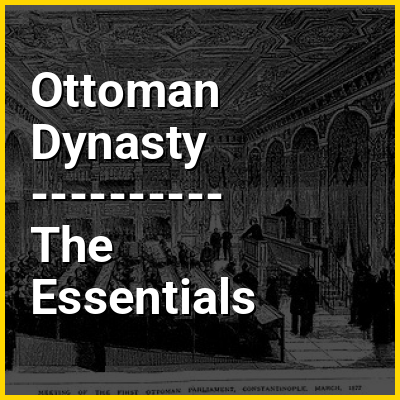
During much of the Empire's history, the sultan was the absolute regent, head of state, and head of government, though much of the power often shifted to other officials such as the Grand Vizier. During the First (1876–78) and Second Constitutional Eras (1908–20) of the late Empire, a shift to a constitutional monarchy was enacted, with the Grand Vizier taking on a prime ministerial role as head of government and heading an elected General Assembly.
↓ Menu

>>>PUT SHARE BUTTONS HERE<<<
In this Dossier

Ottoman Dynasty in the context of Rise of the Ottoman Empire

The rise of the Ottoman Empire is a period of history that started with the emergence of the Ottoman principality (Turkish: Osmanlı Beyliği) in c. 1299, and ended c. 1453. This period witnessed the foundation of a political entity ruled by the Ottoman Dynasty in the northwestern Anatolian region of Bithynia, and its transformation from a small principality on the Byzantine frontier into an empire spanning the Balkans, Caucasus, Anatolia, Middle East and North Africa. For this reason, this period in the empire's history has been described as the "Proto-Imperial Era". Throughout most of this period, the Ottomans were merely one of many competing states in the region, and relied upon the support of local warlords (Ghazis) and vassals (Beys) to maintain control over their realm. By the middle of the fifteenth century the Ottoman sultans were able to accumulate enough personal power and authority to establish a centralized imperial state, a process which was achieved by Sultan Mehmed II (r. 1451–1481– ). The conquest of Constantinople in 1453 is seen as the symbolic moment when the emerging Ottoman state shifted from a mere principality into an empire therefore marking a major turning point in its history.

The causes of Ottoman success cannot be attributed to any single factor, and they varied throughout the period as the Ottomans continually adapted to changing circumstances.

↑ Return to Menu

Ottoman Dynasty in the context of Battle of Nish (1443)

The Battle of Nish (early November 1443) was fought between the Crusaders led by John Hunyadi and Đurađ Branković and the Ottoman Empire led by Kasım Pasha. It saw the Crusaders capture the Ottoman stronghold of Nish (Niš) in Serbia, and defeat two armies of the Ottoman Empire. The Battle of Nish was part of Hunyadi's expedition known as the long campaign. Hunyadi, at the head of the vanguard, crossed the Balkans through the Gate of Trajan, captured Nish, defeated three Ottoman pashas, and after taking Sofia from the Ottomans, united with the royal army and defeated Sultan Murad II at Snaim (Kustinitza). The impatience of the king and the severity of the winter then compelled him (in February 1444) to return home.

↑ Return to Menu

Ottoman Dynasty in the context of Green Tomb

The Green Tomb (Turkish: Yeşil Türbe) is a mausoleum of the fifth Ottoman Sultan, Mehmed I, in Bursa, Turkey. It was built by Mehmed's son and successor Murad II following the death of the sovereign in 1421. The architect Hacı Ivaz Pasha designed the tomb and the Yeşil Mosque opposite to it.

In addition to the sultan's sarcophagus, it contains seven other tombs: those of his sons Mustafa, Mahmud and Yusuf, his daughters Selçuk, Ayşe and Sitti and his wet nurse (Daye Hatun).

↑ Return to Menu

Ottoman Dynasty in the context of Ottoman conquest of Anatolia

The rise of the Ottoman Empire is a period of history that started with the emergence of the Ottoman principality (Ottoman Turkish: Osmanlı Beyliği) in c. 1299, and ended c. 1453. This period witnessed the foundation of a political entity ruled by the Ottoman Dynasty in the northwestern Anatolian region of Bithynia, and its transformation from a small principality on the Byzantine frontier into an empire spanning the Balkans, Caucasus, Anatolia, Middle East and North Africa. For this reason, this period in the empire's history has been described as the "Proto-Imperial Era". Throughout most of this period, the Ottomans were merely one of many competing states in the region, and relied upon the support of local warlords (Ghazis) and vassals (Beys) to maintain control over their realm. By the middle of the fifteenth century the Ottoman sultans were able to accumulate enough personal power and authority to establish a centralized imperial state, a process which was achieved by Sultan Mehmed II (r. 1451–1481). The conquest of Constantinople in 1453 is seen as the symbolic moment when the emerging Ottoman state shifted from a mere principality into an empire therefore marking a major turning point in its history.

The causes of Ottoman success cannot be attributed to any single factor, and they varied throughout the period as the Ottomans continually adapted to changing circumstances.

↑ Return to Menu

Ottoman Dynasty in the context of French Ambassador to the Ottoman Empire

France had a permanent embassy to the Ottoman Empire beginning in 1535, during the time of King Francis I and Sultan Suleiman the Magnificent. It is considered to have been the direct predecessor of the modern-day embassy to the Republic of Turkey.

↑ Return to Menu