Orthophoto in the context of "Digital elevation model"

Play Trivia Questions online!

or

Skip to study material about Orthophoto in the context of "Digital elevation model"

Ad spacer

⭐ Core Definition: Orthophoto

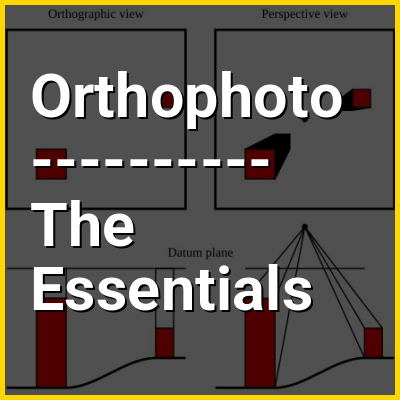
An orthophoto, orthophotograph, orthoimage or orthoimagery is an aerial photograph or satellite imagery geometrically corrected ("orthorectified") such that the scale is uniform: the photo or image follows a given map projection. Unlike an uncorrected aerial photograph, an orthophoto can be used to measure true distances, because it is an accurate representation of the Earth's surface, having been adjusted for topographic relief, lens distortion, and camera tilt.

Orthophotographs are commonly used in geographic information systems (GIS) as a "map accurate" background image. An orthorectified image differs from rubber sheeted rectifications as the latter may accurately locate a number of points on each image but stretch the area between so scale may not be uniform across the image. A digital elevation model (DEM) or topographic map is required to create an orthophoto, as distortions in the image due to the varying distance between the camera/sensor and different points on the ground need to be corrected. An orthoimage and a "rubber sheeted" image can both be said to have been georeferenced; however, the overall accuracy of the rectification varies. Software can display the orthophoto and allow an operator to digitize or place linework, text annotations or geographic symbols (such as hospitals, schools, and fire stations). Some software can process the orthophoto and produce the linework automatically.
↓ Menu

>>>PUT SHARE BUTTONS HERE<<<
In this Dossier

Orthophoto in the context of Instituto Geográfico Nacional (Spain)

The Instituto Geográfico Nacional (IGN), or National Geographic Institute is a Spanish government agency, dependent on the Spanish Ministry of Public Works. Founded in 1870, it is the national mapping agency for Spain, together with the Centro Nacional de Información Geográfica (CNIG).

Since 2015, most of its products (including MTN50 and MTN25 topographic maps, and PNOA aerial photographies) are freely available online, and licensed under a CC-BY-4.0-like license, as FOM/2807/2015 decree requires its products must be released under a free license.

↑ Return to Menu

Orthophoto in the context of Georeferencing

Georeferencing or georegistration is a type of coordinate transformation that binds a digital raster image or vector database that represents a geographic space (usually a scanned map or aerial photograph) to a spatial reference system, thus locating the digital data in the real world. It is thus the geographic form of image registration or image rectification. The term can refer to the mathematical formulas used to perform the transformation, the metadata stored alongside or within the image file to specify the transformation, or the process of manually or automatically aligning the image to the real world to create such metadata. The most common result is that the image can be visually and analytically integrated with other geographic data in geographic information systems and remote sensing software.

A number of mathematical methods are available, but the process typically involves identifying a sample of several ground control points (GCPs) with known locations on the image and the ground, then using curve fitting techniques to generate a parametric (or piecewise parametric) formula to transform the rest of the image. Once the parameters of the formula are stored, the image may be transformed dynamically at drawing time, or resampled to generate a georeferenced raster GIS file or orthophoto.

↑ Return to Menu