The Orinoco (Spanish pronunciation: [oɾiˈnoko]) is one of the longest rivers in South America at 2,140 km (1,330 mi). Its drainage basin, sometimes known as the Orinoquia, covers approximately 1,000,000 km (390,000 sq mi), with 65% of it in Venezuela and 35% in Colombia. It is the fourth largest river in the world by discharge volume of water (39,000 m/s (1,400,000 cu ft/s) at delta) due to the high precipitation throughout its catchment area (2,300 millimetres per are [0.084 in/sq ft]). The Orinoco River and its tributaries are the major transportation system for eastern and interior Venezuela and the Llanos of Colombia. The environment and wildlife in the Orinoco's basin are extremely diverse.
HINT:
👉 Orinoco River in the context of Orinoquía natural region
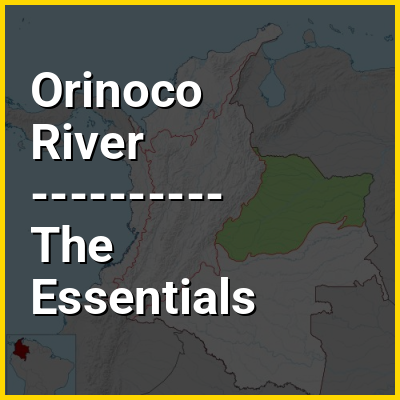
The Orinoquía region is one of the six natural regions of Colombia that belongs to the Orinoco River watershed. It is also known colloquially as the Eastern Plains (Llanos Orientales). The region covers most of the area of the departments of Arauca, Casanare, Meta, and Vichada and small parts of the Boyacá, Norte de Santander, and Cundinamarca departments.
In this Dossier
- ⭐ Core Definition: Orinoco River
- 👉 Orinoco River in the context of Orinoquía natural region
- Orinoco River in the context of Saladoid
- Orinoco River in the context of Orinoco Delta
- Orinoco River in the context of Lake Tota
- Orinoco River in the context of Cordillera de Mérida
- Orinoco River in the context of Guayuriba River
- Orinoco River in the context of Meta River
- Orinoco River in the context of Inírida River
Orinoco River in the context of Saladoid
The Saladoid culture is a pre-Columbian Indigenous culture of territory in present-day Venezuela and the Caribbean that flourished from 500 BCE to 545 CE. Concentrated along the lowlands of the Orinoco River, the people migrated by sea to the Lesser Antilles, and then to Puerto Rico.
View the full Wikipedia page for SaladoidOrinoco River in the context of Orinoco Delta
The Orinoco Delta is a vast river delta of the Orinoco River, located in eastern Venezuela. [1]
View the full Wikipedia page for Orinoco DeltaOrinoco River in the context of Lake Tota
Lake Tota (Spanish: Lago de Tota) is the largest lake in Colombia, located in the east of Boyacá department, inside the Sugamuxi Province, it is the source of the Upia River which flows into the Orinoco River basin.
The major town on the lake is Aquitania, located on its eastern side. Other nearby villages include Tota, Iza and Cuítiva.
View the full Wikipedia page for Lake TotaOrinoco River in the context of Cordillera de Mérida
The Cordillera de Mérida is a mountain range, or massif, in northwestern Venezuela. The Cordillera de Mérida is a northeastern extension of the Andes Mountains and the most important branch of the Venezuelan Andes. The range runs approximately 400 kilometers, from the Venezuela-Colombia border in the southwest to the Venezuelan Coastal Complex in the northeast. The Táchira depression separates the Cordillera de Mérida from the Cordillera Oriental, which forms the Colombia-Venezuela border.
The range spans about 40,000 square kilometers, covering most of Táchira, Mérida, and Trujillo states, and parts of Lara, Barinas, Portuguesa, Apure and Zulia states. The southeastern slopes are drained by tributaries of the Orinoco River, while the streams that drain the northwestern slopes empty into Lake Maracaibo. At the southwestern end of the range lies the city of San Cristóbal, while at the northeast tip lies the city of Barquisimeto and the headwaters of the River Cojedes.In the centre of the range is the city of Mérida, its namesake. Two subsidiary ranges of peaks lie on either side of the city: the Sierra de la Culata to the north and Sierra Nevada de Mérida to the south. Pico Bolívar, at 4,981 meters elevation (16,342 feet), is the highest peak in Venezuela.
View the full Wikipedia page for Cordillera de MéridaOrinoco River in the context of Guayuriba River
Guayuriba River is a river of Colombia. It is part of the Orinoco River basin.
View the full Wikipedia page for Guayuriba RiverOrinoco River in the context of Meta River
The Meta River is a major left tributary of the Orinoco River in eastern Colombia and southern Venezuela, South America. The Meta originates in the Eastern Ranges of the Andes and flows through the Meta Department, Colombia as the confluence of the Humea, Guatiquía and Guayuriba rivers. It flows east-northeastward across the Llanos Orientales ("Eastern Plains") of Colombia following the direction of the Meta Fault. The Meta forms the northern boundary of Vichada Department, first with Casanare Department, then with Arauca Department, and finally with Venezuela, down to Puerto Carreño where it flows into the Orinoco.
The Meta River is 1,100 km (680 mi) long and its drainage basin is 103,000 km (40,000 mi). The Meta divides the Colombian Llanos in two different parts: the western portion on the left bank is more humid, receives the relatively nutrient-rich sediments from the Andean mountain range and therefore soils and tributaries are also nutrient-rich, while the eastern portion, high plain or altillanura, drains not to the Meta river but to the Orinoco, has a longer dry season and soils and surface waters are oligotrophic (nutrient poor).
View the full Wikipedia page for Meta RiverOrinoco River in the context of Inírida River
The Inírida (Spanish pronunciation: [iˈniɾiða], Spanish: Río Inírida) is a river in the north-west of South America, in the territory of Colombia, the largest tributary of the Guaviare (the Orinoco River basin).
The length of the river is 1,300 km (810 mi), 1,000 km (620 mi) of which are navigable for small vessels. There are rapids and waterfalls in the upper and middle courses of the river. The river has a dark colour due to the abundance of plant residues.
View the full Wikipedia page for Inírida River