Operation (mathematics) in the context of Reverse Polish notation


Operation (mathematics) in the context of Reverse Polish notation

Operation (mathematics) Study page number 1 of 4

Play TriviaQuestions Online!

or

Skip to study material about Operation (mathematics) in the context of "Reverse Polish notation"


⭐ Core Definition: Operation (mathematics)

In mathematics, an operation is a function from a set to itself. For example, an operation on real numbers will take in real numbers and return a real number. An operation can take zero or more input values (also called "operands" or "arguments") to a well-defined output value. The number of operands is the arity of the operation.

The most commonly studied operations are binary operations (i.e., operations of arity 2), such as addition and multiplication, and unary operations (i.e., operations of arity 1), such as additive inverse and multiplicative inverse. An operation of arity zero, or nullary operation, is a constant. The mixed product is an example of an operation of arity 3, also called ternary operation.

↓ Menu
HINT:

In this Dossier

Operation (mathematics) in the context of Exponentiation

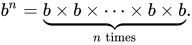
In mathematics, exponentiation, denoted b, is an operation involving two numbers: the base, b, and the exponent or power, n. When n is a positive integer, exponentiation corresponds to repeated multiplication of the base: that is, b is the product of multiplying n bases:In particular, .

The exponent is usually shown as a superscript to the right of the base as b or in computer code as b^n. This binary operation is often read as "b to the power n"; it may also be referred to as "b raised to the nth power", "the nth power of b", or, most briefly, "b to the n".

View the full Wikipedia page for Exponentiation
↑ Return to Menu

Operation (mathematics) in the context of Symbolic language (mathematics)

In mathematics, a symbolic language is a language that uses characters or symbols to represent concepts, such as mathematical operations, expressions, and statements, and the entities or operands on which the operations are performed.

View the full Wikipedia page for Symbolic language (mathematics)
↑ Return to Menu

Operation (mathematics) in the context of Algebraic structures

In mathematics, an algebraic structure or algebraic system consists of a nonempty set A (called the underlying set, carrier set or domain), a collection of operations on A (typically binary operations such as addition and multiplication), and a finite set of identities (known as axioms) that these operations must satisfy.

An algebraic structure may be based on other algebraic structures with operations and axioms involving several structures. For instance, a vector space involves a second structure called a field, and an operation called scalar multiplication between elements of the field (called scalars), and elements of the vector space (called vectors).

View the full Wikipedia page for Algebraic structures
↑ Return to Menu

Operation (mathematics) in the context of Expression (mathematics)

In mathematics, an expression is an arrangement of symbols following the context-dependent, syntactic conventions of mathematical notation. Symbols can denote numbers, variables, operations, and functions. Other symbols include punctuation marks and brackets, used for grouping where there is not a well-defined order of operations.

Expressions are commonly distinguished from formulas: expressions usually denote mathematical objects, whereas formulas are statements about mathematical objects. This is analogous to natural language, where a noun phrase refers to an object, and a whole sentence refers to a fact. For example, and are both expressions, while the inequality is a formula. However, formulas are often considered as expressions that can be evaluated to the Boolean values true or false.

View the full Wikipedia page for Expression (mathematics)
↑ Return to Menu

Operation (mathematics) in the context of Algebraic operation

In mathematics, a basic algebraic operation is a mathematical operation similar to any one of the common operations of elementary algebra, which include addition, subtraction, multiplication, division, raising to a whole number power, and taking roots (fractional power). The operations of elementary algebra may be performed on numbers, in which case they are often called arithmetic operations. They may also be performed, in a similar way, on variables, algebraic expressions, and more generally, on elements of algebraic structures, such as groups and fields.

An algebraic operation on a set may be defined more formally as a function that maps to the tuples of a given length of elements of . The length of the tuples is called the arity of the operation, and each member of the tuple is called an operand. The most common case is the case of arity two, where the operation is called a binary operation and the operands form an ordered pair. A unary operation is an operation of arity one that has only one operand; for example, the square root. An example of a ternary operation (arity three) is the triple product.

View the full Wikipedia page for Algebraic operation
↑ Return to Menu

Operation (mathematics) in the context of Addition

Addition, usually denoted with the plus sign +, is one of the four basic operations of arithmetic, the other three being subtraction, multiplication, and division. The addition of two whole numbers results in the total or sum of those values combined. For example, the adjacent image shows two columns of apples, one with three apples and the other with two apples, totaling to five apples. This observation is expressed as "3 + 2 = 5", which is read as "three plus two equals five".

Besides counting items, addition can also be defined and executed without referring to concrete objects, using abstractions called numbers instead, such as integers, real numbers, and complex numbers. Addition belongs to arithmetic, a branch of mathematics. In algebra, another area of mathematics, addition can also be performed on abstract objects such as vectors, matrices, and elements of additive groups.

View the full Wikipedia page for Addition
↑ Return to Menu

Operation (mathematics) in the context of Elementary algebra

Elementary algebra, also known as high school algebra or college algebra, encompasses the basic concepts of algebra. It is often contrasted with arithmetic: arithmetic deals with specified numbers, whilst algebra introduces numerical variables (quantities without fixed values).

This use of variables entails use of algebraic notation and an understanding of the general rules of the operations introduced in arithmetic: addition, subtraction, multiplication, division, etc. Unlike abstract algebra, elementary algebra is not concerned with algebraic structures outside the realm of real and complex numbers.

View the full Wikipedia page for Elementary algebra
↑ Return to Menu

Operation (mathematics) in the context of Mathematical structure

In mathematics, a structure on a set (or on some sets) refers to providing or endowing it (or them) with certain additional features (e.g. an operation, relation, metric, or topology). Τhe additional features are attached or related to the set (or to the sets), so as to provide it (or them) with some additional meaning or significance.

A partial list of possible structures is measures, algebraic structures (groups, fields, etc.), topologies, metric structures (geometries), orders, graphs, events, differential structures, categories, setoids, and equivalence relations.

View the full Wikipedia page for Mathematical structure
↑ Return to Menu

Operation (mathematics) in the context of Adicity

In logic, mathematics, and computer science, arity (/ˈærɪti/ ) is the number of arguments or operands taken by a function, operation or relation. In mathematics, arity may also be called rank, but this word can have many other meanings. In logic and philosophy, arity may also be called adicity and degree. In linguistics, it is usually named valency.

View the full Wikipedia page for Adicity
↑ Return to Menu

Operation (mathematics) in the context of Negation

In logic, negation, also called the logical not or logical complement, is an operation that takes a proposition to another proposition "not ", written , , or . It is interpreted intuitively as being true when is false, and false when is true. For example, if is "The dog runs", then "not " is "The dog does not run". An operand of a negation is called a negand or negatum.

Negation is a unary logical connective. It may furthermore be applied not only to propositions, but also to notions, truth values, or semantic values more generally. In classical logic, negation is normally identified with the truth function that takes truth to falsity (and vice versa). In intuitionistic logic, according to the Brouwer–Heyting–Kolmogorov interpretation, the negation of a proposition is the proposition whose proofs are the refutations of .

View the full Wikipedia page for Negation
↑ Return to Menu

Operation (mathematics) in the context of Binary operation

In mathematics, a binary operation or dyadic operation is a rule for combining two elements (called operands) to produce another element. More formally, a binary operation is an operation of arity two.

More specifically, a binary operation on a set is a binary function that maps every pair of elements of the set to an element of the set. Examples include the familiar arithmetic operations like addition, subtraction, multiplication, set operations like union, complement, intersection. Other examples are readily found in different areas of mathematics, such as vector addition, matrix multiplication, and conjugation in groups.

View the full Wikipedia page for Binary operation
↑ Return to Menu

Operation (mathematics) in the context of Unary operation

In mathematics, a unary operation is an operation with only one operand, i.e. a single input. This is in contrast to binary operations, which use two operands. An example is any function , where A is a set; the function is a unary operation on A.

Common notations are prefix notation (e.g. ¬, ), postfix notation (e.g. factorial n!), functional notation (e.g. sinx or sin(x)), and superscripts (e.g. transpose A). Other notations exist as well, for example, in the case of the square root, a horizontal bar extending the square root sign over the argument can indicate the extent of the argument.

View the full Wikipedia page for Unary operation
↑ Return to Menu

Operation (mathematics) in the context of Intersection

In mathematics, the intersection of two or more objects is another object consisting of everything that is contained in all of the objects simultaneously. For example, in Euclidean geometry, when two lines in a plane are not parallel, their intersection is the point at which they meet. More generally, in set theory, the intersection of sets is defined to be the set of elements which belong to all of them.

Intersections can be thought of either collectively or individually, see Intersection (geometry) for an example of the latter. The definition given above exemplifies the collective view, whereby the intersection operation always results in a well-defined and unique, although possibly empty, set of mathematical objects. In contrast, the individual view focuses on the separate members of this set. Given this view, intersections need not be unique, as shown by the two points of intersection between a circle and a line pictured. Similarly, (individual) intersections need not exist as between two parallel but distinct lines in Euclidean geometry.

View the full Wikipedia page for Intersection
↑ Return to Menu

Operation (mathematics) in the context of Operands

In mathematics, an operand is the object of a mathematical operation, i.e., it is the object or quantity that is operated on.

Unknown operands in equalities of expressions can be found by equation solving.

View the full Wikipedia page for Operands
↑ Return to Menu

Operation (mathematics) in the context of Closure (mathematics)

In mathematics, a subset of a larger set is closed under a given operation on the larger set if performing that operation on members of the subset always produces a member of that subset. For example, the natural numbers are closed under addition, but not under subtraction: 1 − 2 is not a natural number, although both 1 and 2 are.

Similarly, a subset is said to be closed under a collection of operations if it is closed under each of the operations individually.

View the full Wikipedia page for Closure (mathematics)
↑ Return to Menu

Operation (mathematics) in the context of Summation

In mathematics, summation is the addition of a sequence of numbers, called addends or summands; the result is their sum or total. Beside numbers, other types of values can be summed as well: functions, vectors, matrices, polynomials and, in general, elements of any type of mathematical objects on which an operation denoted "+" is defined.

Summations of infinite sequences are called series. They involve the concept of limit, and are not considered in this article.

View the full Wikipedia page for Summation
↑ Return to Menu

Operation (mathematics) in the context of Combination puzzle

A combination puzzle, also known as a sequential move puzzle, is a puzzle which consists of a set of pieces which can be manipulated into different combinations by a group of operations. Many such puzzles are mechanical puzzles of polyhedral shape, consisting of multiple layers of pieces along each axis which can rotate independently of each other. Collectively known as twisty puzzles, the archetype of this kind of puzzle is the Rubik's Cube. Each rotating side is usually marked with different colours, intended to be scrambled, then solved by a sequence of moves that sort the facets by colour. Generally, combination puzzles also include mathematically defined examples that have not been, or are impossible to, physically construct.

View the full Wikipedia page for Combination puzzle
↑ Return to Menu

Operation (mathematics) in the context of Mathematical notation

Mathematical notation consists of using symbols for representing operations, unspecified numbers, relations, and any other mathematical objects and assembling them into expressions and formulas. Mathematical notation is widely used in mathematics, science, and engineering for representing complex concepts and properties in a concise, unambiguous, and accurate way.

For example, the physicist Albert Einstein's formula is the quantitative representation in mathematical notation of mass–energy equivalence.

View the full Wikipedia page for Mathematical notation
↑ Return to Menu