Oogenesis (/ˌoʊ.əˈdʒɛnɪsɪs/) or ovogenesis is the differentiation of the ovum (egg cell) into a cell competent to further develop when fertilized. It is developed from the primary oocyte by maturation. Oogenesis is initiated during embryonic development.
HINT:
In this Dossier
- ⭐ Core Definition: Oogenesis
- Oogenesis in the context of Cytokinesis
- Oogenesis in the context of Polar body
- Oogenesis in the context of Spermatogenesis
- Oogenesis in the context of Oocyte
Oogenesis in the context of Cytokinesis
Cytokinesis (/ˌsaɪtoʊkɪˈniːsɪs/) is the part of the cell division process and part of mitosis during which the cytoplasm of a single eukaryotic cell divides into two daughter cells. Cytoplasmic division begins during or after the late stages of nuclear division in mitosis and meiosis. During cytokinesis the spindle apparatus partitions and transports duplicated chromatids into the cytoplasm of the separating daughter cells. It thereby ensures that chromosome number and complement are maintained from one generation to the next and that, except in special cases, the daughter cells will be functional copies of the parent cell. After the completion of the telophase and cytokinesis, each daughter cell enters the interphase of the cell cycle.
Particular functions demand various deviations from the process of symmetrical cytokinesis; for example, in oogenesis in animals, the ovum takes almost all the cytoplasm and organelles. This leaves very little for the resulting polar bodies, which in most species die without function, though they do take on various special functions in other species.Another form of mitosis occurs in tissues such as liver and skeletal muscle; it omits cytokinesis, thereby yielding multinucleate cells (see syncytium).
View the full Wikipedia page for CytokinesisOogenesis in the context of Polar body
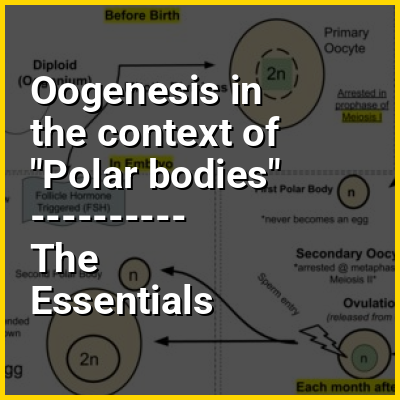
A polar body is a small haploid cell that is formed at the same time as an egg cell during oogenesis, but generally does not have the ability to be fertilized. It is named from its polar position in the egg.
When certain diploid cells in animals undergo cytokinesis after meiosis to produce egg cells, they sometimes divide unevenly. Most of the cytoplasm is segregated into one daughter cell, which becomes the egg or ovum, while the smaller polar bodies only get a small amount of cytoplasm. They frequently die and disintegrate by apoptosis, but in some cases remain and can be important in the life cycle of the organism.
View the full Wikipedia page for Polar bodyOogenesis in the context of Spermatogenesis
Spermatogenesis is the process by which haploid spermatozoa develop from germ cells in the seminiferous tubules of the testicle. This process starts with the mitotic division of the stem cells located close to the basement membrane of the tubules. These cells are called spermatogonial stem cells. The mitotic division of these produces two types of cells. Type A cells replenish the stem cells, and type B cells differentiate into primary spermatocytes. The primary spermatocyte divides meiotically (Meiosis I) into two secondary spermatocytes; each secondary spermatocyte divides into two equal haploid spermatids by Meiosis II. The spermatids are transformed into spermatozoa (sperm) by the process of spermiogenesis. These develop into mature spermatozoa, also known as sperm cells. Thus, the primary spermatocyte gives rise to two cells, the secondary spermatocytes, and the two secondary spermatocytes by their subdivision produce four spermatozoa and four haploid cells.
Spermatozoa are the mature male gametes in many sexually reproducing organisms. Thus, spermatogenesis is the male version of gametogenesis, of which the female equivalent is oogenesis. In mammals it occurs in the seminiferous tubules of the male testes in a stepwise fashion. Spermatogenesis is highly dependent upon optimal conditions for the process to occur correctly, and is essential for sexual reproduction. DNA methylation and histone modification have been implicated in the regulation of this process. It starts during puberty and usually continues uninterrupted until death, although a slight decrease can be discerned in the quantity of produced sperm with increase in age (see Male infertility).
View the full Wikipedia page for SpermatogenesisOogenesis in the context of Oocyte
An oocyte (/ˈoʊəsaɪt/, oöcyte, or ovocyte) is a female germ cell involved in sexual reproduction. An oocyte is an immature ovum, an immature egg cell produced in a female fetus in the ovary during gametogenesis. During oogenesis, the oogonia become primary oocytes. An oocyte is a form of genetic material that can be collected for cryopreservation.
View the full Wikipedia page for Oocyte