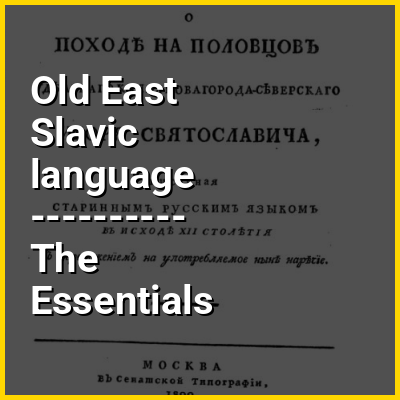
Old East Slavic (traditionally also Old Russian) was a language (or a group of dialects) used by the East Slavs from the 7th or 8th century to the 13th or 14th century, until it diverged into the Russian and Ruthenian languages. Ruthenian eventually evolved into the Belarusian, Rusyn, and Ukrainian languages.
HINT:
In this Dossier
- ⭐ Core Definition: Old East Slavic language
- Old East Slavic language in the context of Varangians
- Old East Slavic language in the context of Vladimir the Great
- Old East Slavic language in the context of Sviatoslav I
- Old East Slavic language in the context of Oleg the Wise
- Old East Slavic language in the context of Principality of Halych
- Old East Slavic language in the context of Yaropolk I of Kiev
- Old East Slavic language in the context of Polans (eastern)
- Old East Slavic language in the context of Grivna
- Old East Slavic language in the context of Vladimir II Monomakh
- Old East Slavic language in the context of Sviatoslav II of Kiev
- Old East Slavic language in the context of Malusha
- Old East Slavic language in the context of Sviatopolk I of Kiev
- Old East Slavic language in the context of Desna (river)
- Old East Slavic language in the context of Vila (fairy)
- Old East Slavic language in the context of Yuri Dolgorukiy
Old East Slavic language in the context of Varangians
The Varangians (/vəˈrændʒiənz/ və-RAN-jee-ənz; Old Norse: Væringjar; Medieval Greek: Βάραγγοι, romanized: Várangoi; Old East Slavic: варяже, romanized: varyazhe, or варяги, varyagi) were Viking warriors, traders and settlers, mostly from present-day Sweden, who settled in the territories of present-day Belarus, Russia and Ukraine from the 8th and 9th centuries and established the state of Kievan Rus' as well as the principalities of Polotsk and Turov. They also formed the Byzantine Varangian Guard.
According to the 12th-century Primary Chronicle, a group of Varangians known as the Rus' settled in Novgorod in 862 under the leadership of Rurik. Before Rurik, the Rus' might have ruled an earlier hypothetical polity known as the Rus' Khaganate. Rurik's relative Oleg conquered Kiev in 882 and established the state of Kievan Rus', which was later ruled by Rurik's descendants.
View the full Wikipedia page for VarangiansOld East Slavic language in the context of Vladimir the Great
Vladimir I Sviatoslavich or Volodymyr I Sviatoslavych (Old East Slavic: Володимѣръ Свѧтославичь, romanized: Volodiměr Svętoslavič; Christian name: Basil; c. 958 – 15 July 1015), given the epithet "the Great", was Prince of Novgorod from 970 and Grand Prince of Kiev from 978 until his death in 1015. The Catholic Church and the Eastern Orthodox Church both canonised him as Saint Vladimir.
Vladimir's father was Sviatoslav I of the Rurik dynasty. After the death of his father in 972, Vladimir, who was then the prince of Novgorod, was forced to flee abroad after his brother Yaropolk murdered his other brother Oleg in 977 to become the sole ruler of Rus'. Vladimir assembled a Varangian army and returned to depose Yaropolk in 978. By 980, Vladimir had consolidated his realm to the Baltic Sea and solidified the frontiers against incursions of Bulgarians, Baltic tribes and Eastern nomads. Originally a follower of Slavic paganism, Vladimir converted to Christianity in 988, and Christianized the Kievan Rus.
View the full Wikipedia page for Vladimir the GreatOld East Slavic language in the context of Sviatoslav I
Sviatoslav I or Svyatoslav I Igorevich (Old East Slavic: Свѧтославъ Игорєвичь, romanized: Svętoslavŭ Igorevičǐ; Old Norse: Sveinald; c. 943 – 972) was Prince of Kiev from 945 until his death in 972. He is known for his persistent campaigns in the east and south, which precipitated the collapse of two great powers in Eastern Europe, Khazaria and the First Bulgarian Empire. He conquered numerous East Slavic tribes, defeated the Alans and attacked the Volga Bulgars, and at times was allied with the Pechenegs and Magyars (Hungarians).
Following the death of his father Igor in 945, Sviatoslav's mother Olga reigned as regent in Kiev until 962. His decade-long reign over the Kievan Rus' was marked by rapid expansion into the Volga River valley, the Pontic steppe, and the Balkans, leading him to carve out for himself the largest state in Europe. In 969, he moved his seat to Pereyaslavets on the Danube. In 970, he appointed his sons Yaropolk and Oleg as subordinate princes of Kiev and Drelinia, while he appointed Vladimir, his son by his housekeeper and servant Malusha, as the prince of Novgorod.
View the full Wikipedia page for Sviatoslav IOld East Slavic language in the context of Oleg the Wise
Oleg (Old East Slavic: Ѡлегъ, romanized: Ōlegǔ, Ольгъ, Olǐgǔ; Old Norse: Helgi; died 912), also known as Oleg the Wise, was a Varangian prince of the Rus' who became prince of Kiev, and laid the foundations of the Kievan Rus' state.
According to the Primary Chronicle, he succeeded his "kinsman" Rurik as ruler of Novgorod, and subdued many of the East Slavic tribes to his rule, extending his control from Novgorod to the south along the Dnieper river. Oleg also launched a successful attack on Constantinople. He died in 912 and was succeeded by Rurik's son, Igor.
View the full Wikipedia page for Oleg the WiseOld East Slavic language in the context of Principality of Halych
The Principality of Galicia (Ukrainian: Галицьке князівство, romanized: Halytske kniazivstvo; Old East Slavic: Галицкоє кънѧжьство, romanized: Galickoje kǔnęžǐstvo), also known as the Principality of Halych or Principality of Halychian Rus', was a medieval East Slavic principality and one of the main regional states within the political framework of Kievan Rus'. It was established by members of the senior line of the descendants of Yaroslav the Wise.
A distinctive feature of the principality was the significant role of the nobility and townspeople in political life, with princely rule depending largely on their consent. Halych, the capital, was first mentioned around 1124 as the seat of Ivan Vasylkovych, grandson of Rostislav of Tmutarakan.
View the full Wikipedia page for Principality of HalychOld East Slavic language in the context of Yaropolk I of Kiev
Yaropolk I Sviatoslavich (also translitered as Iaropolk Svyatoslavich; Old East Slavic: Ꙗрополкъ Свѧтославичъ; 958 – 11 June 978) was Prince of Kiev from 972 to 978. He was the oldest son of Sviatoslav I. Some modern sources suggest that his mother was Malusha, who was a steward in the household of his grandmother, Olga of Kiev. However, primary chronicles such as the Primary Chronicle do not name his mother, and this identification remains unconfirmed by early sources.
View the full Wikipedia page for Yaropolk I of KievOld East Slavic language in the context of Polans (eastern)
The Polans or Polians (Ukrainian: Поляни, romanized: Poliany; Russian: Поляне, romanized: Polyane; Polish: Polanie; Old East Slavic: Полѧне, romanized: Polyąne), also known as Polanians, Polianians, and Eastern Polans, were an East Slavic tribe between the 6th and the 9th century, which inhabited both sides of the Dnieper river from Liubech to Rodnia and also down the lower streams of the rivers Ros', Sula, Stuhna, Teteriv, Irpin', Desna and Pripyat.
The distinct western Polans of the Early Middle Ages were a West Slavic tribe, ancestors of the Poles.
View the full Wikipedia page for Polans (eastern)Old East Slavic language in the context of Grivna
The grivna (Old East Slavic: гривьна) was a currency as well as a measure of weight used in Kievan Rus' and other states in Eastern Europe from the 11th century.
View the full Wikipedia page for GrivnaOld East Slavic language in the context of Vladimir II Monomakh
Vladimir II Monomakh (Old East Slavic: Володимѣръ Мономахъ, romanized: Volodiměrŭ Monomakhŭ; Christian name: Basil (Васи́лий); 26 May 1053 – 19 May 1125) was Grand Prince of Kiev from 1113 to 1125. Prince Monomakh distinguished himself in 83 large-scale campaigns into Polovtsian lands (Cumania), which made Polovtsians (Cumans) and their Khans fear him. He is considered a saint in the Eastern Orthodox Church and is commemorated on May 6, along with 122 other saints of Ukraine and medieval Rus as well as Saint Andrew. He is not to be confused with Saint Vladimir the Great.
View the full Wikipedia page for Vladimir II MonomakhOld East Slavic language in the context of Sviatoslav II of Kiev
Sviatoslav II Iaroslavich or Sviatoslav II Yaroslavich (Old East Slavic: Ст҃ославь Ӕрославичь; 1027 – 27 December 1076) was Grand Prince of Kiev from 1073 until his death in 1076. He was a younger son of Yaroslav the Wise, the grand prince of Kiev. He is the progenitor of the Sviatoslavichi branch of Rurikids.
He ruled the Principality of Vladimir in Volhynia in his father's lifetime (from around 1040 to 1054). Yaroslav the Wise, who divided the Kievan Rus' among his five sons in his testament, willed the Principality of Chernigov to Sviatoslav. Sviatoslav joined his brothers, Iziaslav of Kiev and Vsevolod of Pereyaslav, in forming a princely "triumvirate" that oversaw the affairs of Kievan Rus' until 1072. The three brothers together fought against their enemies, including the nomadic Oghuz Turks, and their distant relative, Prince Vseslav of Polotsk. The Cumans defeated their united force in the autumn of 1068, but Sviatoslav routed a Cuman band plundering his principality.
View the full Wikipedia page for Sviatoslav II of KievOld East Slavic language in the context of Malusha
Malusha Malkovna (Old East Slavic: Малушa) was allegedly a servant (kholopka) for Olga of Kiev and a concubine of Sviatoslav I of Kiev. According to chronicles, she was the mother of Vladimir the Great and sister of Dobrynya. The Norse sagas describe Vladimir's mother as a prophetess who lived to the age of 100 and was brought from her cave to the palace to predict the future.
View the full Wikipedia page for MalushaOld East Slavic language in the context of Sviatopolk I of Kiev
Sviatopolk I Vladimirovich (also called Sviatopolk the Accursed or the Accursed Prince; Old East Slavic: Свѧтоплъкъ, romanized: Svętoplŭkŭ; c. 980 – 1019) was Prince of Turov from 988 to 1015 and Grand Prince of Kiev from 1015 to 1019. He earned his sobriquet after allegedly murdering his brothers during his bid to take the throne. His actual responsibility is disputed by historians.
View the full Wikipedia page for Sviatopolk I of KievOld East Slavic language in the context of Desna (river)
The Desna (Russian and Ukrainian: Десна) is a river in Russia and Ukraine, a major left-tributary of the Dnieper. Its name in Old East Slavic: деснъ means lit. "right hand". It has a length of 1,130 km (702 mi), and its drainage basin covers 88,900 km (34,324 sq mi).
In Ukraine, the river's width ranges from 60 to 250 metres (200 to 820 ft), with its average depth being 3 m (10 ft). The mean annual discharge at its mouth is 360 m/s (13,000 cu ft/s). The river freezes over from early December to early April, and is navigable from Novhorod-Siverskyi to its mouth, a length of about 535 km (332 mi).
View the full Wikipedia page for Desna (river)Old East Slavic language in the context of Vila (fairy)
A vila, or víla (plural: vile, or víly ; Bulgarian: vila, diva, juda, samovila, samodiva, samojuda; Czech: víla, samodiva, divoženka; Old East Slavic: vila; Polish: wiła; Serbo-Croatian: vila; Slovak: víla; Slovene: vila) is a Slavic fairy similar to a nymph.
The vila is mostly known among South Slavs; however, some variants are present in the mythology of West Slavs as well. Among Czechs, víla denotes a woodland spirit (15th century), and ancient place names such as Vilice near Tábor, Vilov near Domažlice, and Vilín near Sedlčany seem to indicate that she was known there as well. In the Chronicle of Dalimil (3, 53) vila is "fool" (as in Old Polish). In Russia, vile are mentioned in the 11th century, but there is doubt that they were truly a part of Russian folklore, and not just a literary tradition. There are common traits between the vile and the rusalki, and Schneeweis holds that they are identical.
View the full Wikipedia page for Vila (fairy)Old East Slavic language in the context of Yuri Dolgorukiy
Yuri I Vladimirovich (Russian: Юрий Владимирович, romanized: Yury Vladimirovich; Old East Slavic: Гюрги Володи́мирович; c. 1099 – 15 May 1157), commonly known as Yuri Dolgorukiy (Russian: Юрий Долгорукий, romanized: Yury Dolgoruky, lit. 'Yuri the Long-armed' or 'Yuri the Long Arm'), was a Monomakhovichi prince of Rostov and Suzdal, acquiring the name Suzdalia during his reign. Noted for successfully curbing the privileges of the landowning boyar class in Rostov-Suzdal and his ambitious building programme, Yuri transformed this principality into the independent power that would evolve into early modern Muscovy. Yuri Dolgorukiy was the progenitor of the Yurievichi (Russian: Юрьевичи, romanized: Yuryevichi; Ukrainian: Юрійовичі, romanized: Yuriiovychi), a branch of the Monomakhovichi.
Yuri spent much of his life in internecine strife with the other Rus' princes for suzerainty over the Kievan Rus, which had been held by his father (Vladimir Monomakh) and his elder brother before him. Although he twice managed to briefly hold Kiev (in September 1149 – April 1151, again in March 1155 – May 1157) and rule as Grand Prince of Kiev, his autocratic rule and perceived foreigner status made him unpopular with the powerful Kievan boyars, leading to his presumed poisoning and the expulsion of his son (later Andrei Bogoliubsky of Vladimir-Suzdal) in 1157. His rule marked the effective end of the Rus' as a unified entity until the Mongol invasions, with powerful provincial territories like Vladimir-Suzdal and Galicia-Volhynia now competing for the throne of Kiev.
View the full Wikipedia page for Yuri Dolgorukiy