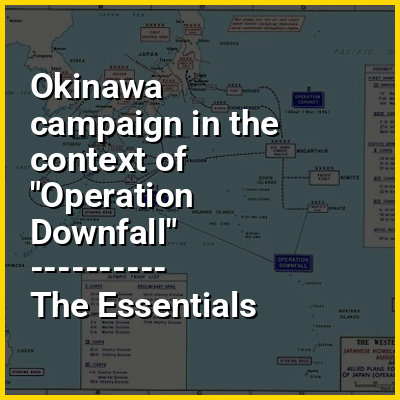
The Battle of Okinawa (Japanese: 沖縄戦, Hepburn: Okinawa-sen), codenamed Operation Iceberg, was a major battle of the Pacific War fought on the island of Okinawa by the United States Army and United States Marine Corps forces against the Imperial Japanese Army. The initial invasion of Okinawa on 1 April 1945 was the largest amphibious assault in the Pacific Theater of World War II. The Kerama Islands surrounding Okinawa were preemptively captured on 26 March 1945 by the U.S. Army 77th Infantry Division. The 82-day battle on Okinawa lasted from 1 April 1945 until 22 June 1945. After a long campaign of island hopping, the Allies were planning to use Kadena Air Base on the island as a staging point for Operation Downfall, the planned invasion of the Japanese home islands, 340 mi (550 km) away.
The United States created the Tenth Army, a cross-branch force consisting of the U.S. Army 7th, 27th, 77th and 96th Infantry Divisions with the 1st, 2nd, and 6th Marine Divisions, to seize the island. The Tenth Army was unique because it had its own Tactical Air Force (joint Army-Marine command) and was supported by combined naval and amphibious forces. Opposing the Allied forces on the ground was the Japanese Lieutenant General Mitsuru Ushijima's Thirty-Second Army, a mixed force consisting of regular army troops, naval infantry and conscripted local Okinawans. There were about 100,000 Japanese troops on Okinawa at the onset of the invasion. The battle was the longest sustained carrier campaign of the Second World War.