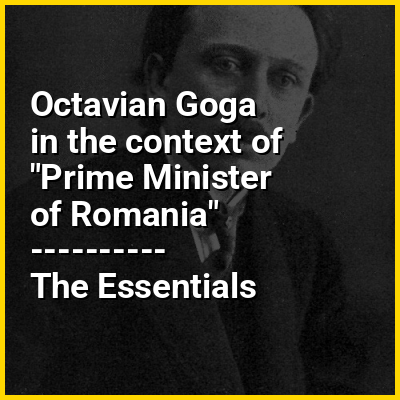
Octavian Goga (Romanian pronunciation: [oktaviˈan ˈɡoɡa]; 1 April 1881 – 7 May 1938) was a Romanian far-right politician, poet, playwright, journalist, and translator. Octavian Goga was the first fascist Prime Minister of Romania.
>>>PUT SHARE BUTTONS HERE<<<
In this Dossier
Octavian Goga in the context of Ion Antonescu
Ion Antonescu (/ˌæntəˈnɛskuː/; Romanian: [iˈon antoˈnesku] ; 14 June [O.S. 2 June] 1882 – 1 June 1946) was a Romanian military officer and marshal who presided over two successive wartime dictatorships as Prime Minister and Conducător during most of World War II. Having been responsible for facilitating the Holocaust in Romania, he was overthrown in 1944, before being tried for war crimes and executed two years later in 1946.
A Romanian Army career officer who made his name during the 1907 peasants' revolt and the World War I Romanian campaign, the antisemitic Antonescu sympathized with far-right and fascist politics. He was a military attaché to France and later Chief of the General Staff, briefly serving as Defence Minister in the National Christian cabinet of Octavian Goga as well as the subsequent First Cristea cabinet, in which he also served as Air and Marine Minister. During the late 1930s, his political stance brought him into conflict with King Carol II and led to his detainment. Antonescu rose to political prominence during the political crisis of 1940, and established the National Legionary State, an uneasy partnership with Horia Sima of the Iron Guard. After entering Romania into an alliance with Nazi Germany, he eliminated the Guard during the Legionary Rebellion of 1941. In addition to being Prime Minister, he served as his own Foreign Minister and Defence Minister. Soon after Romania joined the Axis in Operation Barbarossa, recovering Bessarabia and Northern Bukovina, Antonescu also became Marshal of Romania.
Octavian Goga in the context of 1937 Romanian general election
General elections were held in Romania in December 1937. The Chamber of Deputies was elected on 20 December, whilst the Senate was elected in three stages on 22, 28 and 30 December. Voting was by universal male suffrage, making them the last elections held before women could vote.
The National Liberal Party remained the largest party, winning 152 of the 387 seats in the Chamber of Deputies and 97 of the 112 the Senate seats. However, unlike all previous elections organised by partisan governments, the results did not give the governing party a majority. The National Liberals' unexpectedly poor showing prevented it from creating a government on its own (obtaining 40% of the vote would have automatically awarded them a large parliamentary majority). They ruled out a coalition with their arch-rivals, the second-placed National Peasants' Party, or with the third-placed Iron Guard's Everything for the Country Party. King Carol II invited the fascist Octavian Goga to form a government, though his National Christian Party finished fourth and had an avowedly anti-Semitic platform. Goga's government was formed on 29 December 1937.
Octavian Goga in the context of Alexandru Averescu
Alexandru Averescu (Romanian pronunciation: [alekˈsandru aveˈresku] ; 9 March 1859 – 2 October 1938) was a Romanian marshal, diplomat and populist politician. A Romanian Armed Forces Commander during World War I, he served as Prime Minister of three separate cabinets (as well as being interim Foreign Minister in January–March 1918 and Minister without portfolio in 1938). He first rose to prominence during the peasants' revolt of 1907, which he helped repress with violence. Credited with engineering the defense of Moldavia in the 1916–1917 Campaign, he built on his popularity to found and lead the successful People's Party, which he brought to power in 1920–1921, with backing from King Ferdinand I and the National Liberal Party (PNL), and with the notable participation of Constantin Argetoianu and Take Ionescu.
His controversial first mandate, marked by a political crisis and oscillating support from the PNL's leader Ion I. C. Brătianu, played a part in legislating land reform and repressed communist activities, before being brought down by the rally of opposition forces. His second term of 1926–1927 brought a much-debated treaty with Fascist Italy, and fell after Averescu gave clandestine backing to the ousted Prince Carol. Faced with the People Party's decline, Averescu closed deals with various right-wing forces and was instrumental in bringing Carol back to the throne in 1930. Relations between the two soured over the following years, and Averescu clashed with his fellow party member Octavian Goga over the king's attitudes. Shortly before his death, he and Carol reconciled, and Averescu joined the Crown Council.
Octavian Goga in the context of History of the Jews in Moldova
The history of the Jews in Moldova reaches back to the 1st century BC, when Roman Jews lived in the cities of the province of Lower Moesia. Bessarabian Jews have been living in the area for some time. Between the 4th-7th centuries AD, Moldova was part of an important trading route between Asia and Europe, and bordered the Khazar Khaganate, where Judaism was the state religion. Prior to the Second World War, violent antisemitic movements across the Bessarabian region badly affected the region's Jewish population. In the 1930s and '40s, under the Romanian governments of Octavian Goga and Ion Antonescu, government-directed pogroms and mass deportations led to the concentration and extermination of Jewish citizens followed, leading to the extermination of between 45,000-60,000 Jews across Bessarabia. The total number of Romanian and Ukrainian Jews who perished in territories under Romanian administration is between 280,000 and 380,000.
Today, the Jewish community in Moldova has been revived and are primarily represented by the Jewish Community of the Republic of Moldova (JCM) organisation. The group was registered in its current form in 1997, but its roots stretch back to founding of the Union of Jewish Communities in Bessarabia on 3 November 1935. The group estimate that the total population of Moldovan Jews in 2022 to be approx. 20,000. The World Jewish Congress (of which the JCM is an affiliate member) states that there has been "a widespread development of a national self-consciousness and a return to their roots by the Jews of Moldova, with Jewish identity and culture being celebrated in a number of forms". Diplomatic relations with Israel began in 1992 and the Israeli consulate is located in the capital city, Chişinău. Since 2014, Moldova has been an observer country to the International Holocaust Remembrance Alliance, and since 2019 has adopted the IHRA Working Definition of Antisemitism for official use. The Museum of Jewish History was opened in Orhei on 30 January 2023.