Nyquist–Shannon sampling theorem in the context of "Sample rate"

Play Trivia Questions online!

or

Skip to study material about Nyquist–Shannon sampling theorem in the context of "Sample rate"

Ad spacer

⭐ Core Definition: Nyquist–Shannon sampling theorem

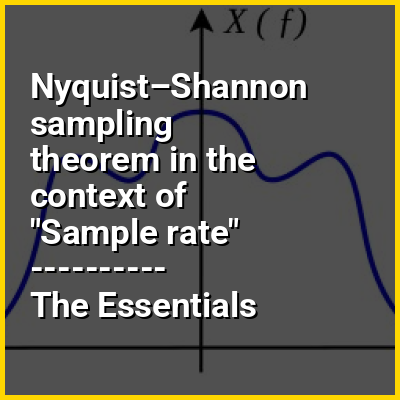
The Nyquist–Shannon sampling theorem is an essential principle for digital signal processing linking the frequency range of a signal and the sample rate required to avoid a type of distortion called aliasing. The theorem states that the sample rate must be at least twice the bandwidth of the signal to avoid aliasing. In practice, it is used to select band-limiting filters to keep aliasing below an acceptable amount when an analog signal is sampled or when sample rates are changed within a digital signal processing function.

The Nyquist–Shannon sampling theorem is a theorem in the field of signal processing which serves as a fundamental bridge between continuous-time signals and discrete-time signals. It establishes a sufficient condition for a sample rate that permits a discrete sequence of samples to capture all the information from a continuous-time signal of finite bandwidth.
↓ Menu

>>>PUT SHARE BUTTONS HERE<<<
In this Dossier

Nyquist–Shannon sampling theorem in the context of Digital recording

In digital recording, an audio or video signal is converted into a stream of discrete numbers representing the changes over time in air pressure for audio, or chroma and luminance values for video. This number stream is saved to a storage device. To play back a digital recording, the numbers are retrieved and converted back into their original analog audio or video forms so that they can be heard or seen.

In a properly matched analog-to-digital converter (ADC) and digital-to-analog converter (DAC) pair, the analog signal is accurately reconstructed, within the constraints of the Nyquist–Shannon sampling theorem, which dictates the sampling rate and quantization error dependent on the audio or video bit depth. Because the signal is stored digitally, assuming proper error detection and correction, the recording is not degraded by copying, storage or interference.

↑ Return to Menu